
Coastal Cooling Battles Between Central AC and Mini Splits
By the American Plumbing Heating and Cooling Team
Licensed Florida contractors — HVAC CAC1821761 · Plumbing CFC1431919

Discover central air vs mini split for the gulf coast homes: efficiency, humidity control and storm resilience tips for Florida properties.
Reviewed bythe American Plumbing Heating and Cooling Team — Licensed Florida contractors — HVAC CAC1821761 · Plumbing CFC1431919. Published April 20, 2026 · Last updated July 29, 2026. About American Plumbing Heating and Cooling
Dealing with this problem right now? Call (941) 735-6616 and talk to our local team.
Request ServiceWhy Choosing Between Central Air vs Mini Split for the Gulf Coast Homes Is One of the Biggest Decisions You'll Make
Central air vs mini split for the gulf coast homes is not a simple choice — and getting it wrong means years of high energy bills, poor humidity control, and costly repairs.
Gulf Coast summers are relentless. Temperatures routinely climb into the 90s, humidity stays stubbornly high for eight to ten months a year, and salt air quietly eats away at outdoor equipment. Your cooling system has to handle all of that, day after day.
The two main options — central AC and ductless mini-splits — work very differently. And in a coastal Florida climate, those differences really matter.
Here is a quick breakdown to help you decide:
| Factor | Central AC | Ductless Mini-Split |
|---|---|---|
| Requires ductwork | Yes | No |
| Best for home size | 2,000+ sq ft with existing ducts | Under 2,000 sq ft or no ducts |
| Energy efficiency | Up to 21 SEER | Up to 27 SEER |
| Humidity control | Strong (whole-home) | Strong (zoned, variable-speed) |
| Salt air exposure risk | Moderate | Moderate (more units to maintain) |
| Zoned temperature control | Limited | Yes, room by room |
| Noise level | Moderate | Very quiet (19–32 decibels) |
| Ideal for | New builds, large homes, existing ducts | Older homes, additions, condos |
Neither system wins outright. The right answer depends on your home's layout, whether you already have ductwork, and how you use your space day to day.
Which is better: Central air vs mini split for the gulf coast homes?

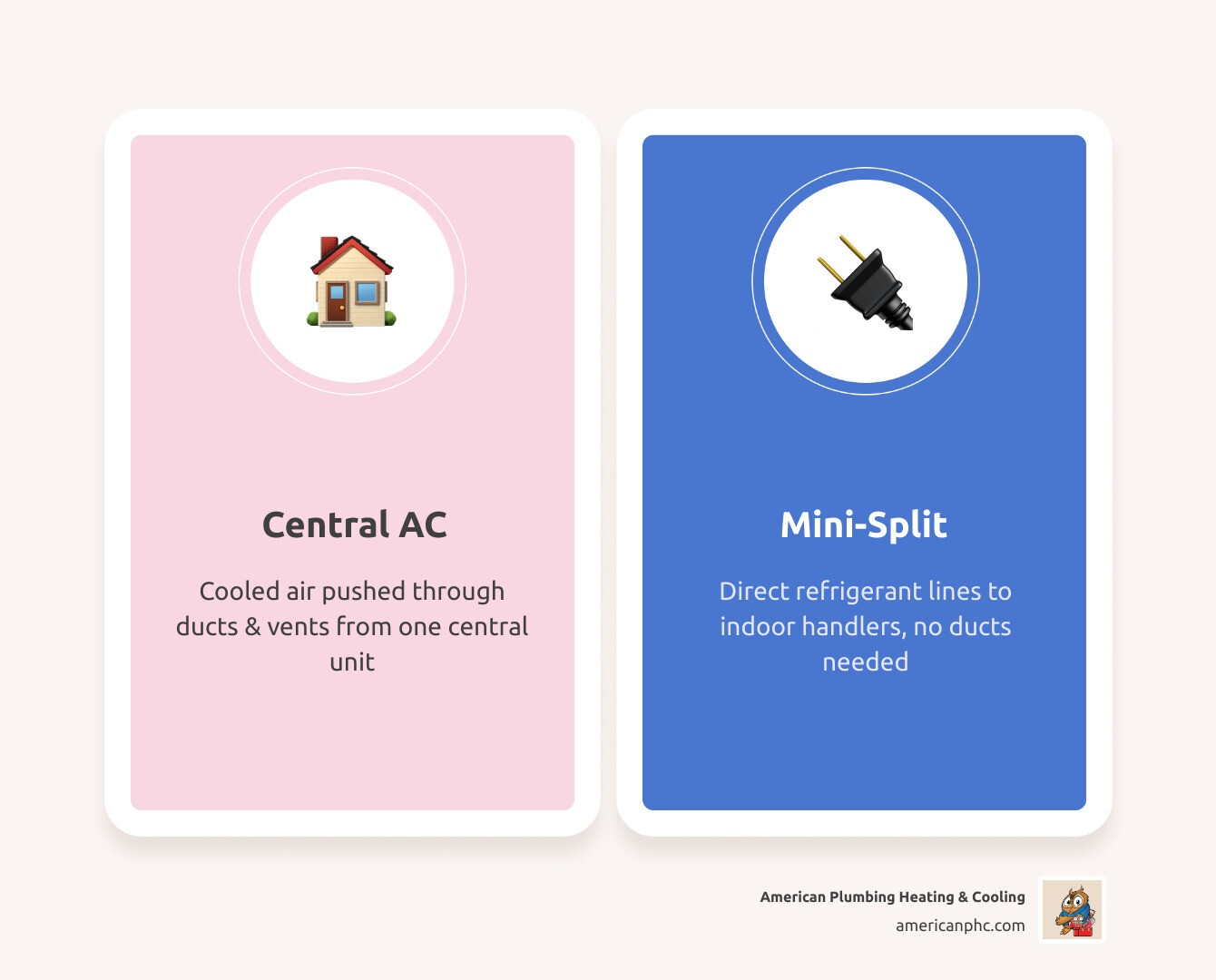
When we talk about central air vs mini split for the gulf coast homes, we are really talking about how we move air around your house. Central AC is the traditional heavyweight. It uses a single large outdoor condenser unit and an indoor air handler (usually tucked away in a closet or attic) to push cooled air through a network of ducts and vents. It’s a "set it and forget it" system that treats your entire house as one big zone.
Ductless mini-splits, on the other hand, skip the ducts entirely. A mini-split system connects an outdoor compressor to one or more indoor air handlers (often called "heads") mounted directly on your walls or ceilings. These heads deliver cool air right into the room where they are located. Because they don’t rely on ducts, they avoid the "energy tax" that comes with pushing air through a hot Florida attic.
In places like Sarasota or Cape Coral, both systems are popular, but they serve different lifestyles. If you have a large family and every room is occupied, central AC provides a consistent blanket of cool. If you have a smaller home or rooms that you rarely use, a mini-split allows you to stop paying to cool empty space. Regardless of which path you take, keeping the system in peak condition is vital. You can learn more about this in our guide on Everything You Need to Know About AC Maintenance in Sarasota.
Structural differences between ducted and ductless systems
The most obvious difference is the ductwork. Central AC requires a complex web of metal or flexible tubes hidden in your walls and ceilings. If your home was built with these, replacing a central unit is often straightforward. However, if you live in an older Florida cottage or a historic home in Pensacola that was built before AC was standard, adding ducts can be an invasive, messy, and expensive nightmare.
Mini-splits only require a small three-inch hole in the exterior wall to connect the indoor and outdoor units via refrigerant lines. This makes them a hero for home additions or renovations.
Then there is the noise and look. Central AC vents are nearly invisible, but the outdoor unit can be quite loud when it kicks on. Mini-splits have visible indoor units, which some homeowners find distracting, but they are incredibly quiet. Some models operate at just 19 decibels — that’s literally quieter than a whisper. If you’re a light sleeper, that difference is huge.
Battling Humidity and Salt Air Corrosion in Florida
Living on the Gulf Coast means we aren't just fighting the heat; we’re fighting the "latent load." This is a fancy HVAC term for the moisture in the air. In Florida, your AC has to work twice as hard because it has to pull gallons of water out of the air before it can even begin to lower the temperature.
Central AC systems are generally excellent at whole-home dehumidification because they move a large volume of air through a single, powerful evaporator coil. However, mini-splits have caught up. Modern mini-splits use inverter technology to run at variable speeds. Instead of turning on and off like a light switch, they stay on at a low, steady level, which allows them to constantly pull moisture out of the air without over-cooling the room.
Humidity isn't just about comfort; it's about health. High indoor humidity leads to mold growth and dust mites. We’ve detailed the risks in our article on Understanding Hidden Impact Humidity.
Then there is the salt air. If you live within a few miles of the Gulf, the salt in the air acts like sandpaper on your AC’s metal coils. This "brine" creates a conductive film that accelerates corrosion. When comparing central air vs mini split for the gulf coast homes, both systems face this threat. We always recommend units with epoxy or phenolic coatings on the coils to provide a protective barrier against the salty breeze.
How do I compare central air vs mini split for the gulf coast homes efficiency?
Efficiency is where the mini-split often takes the lead. In a typical Florida home, ductwork runs through the attic. Even in 2026, with modern insulation, an attic can reach 130°F or higher. The Department of Energy estimates that ductwork in unconditioned spaces can lose 20% to 30% of its cooling energy through leaks and heat gain.
Mini-splits have zero duct loss because there are no ducts. They also boast higher SEER2 (Seasonal Energy Efficiency Ratio) ratings. While a very high-end central AC might reach 21 SEER2, some mini-splits can hit 27 SEER2 or higher.
For our neighbors in SW Florida, improving air quality and beating humidity go hand-in-hand with efficiency. For more tips on this, check out A Sarasota Homeowner's Guide to Improving Indoor Air Quality: Beat Humidity.
Efficiency Showdown: SEER2 and Zoned Cooling
The real "secret sauce" of the mini-split is zoned cooling. Think about your home: do you really need the guest bedroom to be 72°F at 2:00 PM on a Tuesday when no one is in there? With central AC, you usually have one thermostat. If you want the living room cool, you have to cool the whole house.
Mini-splits allow you to set different temperatures for every room. This independent control can lead to massive savings on your electric bills. It’s like the difference between having one light switch for the whole house or a switch in every room.
Don't forget about winter. While we don't get snow in Bradenton or Cape Coral, we do get those chilly January nights. Both central heat pumps and mini-splits provide excellent heating. Since mini-splits are almost always heat pumps, they are incredibly efficient at keeping you warm during our brief Florida winters without the need for expensive electric heat strips. If you're looking for ways to stay cool (or warm) without breaking the bank, see our Budget-Friendly Cooling Solutions for Lakewood Ranch Homeowners.
What should I know when choosing central air vs mini split for the gulf coast homes in 2026?
As we move through 2026, the technology has never been better. Smart thermostats are now standard for both systems, allowing you to control your home's climate from your phone while you're at the beach or at work.
One of the biggest factors in 2026 is the availability of federal tax credits. Under the Inflation Reduction Act, many high-efficiency heat pump systems (both central and ductless) qualify for significant tax credits — sometimes up to $2,000. This significantly improves the long-term ROI of choosing a premium, high-SEER2 system. When we visit your home for a consultation, we can help you identify which systems qualify for these incentives.
Best Use Cases and Maintenance for Florida Properties
To help you visualize which system fits your specific situation, we’ve put together this quick-reference table:
| Home Type | Recommended System | Why? |
|---|---|---|
| New Construction (2,500+ sq ft) | Central AC | Easier to design efficient ductwork from scratch. |
| Historic Home (No existing ducts) | Ductless Mini-Split | Preserves architectural integrity; no need to tear out plaster walls. |
| Garage Conversion / Bonus Room | Ductless Mini-Split | Usually too much load for the existing central AC to handle. |
| Coastal Condo | Ductless Mini-Split | Space-saving; easier to install in high-rise or tight configurations. |
| Large Family Home (Existing ducts) | Central AC | Most cost-effective if ductwork is already in good condition. |
| Sunroom or Home Office | Ductless Mini-Split | Provides targeted cooling for high-heat or high-use areas. |
If you are planning a project in the Florida Panhandle, you might find our guide helpful: Don't Sweat the New AC Unit Installation in Milton.
Maintenance and storm resilience for coastal systems
Maintenance isn't optional on the Gulf Coast — it’s a survival tactic for your equipment. Because of the salt air, we recommend rinsing your outdoor coils with fresh water every few weeks. This simple step can add years to the life of your system by washing away corrosive salt deposits.
Storm resilience is another major factor. In areas like Cape Coral and Venice, we ensure that outdoor units are properly anchored to hurricane pads to withstand high winds. If you live in a flood-prone zone, we often recommend elevating the outdoor unit on a stand to keep it above potential surge levels.
Regular professional check-ups are the best way to catch small issues before they become $4,000 compressor failures. For those in the Bradenton area, we have a specialized guide: Keep Your Cool with Professional AC Maintenance in Bradenton, FL.
Conclusion
Choosing between central air vs mini split for the gulf coast homes comes down to your home's unique "personality." There is no one-size-fits-all answer. A sprawling new build in Lakewood Ranch has different needs than a 1950s bungalow in Siesta Key.
At American Plumbing Heating and Cooling, we’ve spent years helping Florida homeowners navigate these choices. With over 100 years of combined experience, our certified pros provide honest, upfront pricing and 24/7 emergency service. We don't just install boxes; we design comfort solutions that stand up to the salt, the sun, and the humidity.
Questions to Ask Your HVAC Installer:
- Does my current ductwork have enough capacity for a modern high-efficiency central unit?
- Are the units you are recommending "coastal rated" with corrosion-resistant coatings?
- Can you perform a Manual J load calculation to ensure the system is sized perfectly for my home?
- What federal tax credits or local rebates are available for this specific model in 2026?
- How many indoor "zones" do I really need for a mini-split setup?
Ready to upgrade your comfort? Explore our full range of HVAC services and let us help you win the battle against the Florida heat.
Frequently Asked Questions about Coastal HVAC
1. Which system is better for removing humidity in Florida? Both can be excellent, but they work differently. Central AC is great for whole-home moisture removal if properly sized. However, mini-splits with inverter technology are often superior at maintaining a steady humidity level because they run longer, lower cycles, preventing the "clammy" feeling that happens when a central unit short-cycles.
2. Can I use a hybrid approach with both central AC and mini-splits? Absolutely! We see this all the time. Many homeowners use a central AC for the main part of the house but add a mini-split to a "hot spot" like a master bedroom, a sunroom, or a garage workshop. This allows you to keep the main house at a higher temperature while staying icy cool in the room you use most.
3. How does salt air affect the lifespan of my outdoor unit? Salt air is the leading cause of premature HVAC failure on the Gulf Coast. It causes the aluminum fins on your coils to turn into a white powder and eventually fall off, which destroys the unit’s ability to exchange heat. Regular rinsing and choosing units with specialized protective coatings are the best ways to combat this. In high-salt zones, an unprotected unit might only last 5–7 years, while a protected and maintained unit can last 12–15 years.
Need HVAC Help?
Our certified technicians are ready to help with all your heating and cooling needs.
Request ServiceAbout the Author
American Plumbing Heating and Cooling Team
Licensed Florida contractors — HVAC CAC1821761 · Plumbing CFC1431919
More Articles
View All PostsRelated Articles


Ready to Get Started?
Whether you need a repair, maintenance, or a new system installation, our expert team is here to help.