
How to Apply for Energy Rebates in Florida Without the Headache
By the American Plumbing Heating and Cooling Team
Licensed Florida contractors — HVAC CAC1821761 · Plumbing CFC1431919

Learn how to apply for energy rebates in Florida: FPL, Duke, OUC incentives, HOMES/HEAR programs and step-by-step guide to max savings.
Reviewed bythe American Plumbing Heating and Cooling Team — Licensed Florida contractors — HVAC CAC1821761 · Plumbing CFC1431919. Published May 12, 2026 · Last updated July 29, 2026. About American Plumbing Heating and Cooling
Dealing with this problem right now? Call (941) 735-6616 and talk to our local team.
Request ServiceWhy Knowing How to Apply for Energy Rebates in Florida Can Save You Real Money
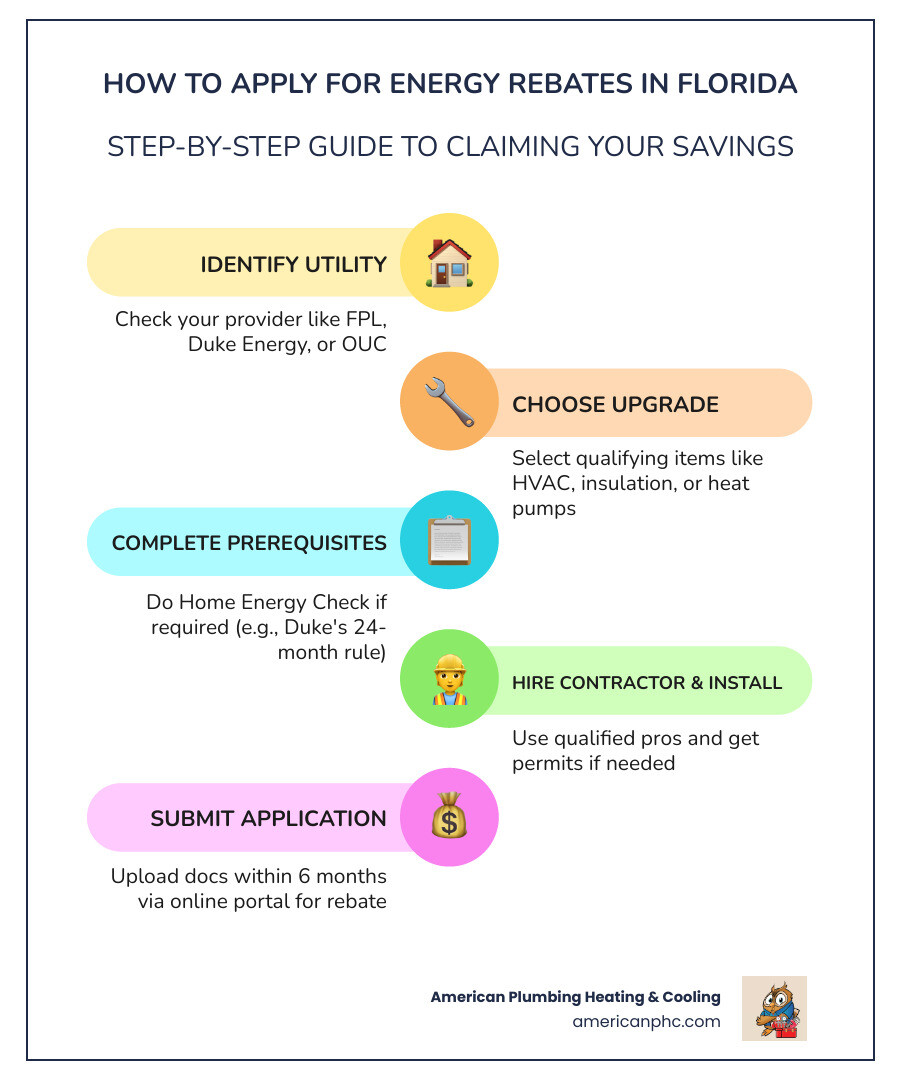
How to apply for energy rebates in Florida is simpler than most homeowners expect — and the savings are worth the effort. Here's a quick overview of the process:
- Identify your utility provider (FPL, Duke Energy, OUC, or another Florida utility)
- Choose a qualifying upgrade such as a new HVAC system, heat pump, ceiling insulation, or heat pump water heater
- Complete any prerequisites like a Home Energy Check (required by Duke Energy within the past 24 months)
- Hire a qualified contractor and complete the installation
- Submit your application through your utility's online portal within the required window (typically within 6 months of purchase)
- Provide documentation including invoices, proof of payment, and permit inspections
- Receive your rebate as a bill credit, instant discount, or check depending on the program
Florida homeowners are sitting on a lot of unskilled money. Between utility rebate programs from providers like Florida Power and Light and Orlando Utilities Commission, and a state-backed program called Florida Energy Saver — supported by roughly $346 million in federal funding — there are more ways than ever to offset the cost of energy-efficient upgrades.
The problem? Most people don't know where to start. Programs have different rules, deadlines, and paperwork requirements. Miss one step and your application can be denied outright.
This guide walks you through everything you need to know — from the current utility rebates available right now to the upcoming HOMES and HEAR programs launching through the Florida Energy Saver portal.
Understanding the Main Energy Rebate Programs in Florida
In Florida, the landscape of energy rebates is largely shaped by the major utility providers. Whether you are in Sarasota, Cape Coral, or Pensacola, your first stop should always be your local utility company's website. These organizations are incentivized to help you reduce your energy consumption because it lowers the strain on the overall power grid.
Major players like Florida Power and Light (FPL), Duke Energy, and the Orlando Utilities Commission (OUC) offer robust programs. For instance, FPL provides an instant $200 rebate for new energy-efficient air conditioning units. Meanwhile, OUC offers a heat pump A/C rebate that can range from $45 all the way up to $1,150, depending on the size and SEER2 (Seasonal Energy Efficiency Ratio) value of the unit.
If you are looking for the Top Companies for Plumbing and HVAC in Sarasota, Cape Coral, Pensacola, it is essential to find a partner who understands these local incentives. Upgrades that typically qualify include:
- High-Efficiency HVAC Systems: Replacing an old, power-hungry AC with a modern heat pump.
- Ceiling Insulation: Adding layers to keep the Florida heat out and the cool air in.
- Heat Pump Water Heaters: A significantly more efficient way to heat your water than traditional electric tanks.

How to apply for energy rebates in Florida through your utility provider
The application process usually begins with verifying your service territory and account status. You cannot apply for a Duke Energy rebate if you are an FPL customer, so ensure you are logged into the correct portal.
Many providers offer "Energy Manager" surveys or audits. These are often free and help you identify where your home is losing energy. Once you know what you need, the next step is hiring a pro. How to Choose the Best HVAC Company: Your Comprehensive Guide can help you vet contractors who are familiar with utility requirements.
Some rebates are "instant," meaning the contractor deducts the amount directly from your invoice. Others are "post-purchase," where you submit your receipt to receive a bill credit. Using a preferred contractor network is often the smoothest path, as these professionals are already registered with the utility and know exactly how to handle the paperwork.
Qualifying upgrades for maximum savings
To get the biggest bang for your buck, you need to pay attention to technical specifications like SEER2 ratings. As of 2026, many programs require higher efficiency standards than in years past. Beyond the AC unit, don't overlook duct repair and attic insulation. OUC, for example, offers a ceiling insulation rebate of $0.10 per square foot.
We also recommend looking into surge protection. In 2025, Florida saw over 20 million lightning strikes. Protecting your new, high-efficiency equipment with a surge protector is not just smart—it’s often incentivized by utilities like FPL to prevent equipment failure. For those in the Panhandle, checking The Ultimate List of HVAC Installation Contractors in Milton can help you find local experts who specialize in these high-efficiency installs.
Step-by-Step Guide: How to Apply for Energy Rebates in Florida
Applying for a rebate is a bit like following a recipe; if you skip an ingredient, the whole thing falls apart.

- The Pre-Check: Before you buy anything, check if a Home Energy Check (HEC) is required. For Duke Energy customers, an HEC must have been completed within the past 24 months to qualify for HVAC, window, or water heater rebates.
- The Install: Hire a licensed professional. If you use an unlicensed contractor, your rebate will almost certainly be denied. How to Choose a Reliable Home Service Company: Your Essential Vetting Gui provides a great checklist for this stage.
- The Submission: Log into your utility’s reward center (like the Duke Energy Reward Center or the OUC online portal).
- The Clock: Watch your deadlines! OUC requires applications to be submitted within six months of the purchase date. New construction rebates often have a six-month window from the closing date.
Essential documentation for your Florida energy rebate application
Don't let "paperwork fatigue" stop you. Most denials happen because of missing or illegible documents. You will typically need:
- Detailed Invoices: These must show the model number, serial number, and SEER2 rating of the installed equipment.
- Proof of Payment: This could be a credit card statement or a cleared check. Handwritten invoices often require additional proof of payment.
- Permit Inspections: For windows or major HVAC work, a final county inspection report may be required.
- Account Numbers: Ensure the name on the utility bill matches the name on the rebate application.
Avoiding common application pitfalls
One of the most common mistakes is using the "contract date" instead of the "installation date" on the form. For window replacements, Duke Energy specifically requires the installation date or the permit final inspection date.
Another pitfall is failing to respond to requests for "supplemental info." If a utility company asks for a clearer photo of your invoice, you usually only have about 15 days to provide it before they reject the application. Always track your application status online to ensure no messages are missed.
Preparing for the Florida Energy Saver Program (HOMES and HEAR)
There is a massive wave of funding coming to the Sunshine State. Supported by approximately $346 million in federal funding, the Florida Energy Saver Program is set to launch in stages throughout 2026. This program includes two main branches: HOMES (Home Owner Managing Energy Savings) and HEAR (Home Electrification and Appliance Rebates).
Unlike traditional utility rebates that often come as bill credits, these programs are designed to provide upfront discounts at the point of sale. This means you don't have to wait months for a check; the savings are applied immediately by a qualified contractor.
To qualify for the HOMES program, your upgrades must achieve at least a 20% modeled energy savings for your home. If you can reach the 35% savings threshold, the rebate amounts increase significantly.
Income eligibility and rebate caps
The Florida Energy Saver Program is heavily weighted toward helping low-to-moderate income (LMI) households. Eligibility is based on your Area Median Income (AMI).
| Program Feature | HOMES (Energy Savings) | HEAR (Electrification) |
|---|---|---|
| Target Audience | All Homeowners (Higher for LMI) | Households < 150% AMI |
| Max Rebate (LMI) | Up to $16,000 | Up to $14,000 |
| Savings Goal | 20% - 35%+ Energy Reduction | Specific Appliance Upgrades |
| Delivery Method | Discount through Contractor | Discount through Contractor |
For a single-family household earning less than 80% of the AMI, the HOMES program can cover up to 100% of the project cost (capped at $16,000) if 35% energy savings are achieved. Even if you earn more than 80% of the AMI, you can still receive up to $4,000 in rebates.
Low-Income Assistance and Complementary Programs
If the upfront cost of energy-efficient upgrades is still too high, there are other state and federal resources available. The Low-Income Home Energy Assistance Program (LIHEAP), administered through FloridaJobs.org, helps eligible residents with their actual energy bills.
Complementary to LIHEAP is the Weatherization Assistance Program. This program focuses on making the home itself more efficient through "building envelope" improvements like weatherstripping and sealing. These programs work alongside utility rebates to provide a comprehensive safety net for Florida families.
Frequently Asked Questions about Florida Energy Rebates
How long does it take to receive my rebate?
It depends on the provider. FPL often provides "instant" rebates that are handled by the contractor. For OUC or Duke Energy, once your application is approved, it typically takes 4 to 8 weeks to see a credit on your utility bill or receive a check. If there is missing information, you usually have a 15-day window to fix it, or the process starts over.
What is the best way to find a qualified contractor for rebates?
We always recommend using a utility's "Preferred Contractor Network." These pros are vetted and understand the specific SEER2 requirements and documentation needed for a successful claim. Additionally, getting a free conservation audit from your utility specialist is a great way to meet the experts in your area.
Can I apply for multiple rebates at once?
Yes! In fact, we encourage "stacking." You can often combine a utility rebate (like the FPL AC rebate) with federal tax credits (like the 25C tax credit for heat pumps). The upcoming Florida Energy Saver Program will use a single application for both HOMES and HEAR to ensure you get the maximum benefit available.
Conclusion
Navigating energy efficiency doesn't have to be a headache. By staying informed about how to apply for energy rebates in Florida, you can transform your home into a high-performance sanctuary without breaking the bank. From the instant savings offered by FPL to the massive federal funds backing the Florida Energy Saver Program, the opportunities are everywhere in 2026.
At American Plumbing Heating and Cooling, we’ve spent over 100 years (combined!) helping Florida homeowners stay cool and comfortable. Whether you are in Sarasota, Cape Coral, or Pensacola, our team of certified pros is here to help you choose the right equipment that qualifies for these lucrative programs. We believe in honest, upfront pricing and quality workmanship that lasts.
Ready to lower your power bills and upgrade your home’s comfort? Schedule your energy-efficient upgrade today and let us handle the heavy lifting. From 24/7 emergency support to expert HVAC installations, we are your local partners in Florida energy savings.
{"@context": "https://schema.org", "@graph": [{"@type": "Article", "headline": "How to Apply for Energy Rebates in Florida | APHC", "description": "Learn how to apply for energy rebates in Florida, avoid common mistakes, and maximize savings. Read the guide and start your rebate today.", "author": {"@type": "Person", "name": "American Plumbing Heating and Cooling"}, "publisher": {"@type": "Organization", "name": "American Plumbing Heating and Cooling", "logo": {"@type": "ImageObject", "url": "https://firebasestorage.googleapis.com/v0/b/ai-templates.appspot.com/o/bot%2FiTB8FxoyvSplQzS7StV8%2Flogo%2FScreenshot%202026-03-16%20at%2012.43.20%E2%80%AFPM.png?alt=media&token=4ae5e171-7bb5-4a27-91f4-47e969b91c80"}}, "datePublished": "2026-05-12T02:47:09+00:00", "dateModified": "2026-05-12T02:47:13.627541", "mainEntityOfPage": {"@type": "WebPage", "@id": "https://pms.ciwebgroup.com/americanphc/2026/05/12/how-to-apply-for-energy-rebates-in-florida-without-the-headache/"}, "image": "https://images.bannerbear.com/direct/4mGpW3zwpg0ZK0AxQw/requests/000/141/621/481/ZwVbKlDe9Y8g8XZeQ8moa3jPM/d0847cb6013d349277f48b09c3d2d38063de19db.jpg"}, {"@type": "FAQPage", "mainEntity": [{"@type": "Question", "name": "How do I apply for energy rebates in Florida?", "acceptedAnswer": {"@type": "Answer", "text": "Start by identifying your utility provider, choosing a qualifying upgrade, completing any required prerequisites, hiring a qualified contractor, and finishing the installation. Then submit your application through your utility’s online portal within the required timeframe, usually within 6 months, with invoices, proof of payment, and any permit inspection documents."}}, {"@type": "Question", "name": "What documents do I need to submit for a Florida energy rebate application?", "acceptedAnswer": {"@type": "Answer", "text": "Applicants typically need to provide invoices, proof of payment, and permit inspection documentation. Requirements can vary by program, so missing a required document may cause the application to be denied."}}, {"@type": "Question", "name": "Which Florida utilities offer energy rebate programs?", "acceptedAnswer": {"@type": "Answer", "text": "Major Florida utility providers offering rebate programs include Florida Power and Light (FPL), Duke Energy, and Orlando Utilities Commission (OUC). Homeowners should check their local utility company’s website first because available rebates and rules depend on the provider."}}, {"@type": "Question", "name": "Are there prerequisites before applying for certain Florida energy rebates?", "acceptedAnswer": {"@type": "Answer", "text": "Yes, some programs require steps before installation, such as a Home Energy Check for Duke Energy completed within the past 24 months. Each utility program has its own rules, deadlines, and paperwork requirements."}}, {"@type": "Question", "name": "What kinds of energy-efficient upgrades qualify for rebates in Florida?", "acceptedAnswer": {"@type": "Answer", "text": "Qualifying upgrades mentioned in the article include new HVAC systems, heat pumps, ceiling insulation, and heat pump water heaters. Some utilities also offer specific rebates, such as FPL’s $200 rebate for new energy-efficient air conditioning units and OUC’s heat pump A/C rebate ranging from $45 to $1,150."}}]}]}Need HVAC Help?
Our certified technicians are ready to help with all your heating and cooling needs.
Request ServiceAbout the Author
American Plumbing Heating and Cooling Team
Licensed Florida contractors — HVAC CAC1821761 · Plumbing CFC1431919
More Articles
View All PostsRelated Articles


Ready to Get Started?
Whether you need a repair, maintenance, or a new system installation, our expert team is here to help.