
The Floridian's Guide to High Efficiency Cooling Incentives
By the American Plumbing Heating and Cooling Team
Licensed Florida contractors — HVAC CAC1821761 · Plumbing CFC1431919

Discover florida energy rebates for ac upgrades: FPL, Duke incentives, HOMES/HEAR rebates, tax credits and stacking tips for 2026 savings.
Reviewed bythe American Plumbing Heating and Cooling Team — Licensed Florida contractors — HVAC CAC1821761 · Plumbing CFC1431919. Published May 15, 2026 · Last updated July 29, 2026. About American Plumbing Heating and Cooling
Dealing with this problem right now? Call (941) 735-6616 and talk to our local team.
Request ServiceWhy Florida Energy Rebates for AC Upgrades Can Put Real Money Back in Your Pocket
Florida energy rebates for ac upgrades are available right now through multiple programs — and most homeowners are leaving hundreds, sometimes thousands, of dollars on the table simply because they don't know where to look.
Here's a quick breakdown of the main rebate options active in April 2026:
| Program | Who Offers It | Max Rebate | Key Requirement |
|---|---|---|---|
| FPL A/C Rebate | Florida Power and Light | $200 instant | SEER2 15.2+, FPL-approved contractor |
| Duke Energy HVAC Rebate | Duke Energy | Up to $1,000 | 16 SEER2 / 7.5 HSPF2, Home Energy Check |
| Florida Public Utilities | FPU Electric | $100 | 15.0 SEER minimum, ducted system |
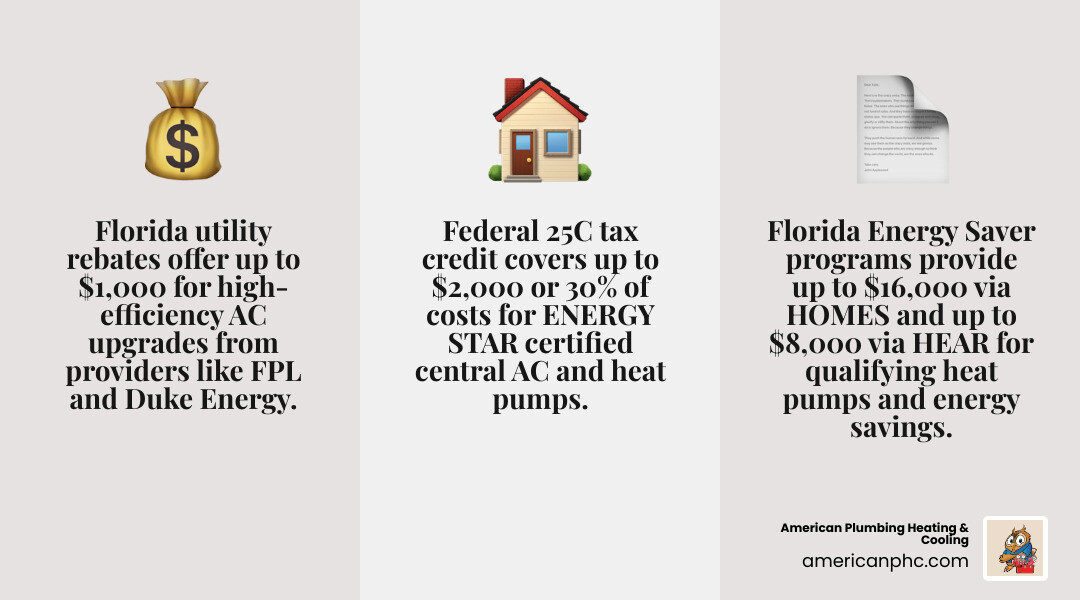
| HOMES Program | Florida Energy Saver | Up to $16,000 | 20%+ energy savings, qualified contractor |
| HEAR Program | Florida Energy Saver | Up to $8,000 | Under 150% AMI, heat pump equipment |
| Federal Tax Credit (25C) | IRS | Up to $2,000 | ENERGY STAR / CEE certified, primary residence |
Florida's climate means your air conditioner runs hard — and often year-round. In fact, heating and cooling can account for up to 50% of your monthly energy bill. That makes AC upgrades one of the highest-impact investments a Florida homeowner can make.
The good news? Between utility rebates, the state's federally funded Florida Energy Saver Program, and the federal Energy Efficient Home Improvement Tax Credit, there are now more ways than ever to offset those upgrade costs. Some programs even stack together.
This guide covers everything you need to know — which programs are active, what equipment qualifies, how to apply, and how to avoid the mistakes that get claims rejected.
I'm looking for florida energy rebates for ac upgrades. Which utility programs are active in 2026?

As we move through April 2026, several major utility companies in Florida continue to offer robust incentives to help us transition to more efficient cooling. These programs are often the easiest to access because they are managed directly by the providers we already pay every month.
Florida Power and Light (FPL) FPL offers a straightforward $200 instant rebate for residential customers. To qualify, you must purchase a new A/C system (both indoor and outdoor units) with a SEER2 rating of 15.2 or higher. The "instant" part is the best feature—the rebate is applied as a credit directly on your invoice from a Participating Independent Contractor (PIC). This means no waiting for a check in the mail!
Duke Energy Duke Energy has significantly increased its incentives, effective May 2025. They offer a tiered rebate system:
- Higher Efficiency Heat Pump: Up to $1,000 for units meeting 16.8 SEER / 9.0 HSPF (or 16 SEER2 / 7.5 HSPF2).
- High Efficiency Heat Pump: Up to $600 for units meeting 16.0 SEER / 9.0 HSPF (or 15.2 SEER2 / 7.5 HSPF2).
- Central AC Upgrade: A $300 rebate for systems meeting 16 SEER or 15.2 SEER2.
A unique requirement for Duke Energy is that you must have a free Home Energy Check completed within the 24 months prior to your installation to qualify.
Florida Public Utilities (FPU) For those in FPU electric service areas, such as parts of Northwest Florida near Milton or Navarre, there is a $100 customer rebate available for AC replacements or heat pump installs. These systems must meet a minimum 15.0 SEER rating and be installed in a residence with a ducted HVAC system.
If you are ready to see how these systems fit into your home, you can find More info about air conditioning services to help you choose the right efficiency level for your specific Florida neighborhood.
What is the Florida Energy Saver Program and how do HOMES and HEAR rebates work?
The landscape for florida energy rebates for ac upgrades changed dramatically with the launch of the Florida Energy Saver Program. Funded by approximately $346 million from the federal Inflation Reduction Act, this state-run initiative is split into two distinct paths: HOMES and HEAR.
The HOMES Program (Home Efficiency Rebates) This program is "performance-based," meaning the rebate amount depends on how much energy the upgrade actually saves. It is open to Florida homeowners of all income levels, but the rewards are higher for those with lower household incomes.
- Low-income households (<80% AMI): Can receive up to $16,000 for upgrades that achieve at least 35% energy savings.
- Moderate-to-high-income households: Can receive up to $4,000 for the same 35% savings tier, capped at 50% of the project cost.
The HEAR Program (Home Electrification and Appliances Rebates) The HEAR program is "equipment-based" and specifically targets low-to-moderate-income families (those earning less than 150% of the Area Median Income). Instead of calculating energy percentages, it provides upfront, point-of-sale discounts on specific high-efficiency electric equipment. A qualifying heat pump HVAC system can net you an $8,000 discount right at the time of purchase.
The Florida Energy Saver portal officially reopened for applications in August 2025, and by April 2026, the program is in full swing across our service areas from Pensacola down to Sarasota and Cape Coral.
What are the eligibility requirements for florida energy rebates for ac upgrades?
To ensure you don't miss out, you need to meet very specific technical standards. In 2026, the industry has fully transitioned to SEER2 (Seasonal Energy Efficiency Ratio 2) ratings, which are more rigorous than the old SEER standards.
- Efficiency Minimums: Most utility programs require at least a 15.2 SEER2. For federal tax credits and the highest state rebates, you'll often need to look for units that meet the CEE (Consortium for Energy Efficiency) highest efficiency tiers.
- AHRI Certification: Your new system must have an AHRI (Air-Conditioning, Heating, and Refrigeration Institute) reference number. This proves the indoor and outdoor units are matched to perform at the rated efficiency.
- Primary Residence: Most of these rebates apply only to your "principal residence." Investment properties or second homes may not qualify for the full suite of incentives.
- Contractor Status: For FPL and the Florida Energy Saver Program, you must use a qualified, licensed contractor. DIY installations or using an unapproved handyman will immediately disqualify your application.
Step-by-Step: How to claim florida energy rebates for ac upgrades.
The process can feel like a lot of paperwork, but following these steps in order will keep your claim on track:
- Register Your Profile: Visit the Florida Energy Saver Portal and create a profile before you buy. This ensures you are in the system for the HOMES or HEAR programs.
- Get an Energy Assessment: For the HOMES program, a professional energy assessment is required to model your potential energy savings.
- Select Your Equipment: Ensure the unit meets the 15.0 or 15.2 SEER2 minimums required by your utility.
- Keep Every Document: You will need the final invoice, the AHRI certificate (your contractor provides this), and proof of payment.
- Submit Within the Window: Most utilities, like FPU, require you to submit your application within 90 days of installation. Don't let the deadline slip!
| Utility/Program | Application Deadline | Key Document Needed |
|---|---|---|
| FPL | Instant at time of sale | PIC Invoice |
| Duke Energy | Within 24 months of Energy Check | AHRI Certificate |
| FPU | 90 days post-install | Signed Rebate Form |
| FL Energy Saver | Pre-registration required | Energy Savings Model |
Can I stack federal tax credits with my local Florida utility rebates?
One of the most frequent questions we hear in Sarasota and Bradenton is: "Can I get both?" The answer is usually a resounding yes.
The federal government offers the 25C Energy Efficient Home Improvement Credit. This is a tax credit, meaning it reduces the amount of tax you owe dollar-for-dollar.
- Central AC: 30% of the cost, up to $600.
- Heat Pumps: 30% of the cost, up to $2,000.
The "Stacking" Rule: You can typically take an instant $200 rebate from FPL and still claim the $2,000 federal tax credit for a heat pump. However, you cannot use two different federal grants for the exact same upgrade. For example, if the HEAR program (which is federally funded) pays for 100% of your heat pump, you cannot claim a tax credit on the portion you didn't pay for.
The goal is to reduce your "net cost." If a high-efficiency heat pump costs you $8,000, and you receive an $8,000 HEAR rebate, your net cost is zero. If you are a higher-income earner and get a $2,000 tax credit plus a $1,000 Duke Energy rebate, you’ve just shaved $3,000 off the price of your upgrade.
What are the most common mistakes homeowners make when applying for AC incentives?
We have seen many well-intentioned homeowners lose out on thousands of dollars due to small technicalities. Here is what to avoid:
- Using Unlicensed Installers: In Florida, it's not just about safety; it's about the money. Rebates require proof of professional installation by a licensed contractor.
- Ignoring SEER2 vs. SEER: Make sure your contractor is quoting you based on the new SEER2 standards. A unit that was "high efficiency" five years ago might not meet the 15.2 SEER2 minimum required today.
- Missing the Home Energy Check: For Duke Energy customers, if you install the unit before doing your Home Energy Check, you are ineligible for the rebate.
- Discarding the AHRI Certificate: This is the "birth certificate" of your AC system. Without it, you cannot prove to the IRS or the utility company that your system actually meets the efficiency claims.
- Non-Ducted Systems: Some programs, particularly FPU's, specifically require a ducted HVAC system. If you are installing a mini-split in a garage, it may not qualify for the same rebates as a whole-home central system.
If you’re unsure if your current setup qualifies, you can always find More info about air conditioning services to see which modern systems are compatible with your home's ductwork.
Frequently Asked Questions about Florida AC Incentives
Can I get a rebate for a mini-split system?
Yes! Many ductless mini-split heat pumps qualify for the federal 25C tax credit (up to $2,000) and the Florida HEAR program if you meet the income requirements. However, some utility-specific rebates (like FPU) are strictly for ducted systems, so always check your provider's fine print.
How long does it take to receive a Florida AC rebate check?
It varies. FPL's rebate is instant—you never even pay the $200. Duke Energy and FPU typically process applications within 6 to 8 weeks. For the Florida Energy Saver Program (HOMES), the timeline can be longer as it requires verification of energy savings, though HEAR is designed to be a point-of-sale discount.
Do I need to own the home to qualify for HEAR rebates?
The HEAR program is designed to help low-to-moderate-income Floridians, including renters, provided they have the landlord's permission for the installation. However, the HOMES program and the federal tax credit are primarily geared toward homeowners.
Conclusion
Navigating florida energy rebates for ac upgrades doesn't have to be a headache. With the right planning, you can significantly lower the cost of a system that will keep you cool during those humid July afternoons in Pensacola or Cape Coral while slashing your monthly power bill.
At American Plumbing Heating and Cooling, we bring over 100 years of combined experience to every job. Whether you are in Sarasota, Bradenton, Milton, or Navarre, our certified pros are here to help you select equipment that meets all the latest SEER2 standards and qualifies for the maximum available incentives. We believe in honest, upfront pricing and are available 24/7 for those unexpected Florida cooling emergencies.
Don't let these incentives expire or the funding pools run dry. Check eligibility for air conditioning services today and let us help you maximize your savings.
{"@context": "https://schema.org", "@graph": [{"@type": "Article", "headline": "Florida Energy Rebates for AC Upgrades | American Plumbing", "description": "Explore Florida energy rebates for AC upgrades in 2026, including utility, state, and tax incentives. See what you may qualify for today.", "author": {"@type": "Person", "name": "American Plumbing Heating and Cooling"}, "publisher": {"@type": "Organization", "name": "American Plumbing Heating and Cooling", "logo": {"@type": "ImageObject", "url": "https://firebasestorage.googleapis.com/v0/b/ai-templates.appspot.com/o/bot%2FiTB8FxoyvSplQzS7StV8%2Flogo%2FScreenshot%202026-03-16%20at%2012.43.20%E2%80%AFPM.png?alt=media&token=4ae5e171-7bb5-4a27-91f4-47e969b91c80"}}, "datePublished": "2026-05-15T02:46:55+00:00", "dateModified": "2026-05-15T02:46:58.206904", "mainEntityOfPage": {"@type": "WebPage", "@id": "https://pms.ciwebgroup.com/americanphc/2026/05/15/the-floridians-guide-to-high-efficiency-cooling-incentives/"}, "image": "https://images.unsplash.com/photo-1728030309230-e8df40521207?crop=entropy&cs=tinysrgb&fit=max&fm=jpg&ixid=M3w2MTMxNjF8MHwxfHNlYXJjaHw4fHxoaWdoLWVmZmljaWVuY3klMjBjZW50cmFsJTIwYWlyJTIwY29uZGl0aW9uaW5nJTIwdW5pdCUyMGluc3RhbGxlZHxlbnwwfDB8fHwxNzc3NDcwNjAzfDA&ixlib=rb-4.1.0&q=80&w=1080"}, {"@type": "FAQPage", "mainEntity": [{"@type": "Question", "name": "What Florida energy rebates for AC upgrades are available in 2026?", "acceptedAnswer": {"@type": "Answer", "text": "As of April 2026, the article lists rebates from FPL, Duke Energy, Florida Public Utilities, the Florida Energy Saver HOMES and HEAR programs, and the federal 25C tax credit. Available amounts range from $100 utility rebates to as much as $16,000 through the HOMES program."}}, {"@type": "Question", "name": "How much is the FPL A/C rebate and what are the requirements?", "acceptedAnswer": {"@type": "Answer", "text": "Florida Power and Light offers a $200 instant rebate for residential customers. To qualify, you must install a new A/C system with both indoor and outdoor units and a SEER2 rating of 15.2 or higher through an FPL Participating Independent Contractor."}}, {"@type": "Question", "name": "Can Florida AC rebates be combined with other incentives?", "acceptedAnswer": {"@type": "Answer", "text": "Yes, the article says some programs can stack together. Homeowners may be able to combine utility rebates, Florida Energy Saver incentives, and the federal Energy Efficient Home Improvement Tax Credit to reduce upgrade costs."}}, {"@type": "Question", "name": "What are the Florida Energy Saver HOMES and HEAR program rebate amounts?", "acceptedAnswer": {"@type": "Answer", "text": "The HOMES program offers up to $16,000 if the project achieves 20% or more energy savings and uses a qualified contractor. The HEAR program offers up to $8,000 for heat pump equipment for households under 150% of area median income."}}, {"@type": "Question", "name": "Why are AC upgrades such a high-impact investment for Florida homeowners?", "acceptedAnswer": {"@type": "Answer", "text": "Florida's climate causes air conditioners to run heavily and often year-round. According to the article, heating and cooling can make up as much as 50% of a monthly energy bill, so improving efficiency can significantly lower costs."}}]}]}Need HVAC Help?
Our certified technicians are ready to help with all your heating and cooling needs.
Request ServiceAbout the Author
American Plumbing Heating and Cooling Team
Licensed Florida contractors — HVAC CAC1821761 · Plumbing CFC1431919
More Articles
View All PostsRelated Articles


Ready to Get Started?
Whether you need a repair, maintenance, or a new system installation, our expert team is here to help.