
10 HVAC Maintenance Mistakes to Avoid
By the American Plumbing Heating and Cooling Team
Licensed Florida contractors — HVAC CAC1821761 · Plumbing CFC1431919

Avoid the most costly HVAC maintenance mistakes homeowners make with this Sarasota guide to protecting your system and lowering energy bills.
Reviewed bythe American Plumbing Heating and Cooling Team — Licensed Florida contractors — HVAC CAC1821761 · Plumbing CFC1431919. Published June 18, 2026 · Last updated July 17, 2026. About American Plumbing Heating and Cooling
Dealing with this problem right now? Call (941) 735-6616 and talk to our local team.
Request ServiceWhy HVAC Maintenance Mistakes Homeowners Make Cost More Than You Think
The most common hvac maintenance mistakes homeowners make include neglecting air filters, skipping seasonal tune-ups, closing vents in unused rooms, blocking the outdoor condenser unit, misplacing the thermostat, attempting DIY repairs, and ignoring early warning signs like strange noises or moisture near the unit.
Quick answer — most common HVAC maintenance mistakes:
- Not changing air filters often enough
- Skipping professional seasonal tune-ups
- Closing or blocking indoor air vents
- Allowing debris to build up around the outdoor condenser
- Poor thermostat placement or misuse
- Attempting complex DIY repairs
- Installing an improperly sized system
- Ignoring ductwork leaks
- Dismissing warning signs like grinding noises or musty odors
- Neglecting the condensate drain line
Your HVAC system handles close to half of your home's total energy use. Here in Florida, where the heat and humidity push air conditioners to work harder and longer than almost anywhere else in the country, small maintenance slip-ups don't stay small for long. A dirty filter or a missed tune-up can quietly chip away at your system's efficiency — driving up your energy bills, shortening the life of expensive equipment, and setting the stage for a breakdown on the hottest night of the year.
The frustrating part? Most of these mistakes are completely preventable. Research consistently shows that lack of maintenance is the number one problem with HVAC systems, and that neglected systems can lose three to five years off their expected lifespan. On the flip side, regular maintenance can extend the life of your equipment by up to 30%.
This guide walks through the most damaging HVAC maintenance mistakes — and exactly how to avoid them.
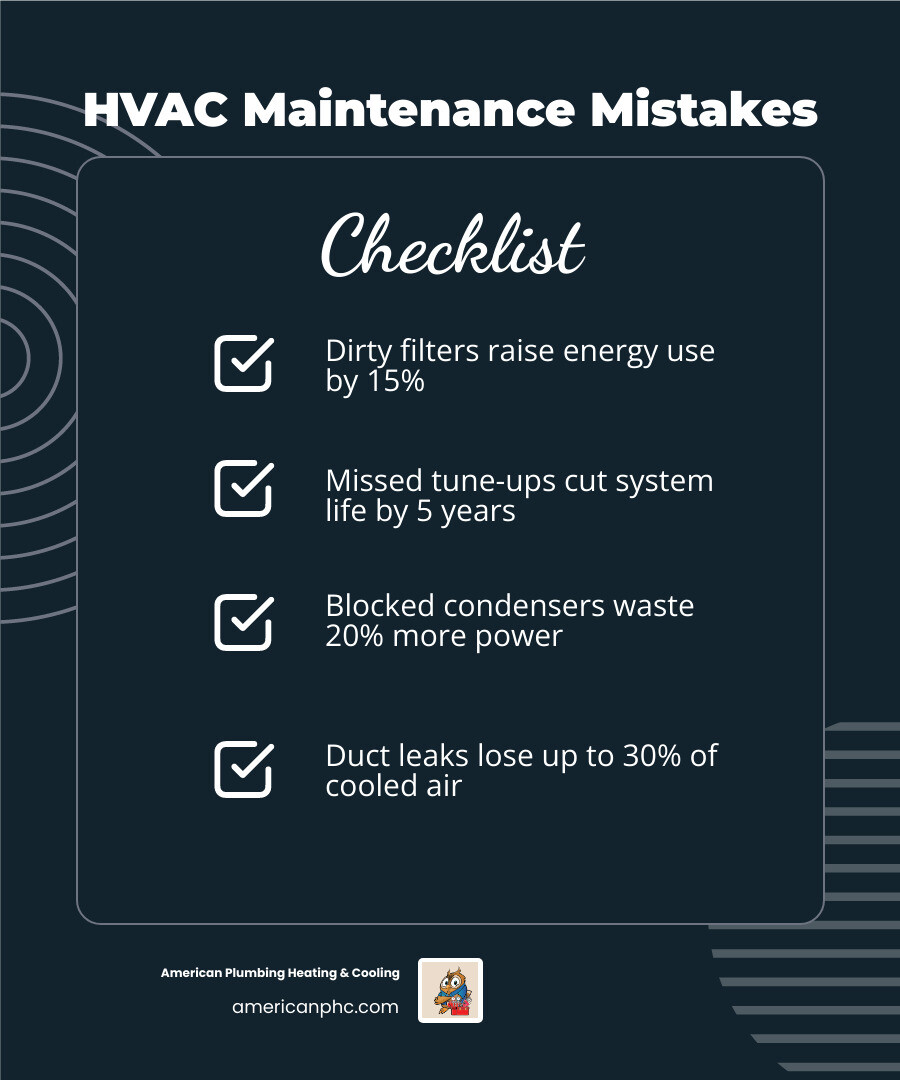
Basic hvac maintenance mistakes homeowners make terms:
- benefits of regular furnace and ac tune ups
- how to maintain your heating and cooling system
The Most Costly hvac maintenance mistakes homeowners make
When we talk about the financial consequences of deferred maintenance, we aren't just talking about a sudden breakdown. The true costs are often silent, compounding month after month in your utility bills before culminating in a premature system replacement.
An average HVAC system in Southwest or Northwest Florida is subjected to relentless stress. While systems in milder climates might last up to 15 years, a neglected unit along the Gulf Coast can easily fail in just 8 to 10 years. Salt air, high humidity, and near-constant operation accelerate the wear and tear on every single component.
Furthermore, skipping basic care can directly void your manufacturer's parts warranty. Most major HVAC brands require documented proof of regular professional maintenance to honor warranty claims. If a major component like your compressor fails in 2026, and you cannot prove the system was serviced annually, you could be left paying for the replacement entirely out of pocket. To understand how to protect your investment fully, check out our guide on Everything You Need to Know About AC Maintenance in Sarasota.
Neglecting Air Filters: The Easiest HVAC Maintenance Mistakes Homeowners Make to Prevent
If your HVAC system had a set of lungs, the air filter would be its windpipe. Neglecting this simple component is easily the most common mistake we see, yet it is also the easiest to prevent.
When an air filter becomes clogged with dust, pet dander, and fibers, it restricts the volume of air flowing through your system. This forces your blower motor to work twice as hard to circulate air, which can increase your system's energy consumption by 5% to 15%.
But the problems don't stop at your utility bill. Restricted airflow prevents the warm indoor air from passing over the cold evaporator coils. Without sufficient heat to absorb, the refrigerant inside those coils drops below freezing, causing the condensation on the coils to turn to ice. Once your evaporator coils freeze over, your system will short-cycle, blow warm air, or shut down entirely.
How often should you replace your filter? While a general rule of thumb is every 90 days for a standard suburban home, Florida households often need to change them much more frequently. If you have pets, suffer from allergies, or live in a dusty coastal environment, you should check your filter every 30 days and replace it every 30 to 60 days.
Be careful when choosing a replacement. Homeowners often buy medical-grade, high-MERV filters thinking they are doing their family a favor. However, if your system's blower motor isn't designed to handle the dense material of an ultra-high-MERV filter, it will restrict your airflow just as severely as a dirty filter. For more insights on prepping your filter and system for the heat, read about One Simple Way to Spring AC Maintenance Before Florida Heat and discover The Magic Number for HVAC Maintenance Success.
Skipping Seasonal Tune-Ups: Why This is One of the Biggest HVAC Maintenance Mistakes Homeowners Make
Many homeowners operate under an "out of sight, out of mind" philosophy when it comes to their heating and cooling. If the air coming out of the vents is cold, they assume everything is fine. However, waiting for your system to break down before calling a professional is a major gamble that usually results in emergency repair bills.
Regular preventive care is the single best way to protect your system. A professional tune-up twice a year (ideally in the spring before the brutal summer heat, and in the fall) can extend the life of your HVAC equipment by up to 30%.
During a professional inspection, a certified technician checks critical components that you cannot see or test yourself. They measure refrigerant levels, test electrical draw, clean the condenser coils, and inspect the electrical contacts. Catching a weak capacitor or a minor refrigerant leak during a routine visit prevents that component from failing on a 95-degree afternoon in July, saving you from the stress of a sudden outage.
To learn more about why these visits are so crucial, explore the 20 Reasons to Schedule Your HVAC Tune-Up Today. If you are looking for localized advice on preparing your Gulf Coast home, read our guides on Spring AC Tune-Up in Florida 101 and Spring AC and HVAC Maintenance for the Gulf Coast.
Airflow and Ventilation Blunders That Strain Your System
Your HVAC system is a carefully balanced loop. It draws a specific volume of air in through your return registers, conditions it, and pushes that exact same volume back out through your supply vents. Disrupting this balance is a recipe for system strain and high energy bills.
Closing Vents in Unused Rooms
A persistent home efficiency myth is that closing the vents in guest rooms or unused spaces will redirect the conditioned air to the rooms you are using, saving energy. In reality, this does the exact opposite.
Modern central HVAC systems utilize blowers designed to move air against a specific amount of resistance, known as static pressure. When you close supply vents, you restrict the paths the air can take. This dramatically increases the static pressure inside your ductwork.
This pressure buildup forces your blower motor to work harder, which can lead to motor burnout. Furthermore, the excess pressure can cause air to force its way out of any minor gaps or seams in your ductwork, turning small leaks into major energy drains. The drop in airflow can also cause your evaporator coils to freeze, leading to a complete system shutdown. To keep your system healthy, keep all supply and return vents open and clear of furniture or heavy drapes.
Neglecting Leaky or Uninsulated Ductwork
Your ductwork is responsible for carrying conditioned air throughout your home. Unfortunately, because ducts are hidden away in attics, crawlspaces, or behind drywall, they are frequently neglected.
Leaky ducts can waste up to 30% of your conditioned air. In Florida, where attics routinely reach temperatures north of 130 degrees in the summer, leaky ductwork is a double disaster. Not only does your expensive, cooled air escape into your unconditioned attic, but the negative pressure created inside the ductwork can actually pull hot, humid, dusty attic air directly into your living spaces.
This drastically reduces your system's cooling efficiency and introduces allergens, insulation fibers, and moisture into your home. Ensuring your ducts are properly sealed and insulated is a critical step in maintaining indoor air quality and keeping your utility bills under control.
Thermostat and Outdoor Unit Neglect
Your HVAC system relies on clear pathways for heat transfer. If either the indoor control center (the thermostat) or the outdoor heat disperser (the condenser) is neglected, the entire cycle breaks down.
Blocking the Outdoor Condenser Unit
The outdoor condenser unit is responsible for releasing the heat that was absorbed from inside your home. To do this effectively, the metal fins and coils need a constant, unobstructed flow of outdoor air.
Allowing bushes, weeds, or stored items to crowd around your outdoor unit is a costly mistake. Obstructions near the outdoor condenser unit can restrict airflow and increase your system's energy consumption by up to 20%. When heat cannot escape from the condenser coils, the compressor has to run longer and hotter, which drastically shortens its lifespan.
Keep a clear zone of at least two feet around all sides of your outdoor unit, and clear away any leaves, twigs, or grass clippings that accumulate on the fins. Additionally, if you have pets, keep them away from the unit; pet urine is highly acidic and can quickly corrode the delicate aluminum fins and copper coils, leading to expensive refrigerant leaks.
Improper Thermostat Use and Placement
Your thermostat is the brain of your heating and cooling system, but it can only make decisions based on the temperature it senses. If your thermostat is installed in a poor location — such as in direct sunlight, near drafty windows, or close to heat-producing appliances like ovens or lamps — it will register "ghost readings."
For example, a thermostat warmed by afternoon sunlight will read the room as much hotter than it actually is, forcing your air conditioner to run constantly and freeze you out of your own home. Conversely, a thermostat placed in a drafty hallway may cycle off too quickly, leaving the rest of the house warm and humid.
How you interact with your thermostat matters too. Many homeowners engage in "thermostat ping-pong," constantly cranking the temperature down to 65 degrees in hopes of cooling the house faster, only to raise it to 75 degrees when they get too cold. Your system cools at one steady rate; setting it lower only forces it to run longer, wasting energy. Upgrading to a smart thermostat can automate these adjustments, optimizing your comfort and saving hundreds of dollars a year on your utility bills.
The Dangers of DIY Repairs and Sizing Errors
The rise of online video tutorials has tempted many homeowners to attempt their own HVAC repairs and installations. However, central heating and cooling systems are complex, highly pressurized machines that carry significant safety and financial risks.
Attempting Complex DIY Mechanical Fixes
While changing an air filter or hosing off your condenser unit are perfectly safe DIY tasks, anything involving the internal mechanics, electrical wiring, or refrigerant lines must be left to the professionals.
HVAC systems utilize high-voltage electricity that can cause severe injury or death if handled improperly. Additionally, the capacitor — which is the most common HVAC part to fail — stores a massive electrical charge even when the power to the system is turned off. Discharging or replacing a capacitor incorrectly can easily shock you or ruin your system's fan motor or compressor.
Furthermore, handling refrigerant is highly regulated. Under federal EPA Section 608 regulations, it is illegal for anyone without proper certification to handle, purchase, or vent chemical refrigerants. Attempting to recharge your own system can result in heavy fines, permanent compressor damage, and an immediate voiding of your equipment's warranty.
Installing an Improperly Sized HVAC System
When it comes to HVAC systems, bigger is definitely not better. Some homeowners assume that installing an oversized unit will cool their home faster and more efficiently. In reality, an oversized system is an operational nightmare.
An oversized air conditioner will cool your home incredibly fast, but it will shut off before it has a chance to run a full cycle. This is known as short-cycling. Because the system runs in short, intense bursts, it never has enough time to perform its second crucial job: removing moisture from the air. This leaves your home feeling cold, damp, and clammy, creating a breeding ground for mold and mildew.
An undersized system has the opposite problem; it will run constantly without ever reaching your thermostat's set temperature, driving your energy bills through the roof and wearing out the compressor in a fraction of its normal lifespan. Professional installers use a detailed calculation called a Manual J load calculation — which takes into account your home's square footage, insulation levels, window placement, and local climate — to ensure your new system is sized perfectly.
Warning Signs Your System Needs Immediate Professional Attention
Your HVAC system will rarely fail without warning. Usually, it will drop hints that something is wrong. Ignoring these performance red flags is a major mistake that can turn a simple repair into a total system replacement.
To prevent minor issues from turning into catastrophic failures, keep an eye out for these warning signs:
- Strange Noises: Squealing, grinding, or loud metal-on-metal scraping noises usually point to a failing motor bearing or a loose blower wheel. If you ignore a grinding noise, the motor can seize entirely, leading to a much more expensive repair.
- Unusual Odors: A musty smell coming from your vents indicates mold or mildew growth inside your ductwork or on your evaporator coils. A burning sulfur or electrical smell is an immediate warning sign of overheating wires or failing electrical components, requiring you to shut down the system and call for help.
- Moisture and Water Puddles: Your air conditioner pulls massive amounts of water out of the air. This water collects in a drain pan and flows outside through a condensate drain line. In Florida's humid climate, algae and mold thrive in these damp lines, easily causing clogs. If you see water pooling around your indoor unit, your drain line is likely clogged, which can back up and cause severe water damage to your ceilings, walls, and floors.
For more tips on identifying and avoiding these sudden emergencies, check out our guide on Preventing HVAC Emergencies with Regular Maintenance.
A Simple Maintenance Checklist to Protect Your Investment
To help you keep track of your heating and cooling care, we have broken down the essential maintenance tasks into what you can safely handle yourself and what requires our certified professionals.
| Homeowner DIY Tasks (Every 1–3 Months) | Professional Maintenance Tasks (Twice a Year) |
|---|---|
| Check and Replace Filters: Inspect every 30 days; replace every 30–90 days based on pets and allergies. | Electrical Inspection: Tighten connections, measure voltage, and test capacitors for wear. |
| Clear Condenser Unit: Maintain a 2-foot clear zone around the outdoor unit; trim back plants and remove debris. | Refrigerant Check: Measure refrigerant charge and inspect lines for microscopic leaks. |
| Keep Vents Open: Ensure all indoor supply and return registers are unblocked and free of furniture. | Coil Cleaning: Thoroughly clean indoor evaporator and outdoor condenser coils to ensure heat transfer. |
| Clear Drain Line: Flush your condensate drain line with vinegar every few months to prevent algae clogs. | Blower and Motor Tune-Up: Inspect blower assembly, balance the wheel, and lubricate moving parts. |
| Monitor Thermostat: Check batteries and ensure your thermostat is set to consistent, efficient temperatures. | Ductwork and Safety Check: Inspect ducts for leaks and test safety controls, including carbon monoxide risks. |
For a deeper dive into seasonal preparation, read our Spring Maintenance Checklist to Prevent Summer Breakdowns and learn How to Spring Maintenance the Right Way. To make sure you never miss a visit, consider enrolling in our comprehensive Maintenance Plan.
Frequently Asked Questions about HVAC Maintenance
How often should I change my air filter in Florida?
In Florida's hot and humid climate, you should check your air filter every 30 days. For standard homes without pets, replacing it every 90 days is acceptable. However, if you have pets, allergies, or run your system constantly during the summer, you should replace your filter every 30 to 60 days to maintain proper airflow and system efficiency.
What happens if I don't clean my AC condensate drain line?
If you do not clean your condensate drain line, algae, mold, and dust will accumulate and clog the pipe. Since your AC pulls gallons of water from the air daily, a clogged line will cause water to back up, overflowing the drain pan. This leads to serious water damage to your drywall, ceilings, and floors, and can trigger your system's safety float switch to shut the system down completely.
Why is my HVAC system making a loud grinding noise?
A loud grinding noise is usually a sign that a motor bearing inside your blower fan or outdoor condenser fan is failing. This is a mechanical issue that will not resolve itself. If you continue to run the system, the motor can seize up entirely, which can cause secondary electrical damage and result in a much more expensive replacement.
Conclusion
Avoiding the most common hvac maintenance mistakes homeowners make is the single best way to protect your home's comfort, keep your energy bills low, and ensure your system lasts for years to come. From changing your air filters regularly to keeping your outdoor unit clear of debris, these small steps pay massive dividends in peace of mind.
At American Plumbing Heating and Cooling, we are dedicated to keeping your Florida home comfortable in every season. With over 100 years of combined team experience, our certified professionals provide honest, upfront pricing and dependable service across Sarasota, Bradenton, Milton, Navarre, Cape Coral, and the surrounding Gulf Coast areas.
Don't wait for the next major heatwave to find out if your system is struggling. Contact us today to schedule your seasonal tune-up and experience the difference of trusted, local expertise by visiting our professional HVAC services page.
Need HVAC Help?
Our certified technicians are ready to help with all your heating and cooling needs.
Request ServiceAbout the Author
American Plumbing Heating and Cooling Team
Licensed Florida contractors — HVAC CAC1821761 · Plumbing CFC1431919
More Articles
View All PostsRelated Articles


Ready to Get Started?
Whether you need a repair, maintenance, or a new system installation, our expert team is here to help.