
A Homeowner Guide to Efficiency Ratings
By the American Plumbing Heating and Cooling Team
Licensed Florida contractors — HVAC CAC1821761 · Plumbing CFC1431919

Unlock efficiency ratings explained for homeowners: Decode SEER2, HSPF2, AFUE and more for Florida HVAC savings and comfort.
Reviewed bythe American Plumbing Heating and Cooling Team — Licensed Florida contractors — HVAC CAC1821761 · Plumbing CFC1431919. Published May 18, 2026. About American Plumbing Heating and Cooling
Dealing with this problem right now? Call (941) 735-6616 and talk to our local team.
Request ServiceWhy Efficiency Ratings Explained for Homeowners Can Save You Real Money
Understanding efficiency ratings explained for homeowners is one of the most practical things you can do before buying or replacing any HVAC or home comfort system. These ratings tell you — in plain numbers — how well a system converts energy into heating or cooling, so you can compare options and predict what you'll pay on your utility bills for years to come.
Here's a quick breakdown of the most common efficiency ratings you'll encounter:
| Rating | What It Measures | Higher Is Better? |
|---|---|---|
| SEER / SEER2 | Air conditioner cooling efficiency over a full season | Yes |
| EER | AC efficiency at peak demand (single outdoor temp) | Yes |
| IEER | AC efficiency across multiple load levels year-round | Yes |
| HSPF / HSPF2 | Heat pump heating efficiency over a full season | Yes |
| AFUE | Furnace or boiler fuel-to-heat conversion rate (%) | Yes |
| U-Factor | How much heat a window lets through | No (lower = better) |
| SHGC | How much solar heat a window admits | Depends on climate |
| HERS Index | Whole-home energy efficiency score | No (lower = better) |
Think of these ratings like miles per gallon on a car. A higher MPG means less money at the pump — and a higher SEER or AFUE means less money on your energy bill. The difference is real: a system with a SEER rating of 16 compared to one rated at 13 can reduce your cooling costs by 20–25% annually.
For Florida homeowners, this matters even more. Air conditioners run nearly year-round here, which means even a modest improvement in efficiency adds up quickly — month after month, season after season. And because there's no single rating that covers every system in your home, it helps to understand what each label actually means before you shop, upgrade, or schedule a tune-up.
The sections below walk through each major rating in plain language — what it measures, what numbers to look for, and how it affects your home's comfort and your wallet.
Decoding Cooling Metrics: Efficiency Ratings Explained for Homeowners
When we talk about cooling in Florida, we are talking about the biggest slice of your energy pie. Whether you are in Sarasota or Pensacola, your air conditioner is the MVP of your home. But not all AC units are created equal. To understand how they perform, we look at several different metrics that measure energy use under different conditions.
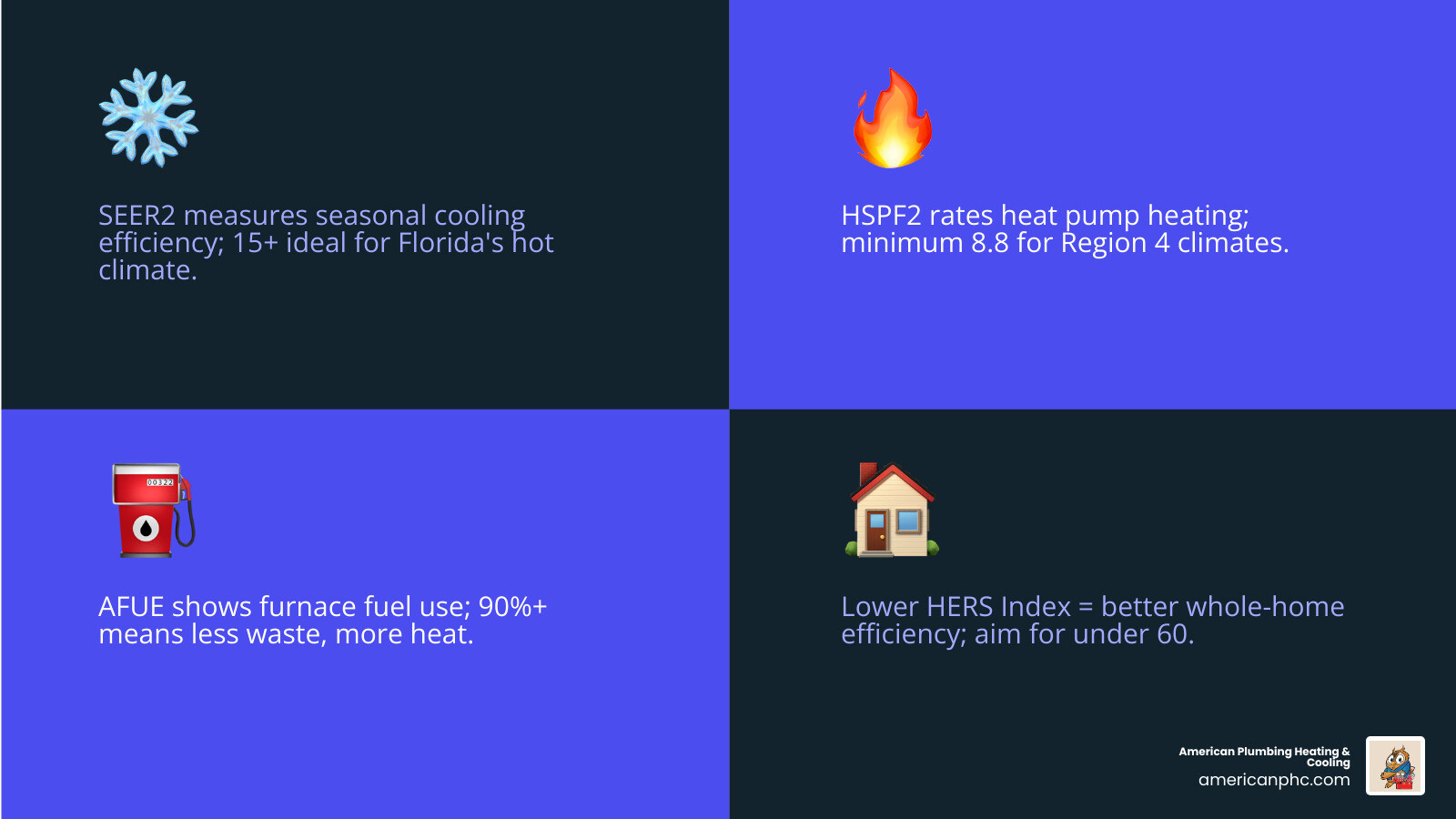
The most famous of these is SEER (Seasonal Energy Efficiency Ratio). As of 2023, the industry shifted to SEER2, which uses a more rigorous testing procedure to better reflect real-world external static pressure. SEER measures the total cooling output of an AC unit over a typical cooling season divided by the total electric energy input during that same period. Essentially, it accounts for the seasonal fluctuations in temperature we see throughout the year.
Then there is EER (Energy Efficiency Ratio). While SEER looks at the whole season, EER is a snapshot of how the unit performs at peak demand—specifically when it is 95°F outside. In the sweltering heat of a Southwest Florida July, EER tells us if the system can keep up without breaking the bank.
Finally, we have IEER (Integrated Energy Efficiency Ratio). This is often more relevant for commercial systems or high-end residential units with variable-speed technology. It measures efficiency at various "load" levels (100%, 75%, 50%, and 25%), which is crucial because your AC doesn't always need to run at full blast.
To keep these systems running at their rated efficiency, regular maintenance is non-negotiable. If you're in the Sun City or Venice area, an AC Maintenance Tune-Up Sarasota FL can ensure your high-SEER unit actually delivers the savings promised on the box.
How to find efficiency ratings explained for homeowners on your current unit
If you’re wondering where your current system stands, the answers are usually right in front of you. Most units have a bright yellow EnergyGuide label affixed to them. This label displays the unit's SEER or SEER2 rating and compares it to similar models.
If the yellow sticker has faded or peeled off, look for the manufacturer’s nameplate—a metal or plastic tag on the outdoor condenser. This plate lists the model number, serial number, and often the BTU (British Thermal Unit) capacity. You can search the model number on the AHRI (Air-Conditioning, Heating, and Refrigeration Institute) directory to find the exact certified rating. Knowing these numbers is the first step in Everything You Need to Know About AC Maintenance in Sarasota, as it helps us determine if your aging unit is still worth repairing or if it's costing you too much in hidden energy waste.
Understanding the Florida-specific importance of IEER
In Florida, our AC units don't just "turn on" in June and "turn off" in September. We use them year-round. This is why the Integrated Energy Efficiency Ratio (IEER) is so vital for us. Most of the time, your home doesn't need 100% of the AC's cooling capacity; it might only need a little bit to maintain the temperature and, more importantly, control humidity.
Units with high IEER ratings typically feature variable-speed compressors. Instead of being "all on" or "all off," they can dial their performance up or down. This leads to much better humidity control and prevents that "clammy" feeling that happens when a system cycles on and off too quickly. For homeowners in Cape Coral or Fort Myers, focusing on IEER and variable-speed tech can be a game-changer for indoor comfort.
Heating Performance: AFUE and HSPF Ratings
Even in Florida, we have those chilly January mornings where the "Heat" setting on the thermostat finally gets some action. Whether you use a furnace or a heat pump, there are specific efficiency ratings explained for homeowners that apply to the heating side of the coin.
Why HSPF matters for Florida heat pumps
Most Florida homes utilize heat pumps because they are incredibly efficient at moving heat rather than creating it. The efficiency of a heat pump in heating mode is measured by HSPF (Heating Seasonal Performance Factor), or the newer HSPF2.
HSPF is calculated by taking the total heating required during the season and dividing it by the total electricity consumed. For our region (Climate Region 4), the federal minimum standard for new heat pumps is now 8.8 HSPF2. A "good" rating is generally anything above 9.0, with top-tier units reaching 10 or higher. If your heat pump is struggling to keep you warm during a cold snap in Milton or Navarre, it might be time for a Furnace Maintenance Tune-Up Cape Coral FL (we service heat pumps too!) to check if the thermal transfer process is working as efficiently as it should.
Calculating furnace efficiency with AFUE
If you have a gas furnace, you’ll look at the AFUE (Annual Fuel Utilization Efficiency). This is expressed as a percentage. For example, a furnace with a 95% AFUE converts 95% of the fuel it burns into heat for your home, while the other 5% escapes through the vents or chimney.
Older furnaces might only be 80% AFUE, meaning 20 cents of every dollar you spend on gas is literally going up in smoke. High-efficiency units (90% to 98.5%) use secondary heat exchangers to "capture" that extra heat, making them much more cost-effective over the long haul.
Whole-Home Efficiency: HERS Scores and Fenestration
Efficiency isn't just about the machines that hum; it’s about the "envelope" of your home—the walls, windows, and doors that keep the cool air in and the Florida sun out.
Why are efficiency ratings explained for homeowners vital for property value?
Did you know that homes with verified efficiency ratings sell for an average of 2.7% more? In some markets, a high-efficiency home can command a 3–5% price premium. Buyers in places like Lakewood Ranch and Sarasota are increasingly savvy; they want to see HERS (Home Energy Rating System) Index scores.
The HERS Index is like a golf score—lower is better. A score of 100 represents a standard new home built to 2006 codes. A score of 0 represents a "Net Zero" home. If your home has a score of 50, it is 50% more efficient than the standard. Understanding these ratings is a key part of The Great Chill Debate of Ducted vs Ductless Systems, as the type of HVAC you choose heavily influences your home's total HERS score.
Evaluating windows and doors with NFRC labels
When shopping for windows, doors, or skylights, look for the NFRC (National Fenestration Rating Council) label. This provides several key numbers:
- U-Factor: Measures the rate of non-solar heat flow. Lower is better.
- SHGC (Solar Heat Gain Coefficient): Measures how much solar radiation comes through the glass. In Florida, you want a low SHGC (typically below 0.25) to block the sun's heat.
- Visible Transmittance (VT): How much natural light comes through. A higher number means more light, which can help you save on artificial lighting.
Factors That Influence Real-World Efficiency
You could buy the most expensive, highest-rated system on the market, but if it isn't handled correctly, those efficiency ratings explained for homeowners won't mean a thing. Real-world performance is often lower than the "lab-tested" rating due to external factors.
The impact of proper system sizing
One of the most common mistakes we see is improper sizing. If an AC unit is too large (oversized), it will "short cycle," turning on and off rapidly. This prevents it from ever reaching its peak efficiency and leaves your home feeling humid because it doesn't run long enough to remove moisture. If it's too small, it will run constantly, wearing out components and spiking your bills.
We use a Manual J calculation to determine the exact cooling load of your home based on square footage, insulation levels, and window orientation. This ensures the SEER2 rating you paid for is actually what you get. To keep that system in peak shape, we recommend a Maintenance Plan to catch small issues before they tank your efficiency.
Maintenance habits that preserve high ratings
Efficiency naturally degrades over time as dust builds up on coils and filters clog. To preserve your ratings:
- Change filters every 1–3 months: A clogged filter makes the blower motor work harder, using more juice.
- Clean the outdoor coils: Dirt and grass clippings insulate the coils, preventing heat from escaping.
- Seal your ducts: Leaky ducts can waste 20–30% of the air your system just spent money to cool.
For more tips, check out Don't Sweat It: A Local Guide to HVAC System Maintenance. If you're in the Bradenton area, scheduling an AC Maintenance Tune-Up Bradenton FL is the best way to ensure your thermostat calibration and refrigerant charge are spot on.
Frequently Asked Questions about Efficiency Ratings
What is a good SEER2 rating for Florida?
While the federal minimum is 14.3 SEER2 (equivalent to the old 15 SEER) for our region, we generally recommend 16 to 18 SEER2 for the best balance of upfront cost and long-term savings. If you plan on staying in your home for more than five years, the extra efficiency usually pays for itself.
Does a high AFUE rating guarantee lower bills?
Not necessarily. A 98% AFUE furnace is incredibly efficient at burning fuel, but if your home has poor insulation or leaky windows, that heat will escape immediately. Efficiency is a "team sport" between your HVAC system and your home's envelope.
How often do federal efficiency standards change?
The Department of Energy typically reviews and updates standards every 6 to 10 years. The last major shift occurred in January 2023, which introduced the SEER2 and HSPF2 metrics. These changes push manufacturers to innovate, leading to better products for you.
Conclusion
Navigating efficiency ratings explained for homeowners can feel like learning a second language, but it is a language that pays dividends. Whether you are looking at SEER2 for your Sarasota home or checking the HSPF2 of a new heat pump in Pensacola, these numbers are your best tools for controlling your home's energy future.
At American Plumbing Heating and Cooling, we bring over 100 years of combined experience to every job. We don't just install boxes; we provide Florida climate solutions tailored to your specific needs. From honest, upfront pricing to 24/7 emergency support, we are here to ensure your home remains a sanctuary of comfort and efficiency.
Ready to see how your home stacks up? More info about our professional HVAC and plumbing services is just a click away. Let us help you turn those confusing ratings into real-world savings.
Need HVAC Help?
Our certified technicians are ready to help with all your heating and cooling needs.
Request ServiceAbout the Author
American Plumbing Heating and Cooling Team
Licensed Florida contractors — HVAC CAC1821761 · Plumbing CFC1431919
More Articles
View All PostsRelated Articles


Ready to Get Started?
Whether you need a repair, maintenance, or a new system installation, our expert team is here to help.