
Florida Room Air Conditioning 101
By the American Plumbing Heating and Cooling Team
Licensed Florida contractors — HVAC CAC1821761 · Plumbing CFC1431919

Master Florida room air conditioning: Discover mini-splits, sizing tips, humidity control and efficiency hacks for your sunroom.
Reviewed bythe American Plumbing Heating and Cooling Team — Licensed Florida contractors — HVAC CAC1821761 · Plumbing CFC1431919. Published May 6, 2026 · Last updated July 29, 2026. About American Plumbing Heating and Cooling
Dealing with this problem right now? Call (941) 735-6616 and talk to our local team.
Request ServiceIs Your Florida Room Turning Into a Sauna? Here's What You Need to Know
Florida room air conditioning is one of the most common cooling challenges homeowners across the Sunshine State face — and it's easy to see why. These bright, glass-enclosed spaces are beautiful additions to any home, but their large window surfaces trap heat like a greenhouse, sending temperatures soaring well beyond the rest of the house.
Here's a quick summary of what works best for cooling a Florida room:
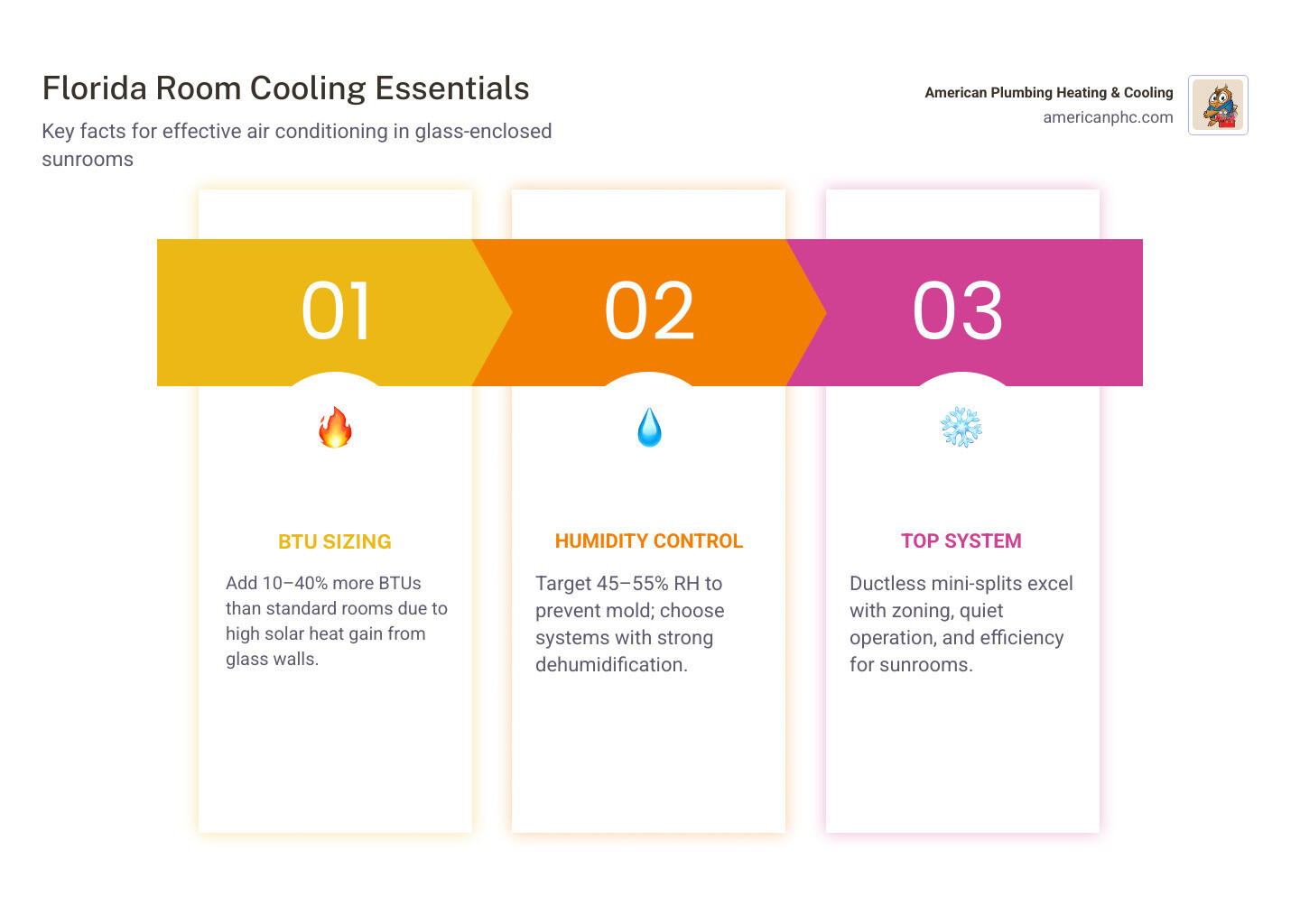
- Best system overall: Ductless mini-split (independent zone, built-in dehumidification, no ductwork needed)
- Budget/temporary option: Portable or window AC unit (best for smaller spaces under 300 sq ft)
- Key sizing rule: Add 10–40% more BTUs than you'd use for a standard room of the same size
- Ideal temperature: 78°F when occupied, higher when away
- Target humidity: 45–55% relative humidity to prevent mold and muggy air
- Top mistake to avoid: Oversizing your unit — bigger is not better; it causes short cycling and leaves air feeling clammy
Florida's heat and humidity make this more than a comfort issue. With HVAC already accounting for over 40% of a typical Florida home's utility bill, getting your Florida room cooling right can save real money — and protect your home from mold and moisture damage.
In this guide, we break down every option, from sizing and system types to energy savings and maintenance tips, so you can make the smartest choice for your space.
Florida room air conditioning glossary:
- Central AC vs Ductless Mini Split Comparison
- Central Air vs Mini Split for the Gulf Coast Homes
- Mini Split vs Central AC Cost Comparison
Why Specialized Florida Room Air Conditioning is Essential
A Florida room isn't just another bedroom; it’s a unique architectural feature with a very different "thermal envelope." In HVAC terms, the thermal envelope is the barrier between your conditioned indoor air and the outdoor elements. In a standard living room, you have insulated walls and perhaps a couple of windows. In a Florida room, the glass-to-wall ratio is often 70% or higher.
This creates a massive "solar heat gain" problem. Glass allows short-wave radiation from the sun to enter the room, but once that energy hits your furniture and floors, it turns into long-wave infrared heat that can't easily escape back through the glass. This is the greenhouse effect in action. Without specialized Air Conditioning, these rooms become unusable for most of the year.
Furthermore, many Florida rooms were originally porches or lanais that were enclosed later. This means they often lack the floor and ceiling insulation found in the rest of the home. When you combine poor insulation with high solar gain, your central HVAC system—if simply extended into the room—will likely struggle to keep up, leading to uneven temperatures and high energy bills.
Challenges of florida room air conditioning in High Humidity
In places like Milton and Bradenton, heat is only half the battle; the humidity is the real opponent. Effective florida room air conditioning must do more than lower the temperature; it must aggressively remove moisture from the air.
If an AC system isn't designed to handle the specific latent heat load (the heat held in water vapor) of a glass-heavy room, the air will feel "heavy" and "clammy" even if the thermostat says it's 72°F. We aim to keep relative humidity between 45% and 55%. Anything higher risks the growth of mold and mildew, which can thrive in the condensation that forms on cool glass surfaces. If you're tired of that sticky feeling, check out our AC Repair in Milton, FL for People Who Hate Sweating for tips on moisture control.
Impact of Solar Radiation on Cooling Loads
The orientation of your Florida room matters immensely. A south-facing room will receive intense direct sunlight for most of the day, while a west-facing room will deal with the brutal "afternoon bake." This infrared heat can cause temperature swings of 10 to 20 degrees in a matter of hours.
Standard cooling calculations often fail to account for this intense radiation. When we evaluate a space, we look at the U-value of the glazing (how well the windows insulate) and the shading available. Without a system designed for these spikes, you'll find yourself constantly fiddling with the dial. For more on managing these local climate spikes, see our Navarre AC Repair Guide for Hot Florida Days.
Best Cooling Systems for Sunrooms and Lanais
Choosing the right hardware is the most important decision you'll make for your sunroom. While you have several options, they are not created equal in terms of efficiency or comfort.
| Feature | Ductless Mini-Split | Window Unit | Portable AC |
|---|---|---|---|
| Efficiency | Very High (up to 25+ SEER) | Low to Medium | Low |
| Noise Level | Whisper Quiet | Loud | Very Loud |
| Dehumidification | Excellent | Moderate | Poor |
| Security | High (Small wall hole) | Low (Window is open) | Low (Vents through window) |
| Installation | Professional Required | DIY Possible | DIY Possible |
Why Ductless Mini-Splits Lead florida room air conditioning Trends
Ductless mini-splits have become the gold standard for florida room air conditioning in April 2026. Because they don't require ductwork, they avoid the 30% energy loss typically associated with leaky ducts in hot attics.
These systems use "inverter technology," which allows the compressor to speed up or slow down precisely based on the cooling demand. Instead of blasting on and off like a traditional unit, a mini-split maintains a steady, whisper-quiet hum. This is perfect for sunrooms where you want to relax or read without the roar of a fan. They also provide independent zoning, meaning you can cool the Florida room only when you're using it, without wasting money cooling the rest of the house. If you're considering an upgrade, our team specializes in AC Installation and Replacement Milton, FL.
Portable vs. Window Units for Supplemental Cooling
If a permanent installation isn't in the cards, portable or window units can provide temporary relief. Portable units are the easiest to set up, as they sit on the floor and vent through a flexible hose. However, they are often the least efficient because they pull some of the cool air they just created back into the unit to cool the compressor, then vent it outside, creating negative pressure that pulls hot air in from other rooms.
Window units are more efficient than portables but come with security risks and block your view. They can also be a source of air leaks if not sealed perfectly. For homeowners in Bradenton looking for a balance between cost and comfort, we often discuss these trade-offs during a consultation. Learn more about local cooling options in our guide: Chill Out: A Guide to Finding Affordable AC Repair Services in Bradenton, FL.
How to Properly Size Your florida room air conditioning
One of the biggest mistakes we see in Sarasota and Cape Coral is improper sizing. A unit that is too small will run constantly and never reach the setpoint. A unit that is too large—a very common error—will "short cycle," turning on and off so quickly that it never has time to remove the humidity, leaving the room feeling like a cold swamp.
We use a Manual J load assessment to determine the exact BTUs (British Thermal Units) needed. While a standard room might require 20 BTUs per square foot, a Florida room usually requires a 10% to 40% "sunroom multiplier" due to the glass. For a deeper dive into why professional sizing is non-negotiable, read How to Survive the Florida Heat with Professional AC Installation.
Balancing SEER Ratings and Sensible Heat Ratio
In 2026, the federal minimum for new split systems is 14 SEER (Seasonal Energy Efficiency Ratio), but for a Florida room, we often recommend 18 to 22 SEER for maximum savings. However, SEER is only half the story.
The Sensible Heat Ratio (SHR) is equally critical. SHR measures how much of the unit’s energy goes toward lowering the temperature (sensible heat) versus removing moisture (latent heat). In our humid climate, you want a unit with a lower SHR, meaning it’s designed to spend a significant portion of its cycle pulling water out of the air. Regular maintenance ensures these ratios stay balanced; see our AC Maintenance Tune-Up Milton, FL service for more details.
Avoiding the Pitfalls of Oversized Units
"Bigger is better" is a myth that leads to energy waste and equipment failure. When a unit is oversized, the thermostat hits the target temperature in five minutes. The air is cool, but the walls and furniture are still damp because the AC didn't run long enough to dehumidify. This leads to mold growth and a "cool but clammy" environment. A properly sized unit that runs for longer cycles is far more efficient and comfortable. If your current unit is cycling too fast, it might be time to Beat the Florida Heat with a New AC Unit Installation.
Maximizing Performance and Energy Efficiency
Once your florida room air conditioning is installed, how you use it determines your monthly bill. Energy Star and the Department of Energy recommend a baseline of 78°F. While that might sound high to some, every degree you set the thermostat below 78°F can increase your cooling costs by up to 8%. Setting it to 73°F could nearly double your energy consumption compared to the recommended setting.
Using a programmable or smart thermostat allows you to raise the temperature when the room isn't in use, then cool it down shortly before you plan to enjoy it. For more local tips on efficiency, check out our Local Guide to HVAC System Maintenance.
Supplemental Strategies for Heat Reduction
You can help your AC work less by using passive cooling strategies:
- Solar Shades and Window Films: High-quality films can block up to 99% of UV rays and significantly reduce infrared heat transfer.
- Ceiling Fans: Fans don't lower the temperature, but the "wind chill" effect makes you feel about 4 degrees cooler, allowing you to raise the thermostat.
- Exterior Awnings: Blocking the sun before it even hits the glass is the most effective way to reduce solar gain.
- Weatherstripping: Ensure that the doors leading from the Florida room to the rest of the house are well-sealed to prevent heat "bleeding" into your main living areas.
If your system is struggling despite these tips, you may need an AC Repair Service Bradenton, FL.
Maintenance Tips for Humid Climates
The salt air and high humidity in areas like Siesta Key and Pensacola are tough on AC components. To keep your Florida room cooling efficiently:
- Clean the Coils: Dust and salt spray on outdoor coils act as insulation, trapping heat and forcing the compressor to work harder.
- Change Filters Monthly: In a high-traffic room, filters clog quickly, reducing airflow and efficiency.
- Clear the Condensate Drain: Because these units remove so much water, the drain lines can easily grow algae and clog.
- Professional Tune-ups: A bi-annual check ensures refrigerant levels are correct and electrical components are safe.
Stay ahead of the heat with Professional AC Maintenance in Bradenton, FL.
Frequently Asked Questions about Florida Room Cooling
What is the best thermostat setting for a Florida room?
We recommend 78°F as the ideal balance between comfort and cost. If you have a high-efficiency system with good dehumidification, 78°F will feel much cooler than it would in a humid environment. When the room is empty, consider bumping it up to 82°F to save on your utility bill. For more on Sarasota-specific settings, see Everything You Need to Know About AC Maintenance in Sarasota.
Can I run my central AC into my sunroom?
While you can extend ductwork, it’s often not the best idea. Your existing central AC was sized for the original square footage of your home. Adding a high-heat-gain room can overwhelm the system, leaving the whole house warm. Additionally, the air pressure balance can be thrown off. A dedicated ductless system is usually the superior choice. Residents in Cape Coral can find more advice in The Ultimate Cape Coral AC Repair Survival Guide.
How do I stop my sunroom from being so humid?
The key is proper sizing and running the unit on a "dry" or dehumidification mode if available. Ensure your room has a proper vapor barrier and that windows are double-paned. If you notice a musty smell, it's a sign your AC isn't removing enough moisture. Regular maintenance is the best defense; learn more at Why Your Milton Home Needs Regular AC Maintenance to Survive the Heat.
Conclusion
A Florida room should be your favorite place to relax, not a source of stress and high utility bills. By choosing the right florida room air conditioning system—ideally a high-SEER ductless mini-split—and following smart sizing and maintenance practices, you can enjoy the sunshine without the sweat.
At American Plumbing Heating and Cooling, we’ve spent over 100 years combined helping homeowners in Sarasota, Bradenton, Pensacola, and across Southwest Florida stay comfortable. Whether you need a new installation, an urgent repair, or just a seasonal tune-up, our certified pros are here to help with honest, upfront pricing.
Ready to reclaim your sunroom? Contact our expert team today for professional HVAC services and experience the difference that local expertise makes.
{"@context": "https://schema.org", "@graph": [{"@type": "Article", "headline": "Florida Room Air Conditioning | American Plumbing Heating", "description": "Learn the best florida room air conditioning options, sizing tips, and humidity control advice. Read the guide and choose the right system today.", "author": {"@type": "Person", "name": "American Plumbing Heating and Cooling"}, "publisher": {"@type": "Organization", "name": "American Plumbing Heating and Cooling", "logo": {"@type": "ImageObject", "url": "https://firebasestorage.googleapis.com/v0/b/ai-templates.appspot.com/o/bot%2FiTB8FxoyvSplQzS7StV8%2Flogo%2FScreenshot%202026-03-16%20at%2012.43.20%E2%80%AFPM.png?alt=media&token=4ae5e171-7bb5-4a27-91f4-47e969b91c80"}}, "datePublished": "2026-05-06T02:46:48+00:00", "dateModified": "2026-05-06T02:46:50.847360", "mainEntityOfPage": {"@type": "WebPage", "@id": "https://pms.ciwebgroup.com/americanphc/2026/05/06/florida-room-air-conditioning-101/"}, "image": "https://images.pexels.com/photos/7005709/pexels-photo-7005709.jpeg?auto=compress&cs=tinysrgb&h=650&w=940"}, {"@type": "FAQPage", "mainEntity": [{"@type": "Question", "name": "What is the best air conditioning option for a Florida room?", "acceptedAnswer": {"@type": "Answer", "text": "A ductless mini-split is presented as the best overall system for a Florida room because it creates an independent cooling zone, includes built-in dehumidification, and does not require ductwork. This makes it especially well-suited for glass-enclosed spaces that trap heat."}}, {"@type": "Question", "name": "Can you use a portable or window AC unit in a Florida room?", "acceptedAnswer": {"@type": "Answer", "text": "Yes, the article says portable or window AC units are a budget-friendly or temporary option for Florida rooms. They work best in smaller spaces under 300 square feet."}}, {"@type": "Question", "name": "How do you size an air conditioner for a Florida room?", "acceptedAnswer": {"@type": "Answer", "text": "The article recommends adding 10–40% more BTUs than you would use for a standard room of the same size. This accounts for the extra heat caused by the room’s large glass surfaces and solar heat gain."}}, {"@type": "Question", "name": "What temperature and humidity should a Florida room be kept at?", "acceptedAnswer": {"@type": "Answer", "text": "The ideal temperature is 78°F when the room is occupied, with a higher setting when no one is using it. The target humidity range is 45–55% relative humidity to help prevent mold and reduce muggy air."}}, {"@type": "Question", "name": "Why does a Florida room need specialized air conditioning?", "acceptedAnswer": {"@type": "Answer", "text": "A Florida room has a high glass-to-wall ratio, often 70% or more, which creates major solar heat gain and a greenhouse effect. Because the space traps heat and humidity more than a standard room, specialized cooling is needed to keep it usable and help prevent moisture problems."}}]}]}Need HVAC Help?
Our certified technicians are ready to help with all your heating and cooling needs.
Request ServiceAbout the Author
American Plumbing Heating and Cooling Team
Licensed Florida contractors — HVAC CAC1821761 · Plumbing CFC1431919
More Articles
View All PostsRelated Articles


Ready to Get Started?
Whether you need a repair, maintenance, or a new system installation, our expert team is here to help.