
How Hurricane Season Affects Your HVAC and Plumbing Systems
By the American Plumbing Heating and Cooling Team
Licensed Florida contractors — HVAC CAC1821761 · Plumbing CFC1431919

Learn how hurricane season affects your HVAC and plumbing. Protect systems from wind, floods and surges with expert prep tips.
Reviewed bythe American Plumbing Heating and Cooling Team — Licensed Florida contractors — HVAC CAC1821761 · Plumbing CFC1431919. Published May 14, 2026 · Last updated July 29, 2026. About American Plumbing Heating and Cooling
Dealing with this problem right now? Call (941) 735-6616 and talk to our local team.
Request ServiceWhy Understanding How Hurricane Season Affects Your HVAC and Plumbing Could Save You Thousands
How hurricane season affects your HVAC and plumbing comes down to six key threats:
- High winds and flying debris - can physically damage or displace your outdoor AC unit
- Power surges and outages - can fry circuit boards, capacitors, and control systems
- Storm surge and flooding - can submerge and destroy outdoor HVAC units and plumbing components
- Heavy rainfall and soil saturation - can shift pipes, cause sewage backups, and overwhelm drains
- Saltwater exposure - silently corrodes condenser coils, fins, and electrical parts in coastal areas
- Contaminated floodwater - can infiltrate your home's plumbing and compromise water quality
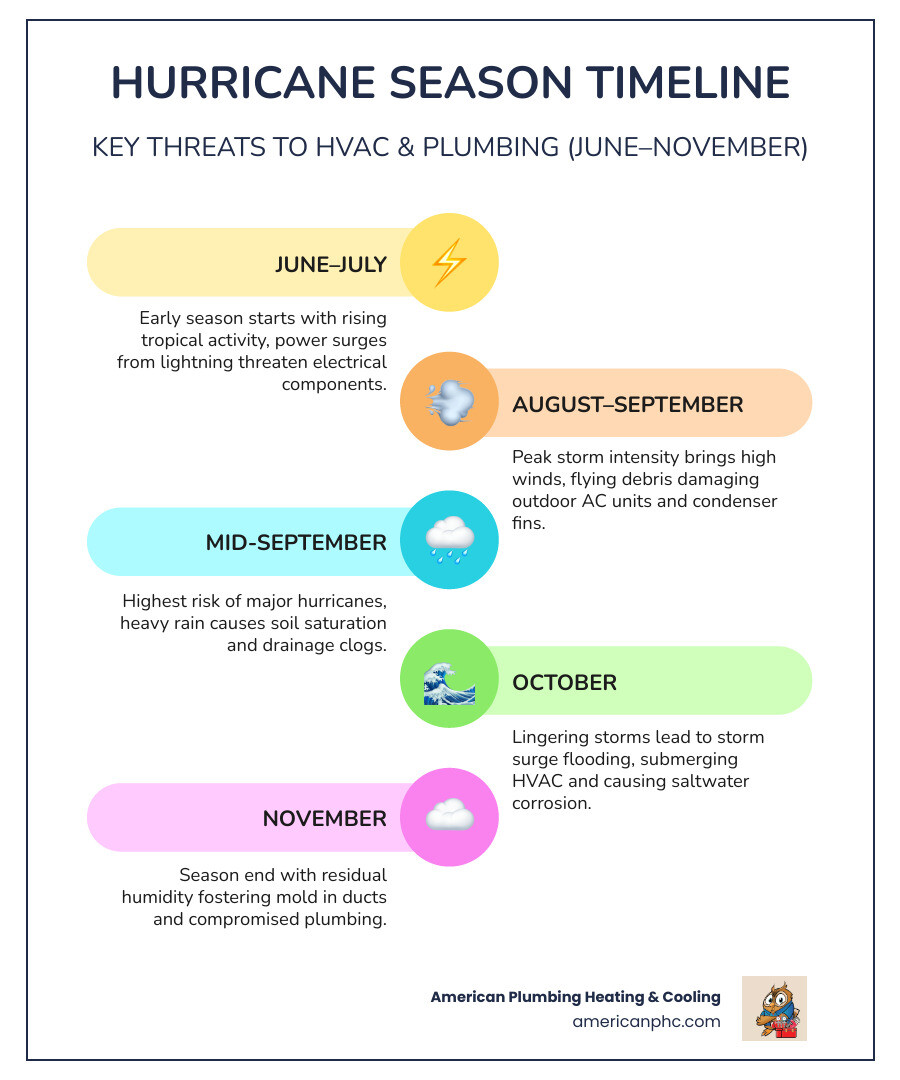
Florida's hurricane season officially runs from June 1 through November 30, with the most intense activity hitting between mid-August and late October. On average, Florida experiences at least one major hurricane every three years — and if you live in Southwest Florida, that's not a distant statistic. It's a seasonal reality.
Most homeowners think about boarding up windows or stocking emergency kits before a storm. Far fewer think about what happens to the systems running behind their walls and outside their homes — until something goes wrong. A flooded AC unit or a sewage backup after a storm can leave your family without cooling or clean water right when you need both most. The average cost to replace a hurricane-damaged AC unit alone ranges from $3,500 to $7,500, and that's before you factor in any plumbing repairs.
The good news is that most of this damage is preventable with the right preparation — and knowing what to watch for after the storm passes.
How Hurricane Season Affects Your HVAC and Plumbing
Living in April 2026, we’ve seen our fair share of tropical activity across Florida. Whether you are in Sarasota, Cape Coral, or up in Milton, the impact of a major storm is felt long after the clouds clear. How hurricane season affects your HVAC and plumbing is often a story of environmental stress meeting mechanical vulnerability.
When a hurricane makes landfall, your outdoor AC condenser is the first line of defense—and the most likely victim. High winds (Category 5 storms reach at least 157 MPH) can turn a simple lawn chair into a projectile that crushes the delicate aluminum fins of your unit. Simultaneously, storm surges and heavy rainfall lead to soil saturation. In sandy Florida soil, this saturation can cause underground pipes to shift or crack. If flooding occurs, contaminated water can infiltrate your plumbing system or submerge your AC's electrical components, often requiring a total system replacement.
To keep your home resilient, we recommend exploring Our Comprehensive HVAC and Plumbing Services to ensure your systems are up to code. You can also Find HVAC and Plumbing Services Near You to get a local expert's eyes on your property before the next "big one" arrives.
How hurricane season affects your HVAC and plumbing electrical components
The most common cause of HVAC failure during a Florida storm isn't actually wind—it’s electricity. Power surges occur when lightning strikes or when the grid fluctuates as lines go down. These surges can "fry" sensitive circuit boards and capacitors instantly. Even if the power stays on, rapid on-off cycling during a storm puts immense strain on the compressor.
We strongly advise installing whole-home surge protectors. These devices act as a gateway, blocking excess voltage before it reaches your expensive appliances. If you’ve already experienced a storm and your unit won't kick back on, you may need AC Repair Services in Cape Coral, FL to diagnose blown fuses or damaged control boards.
How hurricane season affects your HVAC and plumbing drainage systems
Rainfall during a hurricane is measured in feet, not inches. If your gutters are clogged or your exterior drains are blocked by debris, that water has nowhere to go but toward your foundation. This can lead to "back-feeding" into your home’s drain lines. Furthermore, saturated soil puts external pressure on your sewer lines, which can lead to collapses or clogs from root intrusion accelerated by the wet ground. For residents in the Panhandle, keeping these lines clear is vital; our General Plumbing Services in Milton, FL can help ensure your drainage is ready for the deluge.
HVAC Vulnerabilities: Wind, Water, and Saltwater Corrosion
For those of us in coastal areas like Siesta Key or Venice, the threat doesn't disappear when the rain stops. Saltwater exposure is a "hidden threat." Salt particles carried by high winds accumulate on your AC coils, forming an insulating layer that reduces heat exchange efficiency and accelerates rust.
Saltwater is highly conductive and corrosive. It can cause electrical shorts in the outdoor unit and eat through the copper refrigerant lines. Regular maintenance is the only way to combat this. Scheduling an AC Maintenance and Tune-Up in Lakewood Ranch, FL helps by ensuring your coils are professionally cleaned of salt deposits. It’s also important for Understanding the Hidden Impact of Humidity, as salt-damaged units struggle to dehumidify your home effectively.
Protecting the outdoor condenser from debris
You wouldn't leave your car door open in a storm, so don't leave your AC unprotected. Florida Building Code now has strict wind-load requirements for anchoring outdoor units. We use hurricane straps and heavy-duty bolts to secure units to concrete pads, preventing them from tipping or being lifted by 100+ MPH winds.
For additional protection, some homeowners use protective cages or plywood covers (3/4-inch exterior-grade is best). Just remember: never run the AC while it is covered. For more DIY tips, check out our Essential Home Maintenance and Troubleshooting Tips.
Managing indoor air quality during high humidity
When the power goes out, the humidity goes up. In Florida, it only takes 24 to 48 hours for mold to begin growing in damp ductwork. We suggest "pre-cooling" your home by dropping the thermostat a few degrees before the storm hits. This creates a "thermal bank" that keeps the house cooler longer if the power fails.
Post-storm, you may need Indoor Air Quality Services in Sarasota, FL to check for mold spores. In high-humidity areas, we often recommend Humidifier and Dehumidifier Installation in Navarre, FL to maintain a dry environment even when the AC isn't running at full capacity.
Plumbing Risks: Sewage Backups and Ground Saturation
Hurricanes can overwhelm municipal sewer systems. When the city’s pipes fill with rainwater, the pressure can push sewage backward into residential lines. This results in the dreaded "backflow" into your tubs and toilets.
Heavy rain also causes the water table to rise, putting your foundation and basement (if you have one) at risk. Shifting soil can cause pipes to snap or joints to separate. If you suspect a break after a storm, our team provides expert Sewer Line Repair in Bradenton, FL. You should also review our Guide to Preventing Burst Pipes to understand how pressure changes impact your plumbing.
The role of sump pumps and backflow preventers
A sump pump is your last line of defense against rising groundwater. However, a sump pump without a battery backup is useless during a hurricane power outage. We recommend installing high-capacity pumps with dedicated backup power.
Additionally, backflow preventers (check valves) are essential. These one-way valves allow waste to exit your home but prevent city sewage from entering. If you don't have one, consider a Sump Pump Installation in Cape Coral, FL to manage water levels effectively.
Water heater safety and flood prevention
Your water heater is a heavy tank that can become a hazard if it tips over. Ensure your tank is properly anchored to the wall studs. If you have a gas heater, the pilot light can be extinguished by floodwaters, or worse, the gas line could rupture. If your unit is submerged, do not attempt to relight it. You’ll likely need Water Heater Repair in Venice, FL to ensure the electrical components or gas valves are safe to operate.
Essential Pre-Storm Preparation Checklist
Preparation is the difference between a minor inconvenience and a five-figure repair bill. Use this list to get ready:
- Turn off the power: Shut off your HVAC at the thermostat and the breaker box to prevent surge damage.
- Clear the perimeter: Remove patio furniture, potted plants, and loose debris within 10 feet of your AC unit.
- Cover the unit: Use a manufacturer-approved cover or secure a tarp to keep out flying debris (only when the unit is OFF).
- Shut off the water main: If you are evacuating or expect major flooding, turn off your main water valve to prevent contaminated water from entering your home's pipes.
- Check the sump pump: Test it and ensure the battery backup is fully charged.
- Clear the drains: Ensure gutters and yard drains are free of leaves.
HVAC vs. Plumbing: Storm Risk Comparison
| Threat | HVAC Impact | Plumbing Impact |
|---|---|---|
| High Winds | Unit displacement, crushed fins | Dislodged vent pipes, roof leaks |
| Flooding | Electrical failure, motor damage | Sewage backup, contaminated water |
| Power Surge | Fried circuit boards, compressor failure | Sump pump failure, water heater short |
| Debris | Punctured coils, fan blockage | Blocked exterior drains, pipe impact |
To stay ahead of these risks, we recommend our HVAC and Plumbing Maintenance Plans for year-round peace of mind.
Post-Storm Recovery and Insurance Documentation
Once the storm passes, do not rush to turn everything back on. Start with a visual inspection. Look for standing water around your AC, shifted pipes, or "hissing" sounds that might indicate a refrigerant or gas leak.
Check your water meter. If the dial is spinning while all faucets are off, you have a leak. We provide specialized Leak Detection Services in Lakewood Ranch, FL to find hidden pipe damage caused by soil movement. For more help identifying issues, read our guide on Common Plumbing Problems: Identification and Troubleshooting.
Pro Tip: Document everything. Take photos of your units before the season starts and after the storm. This is critical for insurance claims to prove the damage was storm-related and not due to neglect.
Why professional inspections are critical
Even if your AC turns on, it might be running with "hidden" damage. Water may have entered the motor bearings, or salt may be eating the coils from the inside. A professional inspection ensures:
- Electrical Safety: We check for frayed wires or water-damaged connections.
- Refrigerant Integrity: We ensure wind didn't stress the lines and cause a slow leak.
- System Recalibration: We make sure the unit is still level (unlevel units cause compressor failure).
Don't risk a fire or a total system breakdown; Find HVAC and Plumbing Services Near You to schedule a post-storm check-up.
Frequently Asked Questions about Hurricane Damage
Should I turn off my AC before a hurricane hits?
Yes, absolutely. You should turn it off at both the thermostat and the circuit breaker. This protects the system from the "dirty power" and surges that occur as the grid struggles during the storm. Wait at least 24 hours after power is fully restored before turning it back on to allow the compressor oil to settle and to ensure the grid is stable.
How does saltwater affect my AC unit if I live near the coast?
Saltwater is highly corrosive and conductive. It eats away at the aluminum fins on your condenser, reducing the unit's ability to cool your home. It can also cause "pitting" in copper coils, leading to refrigerant leaks. If your unit was exposed to salt spray, rinse it gently with fresh water (with the power OFF) once the storm passes.
What should I do if my plumbing backs up during a storm?
If you experience a backup, stop using all water immediately—do not flush toilets or run sinks. If you have a main shut-off valve, close it. This is often a sign that the municipal system is overwhelmed. You will need a professional to check for clogs or to see if a backflow preventer needs to be installed or serviced.
Conclusion
At American Plumbing Heating and Cooling, we’ve spent over 100 years (combined!) helping Florida families navigate the challenges of our unique climate. Understanding how hurricane season affects your HVAC and plumbing is the first step toward a resilient home. From Sarasota to Pensacola, our certified pros are ready to help you prepare with honest, upfront pricing and 24/7 emergency response.
Whether you need a pre-season tune-up or urgent repairs after a storm, we are here to provide the quality workmanship you deserve. Don't wait for the next Hurricane Warning—protect your investment today by exploring Our Comprehensive HVAC and Plumbing Services. Stay safe, stay cool, and let us handle the rest.
{"@context": "https://schema.org", "@graph": [{"@type": "Article", "headline": "How Hurricane Season Affects Your HVAC and Plumbing", "description": "Learn how hurricane season affects your HVAC and plumbing, from flooding to power surges. Protect your home with expert tips today.", "author": {"@type": "Person", "name": "American Plumbing Heating and Cooling"}, "publisher": {"@type": "Organization", "name": "American Plumbing Heating and Cooling", "logo": {"@type": "ImageObject", "url": "https://firebasestorage.googleapis.com/v0/b/ai-templates.appspot.com/o/bot%2FiTB8FxoyvSplQzS7StV8%2Flogo%2FScreenshot%202026-03-16%20at%2012.43.20%E2%80%AFPM.png?alt=media&token=4ae5e171-7bb5-4a27-91f4-47e969b91c80"}}, "datePublished": "2026-05-14T02:46:46+00:00", "dateModified": "2026-05-14T02:46:50.648926", "mainEntityOfPage": {"@type": "WebPage", "@id": "https://pms.ciwebgroup.com/americanphc/2026/05/14/how-hurricane-season-affects-your-hvac-and-plumbing-systems/"}, "image": "https://images.bannerbear.com/direct/4mGpW3zwpg0ZK0AxQw/requests/000/141/996/913/0Mn5r3E1XY0Zlp2P6WPoD9kg7/e26b5bb2f1204a87e857ae560b86e827e4bf5405.jpg"}, {"@type": "FAQPage", "mainEntity": [{"@type": "Question", "name": "How does hurricane season affect HVAC and plumbing systems?", "acceptedAnswer": {"@type": "Answer", "text": "Hurricane season can damage HVAC and plumbing through six main threats: high winds and debris, power surges and outages, storm surge and flooding, heavy rainfall and soil saturation, saltwater exposure, and contaminated floodwater. These hazards can damage AC units, shift pipes, cause sewage backups, corrode components, and compromise water quality."}}, {"@type": "Question", "name": "What parts of an HVAC system are most vulnerable during a hurricane?", "acceptedAnswer": {"@type": "Answer", "text": "The outdoor AC condenser is especially vulnerable because high winds and flying debris can crush its delicate aluminum fins or physically displace the unit. Power surges, outages, flooding, and saltwater exposure can also damage circuit boards, capacitors, control systems, coils, and other electrical parts."}}, {"@type": "Question", "name": "Can hurricanes cause plumbing problems after the storm?", "acceptedAnswer": {"@type": "Answer", "text": "Yes, heavy rainfall and saturated soil can shift pipes, cause sewage backups, and overwhelm drains. Contaminated floodwater can also infiltrate a home's plumbing system and affect water quality."}}, {"@type": "Question", "name": "When is hurricane season in Florida, and when is it most active?", "acceptedAnswer": {"@type": "Answer", "text": "Florida's hurricane season officially runs from June 1 through November 30. The most intense activity usually occurs between mid-August and late October."}}, {"@type": "Question", "name": "How much can hurricane damage to an AC unit cost?", "acceptedAnswer": {"@type": "Answer", "text": "The average cost to replace a hurricane-damaged AC unit ranges from $3,500 to $7,500. That estimate does not include any additional plumbing repairs that may also be needed after a storm."}}]}]}Need HVAC Help?
Our certified technicians are ready to help with all your heating and cooling needs.
Request ServiceAbout the Author
American Plumbing Heating and Cooling Team
Licensed Florida contractors — HVAC CAC1821761 · Plumbing CFC1431919
More Articles
View All PostsRelated Articles


Ready to Get Started?
Whether you need a repair, maintenance, or a new system installation, our expert team is here to help.