
Making Cents of the Switch: When Oil to Gas Conversion Pays Off
By the American Plumbing Heating and Cooling Team
Licensed Florida contractors — HVAC CAC1821761 · Plumbing CFC1431919

Discover if converting from oil to gas heat worth it: save money, boost efficiency and resale value with expert ROI analysis for FL homes.
Reviewed bythe American Plumbing Heating and Cooling Team — Licensed Florida contractors — HVAC CAC1821761 · Plumbing CFC1431919. Published May 13, 2026. About American Plumbing Heating and Cooling
Dealing with this problem right now? Call (941) 735-6616 and talk to our local team.
Request ServiceIs Converting from Oil to Gas Heat Worth It for Florida Homeowners?
Is converting from oil to gas heat worth it? For most homeowners who have access to a natural gas line and plan to stay in their home for several years, the answer is yes. Here's a quick look at why:
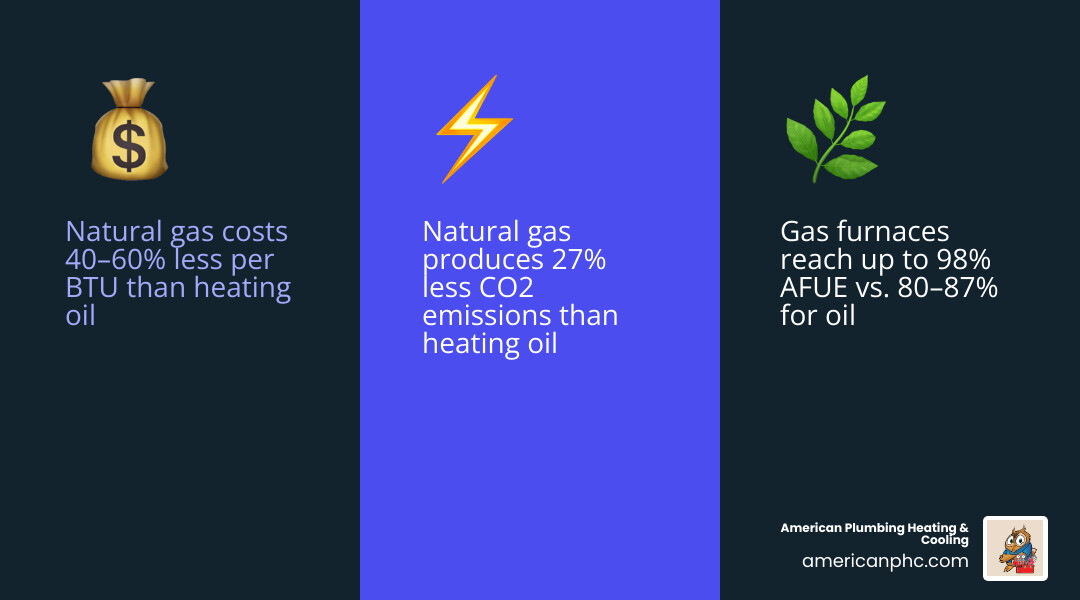
- Lower fuel costs: Natural gas typically costs 40–60% less per BTU than heating oil
- Higher efficiency: Gas systems can reach up to 98% AFUE, compared to 80–87% for oil systems
- Significant annual savings: A typical home can save over $1,000 per year on heating bills after switching
- Reasonable payback period: Most homeowners recoup their investment within 5 to 8 years through fuel savings alone
- Added convenience: No more oil deliveries, no on-site storage tank, and less routine maintenance
- Environmental benefit: Natural gas produces roughly 27% less CO2 than heating oil
That said, conversion isn't the right move for everyone. If you're planning to move soon, if your oil equipment was recently replaced, or if natural gas isn't available on your street, the math may not work in your favor — at least not yet.
If you're heating a home in Florida, where winters are mild but comfort still matters, understanding whether this switch makes financial sense requires looking at your specific situation — including your current system's age, your local gas infrastructure, and how long you plan to stay.
Evaluating the Efficiency: Is converting from oil to gas heat worth it?
When we talk about heating efficiency, we use a term called AFUE, or Annual Fuel Utilization Efficiency. Think of it like your car’s MPG, but for your house. Modern gas systems are the high-performance hybrids of the heating world. While older oil systems often hover between 80% and 87% efficiency—meaning 13 to 20 cents of every dollar you spend literally goes up the chimney—high-efficiency gas furnaces can reach up to 98% AFUE.
This jump in efficiency is largely due to the way gas burns and how modern heat exchangers work. Gas systems are designed to extract almost every bit of thermal energy from the fuel. In a condensing gas furnace, a secondary heat exchanger captures heat from exhaust gases that would otherwise be wasted. Oil, by comparison, is a heavier, more viscous fuel. It burns hot, but it also produces more soot and residue, which can coat the heat exchanger and reduce efficiency over time if not meticulously maintained.
For families in areas like Milton or Cape Coral, Heating Services that focus on high-efficiency transitions can significantly reduce energy waste. When you use less fuel to get the same amount of warmth, you aren't just saving money; you're putting less strain on your equipment, leading to a more reliable home environment.
Determining the ROI: Is converting from oil to gas heat worth it for long-term homeowners?
If you plan on calling your current house "home" for the next decade, the Return on Investment (ROI) for a gas conversion is incredibly compelling. The average payback period—the time it takes for your monthly savings to "pay back" the initial installation—typically falls between 5 and 8 years.
In a state like Florida, where we might not run the heater as often as folks in the Northeast, the ROI also comes from property value and equipment longevity. Gas furnaces often have a simpler mechanical design with fewer moving parts than oil burners, which can lead to a longer, less troublesome lifespan. Furthermore, natural gas prices have historically shown more stability than heating oil, which is a refined petroleum product subject to the whims of global oil markets and geopolitical shifts.
For those looking into Oil to Gas Conversion Sarasota FL, the financial math often points toward a "yes." Beyond the monthly bills, you’re also eliminating the risk of oil tank leaks, which can be a massive financial liability during a home sale.
The Financial and Practical Benefits of Switching to Gas

Beyond the raw data of BTUs and AFUE ratings, there are practical "lifestyle" upgrades that come with switching to gas. One of the biggest perks? You can finally say goodbye to the "oil watch." We’ve all been there—peering into a dark tank with a flashlight or waiting for the delivery truck to arrive before a cold snap. With natural gas, the fuel is piped directly to your home. It’s always there, and you only pay for what you use after you use it.
There is also the "multi-appliance" factor. Once you have a gas line run to your home for heating, you open the door to a world of other upgrades. You can switch to a gas range for gourmet cooking, install a high-recovery gas water heater, or even hook up a permanent line for your backyard grill.
From a resale perspective, gas is a major selling point. In competitive markets like Lakewood Ranch, buyers actively look for homes with modern infrastructure. High-efficiency gas heating is often viewed as a premium feature that makes a home more "turn-key" and affordable to operate. Learn more about how this impacts your local area at Oil to Gas Conversion Lakewood Ranch FL.
Assessing Infrastructure: Is converting from oil to gas heat worth it if I need a new gas line?
One of the most common hurdles homeowners face is the lack of an existing gas line. If the main line is already on your street, the utility company can often run a service line to your house relatively easily. However, if the nearest gas main is miles away, the cost of extending that infrastructure can be prohibitive.
In these cases, we often look at propane as a viable alternative. Propane offers many of the same benefits as natural gas—it’s clean-burning, highly efficient (up to 98% AFUE), and versatile for other appliances. The main difference is that propane is stored in an on-site tank, similar to oil, but without the mess and environmental risks associated with liquid petroleum.
For residents in Venice, checking for street access is the first step. If the infrastructure is there, the transition is usually a "no-brainer." If not, we can help you evaluate propane solutions through our Oil to Gas Conversion Venice FL services.
Understanding the Conversion Process and Infrastructure
Switching systems isn't just about swapping one box for another. It’s a comprehensive process that ensures your home is safe and optimized for a different fuel source.
| Feature | Oil Heating Systems | Natural Gas Systems |
|---|---|---|
| Fuel Storage | On-site tank (often 275 gallons) | Underground utility pipeline |
| Delivery | Scheduled truck deliveries | Continuous supply |
| Efficiency (AFUE) | Typically 80% – 87% | Up to 98% |
| Maintenance | Annual cleaning/soot removal | Periodic safety inspections |
| Carbon Footprint | Higher CO2 and particulates | ~27% less CO2, cleaner burn |
The process generally involves:
- Utility Coordination: Verifying gas availability and installing the meter.
- Equipment Removal: Safely decommissioning and removing the old oil furnace and tank.
- Venting Updates: Gas systems often require different venting. High-efficiency units use PVC pipes vented through a side wall, while others may require a stainless steel chimney liner to protect against acidic condensation.
- Ductwork/Piping: Connecting the new unit to your existing heat distribution system.
- Permits and Inspections: Ensuring everything meets local Florida building codes.
For those in the panhandle, our team handles these logistics seamlessly, including Oil to Gas Conversion Milton FL.
Comparing Environmental Impact and Long-Term Maintenance
If you’re looking to reduce your household's carbon footprint, gas is the clear winner over oil. Natural gas is the cleanest-burning fossil fuel. Switching results in a 27% reduction in CO2 emissions and almost completely eliminates the production of soot and sulfur dioxide.
This cleanliness also translates to lower maintenance. Oil systems require annual "clean and tunes" because the combustion process is inherently dirtier. Soot builds up on the heat exchanger and can clog filters and nozzles. While gas systems still need professional eyes to check safety controls and burners, they don't suffer from the same heavy buildup. This means fewer mid-winter breakdowns and a system that stays closer to its peak efficiency rating for a longer period.
Residents looking for a cleaner, lower-maintenance future can explore Oil to Gas Conversion Bradenton FL to see how local environmental factors and fuel availability play into the decision.
Safety and Performance for Florida Families
Safety is always the top priority for us. While both oil and gas are safe when properly installed, they have different characteristics. Oil is non-explosive in its liquid state, but a leak can lead to expensive soil contamination. Gas is delivered under pressure, which is why professional installation and the use of carbon monoxide (CO) detectors are non-negotiable.
In terms of performance, gas furnaces are known for their "fast heat." They reach maximum temperature almost instantly once the burner ignites, providing a quick response when those rare Florida cold fronts move through. This reliability and speed improve indoor air quality as well, as there are no oily odors or "puff-backs" of soot that can occasionally occur with older oil equipment.
In Cape Coral, we emphasize these safety features during every installation. You can find more details on our Oil to Gas Conversion Cape Coral FL page.
Frequently Asked Questions about Oil to Gas Conversion
How long does the conversion process take?
The physical equipment swap usually takes 1 to 2 days. However, the entire "project" timeline—from the moment you call the gas company to the final inspection—can take 4 to 8 weeks. This includes time for permit approvals, utility line installation, and scheduling the decommissioning of your old oil tank. We work to make this as unobtrusive as possible for our customers in Oil to Gas Conversion Navarre FL.
Does gas heat increase my home's resale value?
Absolutely. Most modern homebuyers view oil heat as an antiquated "chore." By converting, you remove the "red flag" of an underground or basement oil tank and replace it with a modern, energy-efficient amenity. It’s an investment that often pays for itself not just in fuel savings, but in a higher asking price when you decide to sell.
What if natural gas isn't available on my street?
If the utility lines don't reach your home, propane is your best friend. Propane furnaces offer the same high AFUE ratings as natural gas models. While you still need an on-site tank, propane is much cleaner than oil, and the tanks can often be buried underground to keep your landscaping looking beautiful.
Conclusion
At the end of the day, deciding if is converting from oil to gas heat worth it comes down to your goals for your home. If you want lower bills, a smaller environmental footprint, and the convenience of a "set it and forget it" system, the switch is a fantastic move.
At American Plumbing Heating and Cooling, we’ve spent years helping Florida families navigate these big home improvements. With over 100 years of combined experience and a team of certified pros, we provide honest upfront pricing and the peace of mind that comes with a job done right. Whether you’re in Sarasota, Milton, or anywhere in between, we’re here to help you make sense of your heating options.
Ready to upgrade your home comfort? Contact our experts for professional home services today and let’s see if a gas conversion is the right fit for your family.
Need HVAC Help?
Our certified technicians are ready to help with all your heating and cooling needs.
Request ServiceAbout the Author
American Plumbing Heating and Cooling Team
Licensed Florida contractors — HVAC CAC1821761 · Plumbing CFC1431919
More Articles
View All PostsRelated Articles


Ready to Get Started?
Whether you need a repair, maintenance, or a new system installation, our expert team is here to help.