
How to Keep Your Florida Home Mold-Free and Cool
By the American Plumbing Heating and Cooling Team
Licensed Florida contractors — HVAC CAC1821761 · Plumbing CFC1431919

Discover the best smart thermostat schedule for tropical coastal Florida weather. Optimize cooling, control humidity, prevent mold, and save energy now!
Reviewed bythe American Plumbing Heating and Cooling Team — Licensed Florida contractors — HVAC CAC1821761 · Plumbing CFC1431919. Published April 28, 2026 · Last updated July 29, 2026. About American Plumbing Heating and Cooling
Dealing with this problem right now? Call (941) 735-6616 and talk to our local team.
Request ServiceWhy the Best Smart Thermostat Schedule for Tropical Coastal Florida Weather Is Different From Everywhere Else
The best smart thermostat schedule for tropical coastal Florida weather isn’t something you can borrow from a generic app template or a blog written for a drier inland city. Florida’s coastal climate is its own beast — high heat, relentless humidity, salt air, and an AC season that runs nearly year-round from April through November.
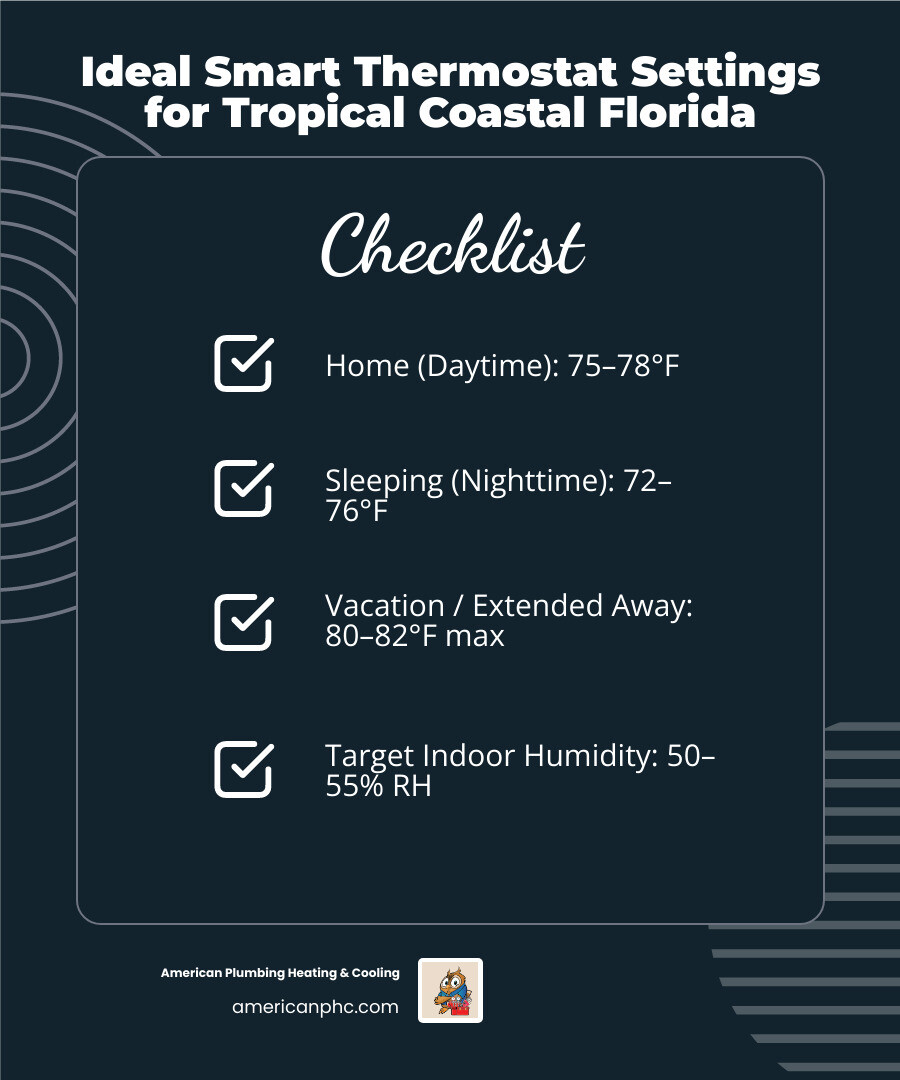
Here’s a quick-reference guide to the recommended smart thermostat settings for tropical coastal Florida:
| Time / Situation | Recommended Setting |
|---|---|
| Home (daytime) | 75–78°F |
| Sleeping (nighttime) | 72–76°F |
| Away (short trips) | 78–82°F |
| Vacation / Extended away | 80–82°F max |
| Pets home alone | 78°F max |
| Target indoor humidity | 50–55% RH |
Setting the wrong temperature — or worse, turning the AC off completely — in a humid coastal Florida home doesn’t just mean discomfort. It means mold, warped wood floors, damaged electronics, and musty smells that take weeks to fix. In South Florida, cooling alone accounts for 40–60% of the average electric bill, so getting your schedule right matters for your wallet just as much as your walls.
The good news: a properly programmed smart thermostat handles most of this automatically, and the savings are real. Done right, optimal scheduling can cut your annual cooling costs by 10–15%.
This guide from American Plumbing Heating and Cooling walks you through exactly how to build a schedule that keeps your home cool, dry, and protected — whether you’re home, at work, or halfway through a vacation.
Mastering the Best Smart Thermostat Schedule for Tropical Coastal Florida Weather
In the Sunshine State, we don’t just fight the heat; we fight the moisture. Living in places like Sarasota, Cape Coral, or Bradenton means your HVAC system is your primary defense against the swampy air that rolls in off the Gulf. The best smart thermostat schedule for tropical coastal Florida weather must prioritize consistent run times to pull moisture out of the air.
If your AC cycles on and off too quickly (short-cycling), it might reach the target temperature, but it won’t stay on long enough to dehumidify. This leaves you with a “cold and clammy” home. By following a structured schedule, you ensure the system operates efficiently while maintaining a healthy indoor environment. For more on keeping your system in peak shape, check out Everything You Need to Know About AC Maintenance in Sarasota.
Optimizing Your Daily Routine for Efficiency
During the day, most of us find that a setting between 75°F and 78°F is the “sweet spot.” While 78°F might sound warm to someone from the North, in Florida, it is the industry-standard recommendation for balancing comfort and cost.
To make 78°F feel like 74°F, we highly recommend integrating ceiling fans. A fan doesn’t actually lower the room temperature, but the “wind chill” effect on your skin allows you to feel perfectly comfortable at a higher thermostat setting. This small adjustment can save you 3–5% on cooling costs for every degree you raise the setpoint.
If you find that your home isn’t reaching these temperatures or feels unusually humid even at 75°F, it might be time for a professional look. You can Keep Your Cool with Professional AC Maintenance in Bradenton, FL to ensure your unit is actually capable of meeting your programmed schedule.
Why the Best Smart Thermostat Schedule for Tropical Coastal Florida Weather Includes Nighttime Adjustments
When the sun goes down in coastal Florida, the temperature drops, but the humidity often spikes. Our bodies also naturally prefer cooler temperatures for deep sleep. We recommend a nighttime range of 72°F to 76°F.
Lowering the temperature slightly at night helps the AC run in longer, steadier cycles during the hours when outdoor humidity is at its highest. This prevents that “sticky” feeling when you wake up. However, avoid dropping the temperature below 70°F. Not only does this skyrocket your electric bill, but it can also cause condensation to form on your vents, which is a leading cause of mold growth in the ceiling.
Consistent maintenance is key to making sure these nighttime transitions happen smoothly. Learn more in our Don’t Sweat It: A Local Guide to HVAC System Maintenance.
Programming for Humidity Control and Mold Prevention
In Florida, the thermostat is more than a temperature dial; it is a humidity controller. Ideally, you want to keep your indoor relative humidity (RH) between 50% and 55%. Once you cross the 60% threshold, you are inviting mold spores to settle into your carpets, drywall, and furniture.
Mold can begin to grow in as little as 24 to 48 hours in high-humidity conditions. This is why we focus so heavily on the best smart thermostat schedule for tropical coastal Florida weather. If your schedule allows the house to get too warm for too long, the humidity will inevitably rise. For a deeper dive into managing your home’s air, see A Sarasota Homeowner’s Guide to Improving Indoor Air Quality: Beat Humidity.
Using Smart Features to Manage Moisture
Modern smart thermostats like the Ecobee Premium or Nest Learning Thermostat have built-in humidity sensors. Here is how to use them effectively:
- Humidity Overcool: Some thermostats allow you to set a “Max Humidity” target. If the humidity exceeds 55%, the AC will continue to run even if the temperature goal has been met (usually up to 2–3 degrees lower) to dry out the air.
- AUTO Fan Setting: Never set your thermostat fan to “ON” in Florida. Always use “AUTO.” If the fan runs constantly, it will blow the moisture that just condensed on your AC coils right back into your home before it has a chance to drain away.
- Dehumidification Cycles: Some high-end systems can slow down the blower fan to pull even more moisture out of the air.
Understanding these technical nuances is vital for coastal living. Read more about Understanding Hidden Impact: Humidity to see how moisture affects your comfort.
Vacation Mode: Protecting Your Coastal Home While Away
One of the biggest mistakes we see in Southwest Florida is homeowners turning their AC off entirely when they head out for vacation. In April 2026, with temperatures already climbing, an uncooled home in Cape Coral or Venice can hit 90°F with 80% humidity in a matter of days. This is a recipe for a “mold bomb.”
When you are away, your thermostat should be set between 78°F and 82°F. This range is high enough to save significant energy but low enough to ensure the AC cycles frequently enough to keep humidity under control.
Pre-Vacation AC Checklist:
- Change your air filter (a clogged filter can lead to a frozen coil while you’re gone).
- Flush your condensate drain line with vinegar to prevent clogs and floods.
- Close the blinds and curtains to block “solar gain.”
- Set your smart thermostat to “Vacation Mode” so it knows when to resume your normal schedule before you return.
If your system is old and struggling, a vacation might be the time it finally gives up. Consider your options with Everything You Need for a New Air Conditioner Replacement in Bradenton before your next big trip.
The Dangers of Turning Off Your AC in Florida
Turning off the AC doesn’t just risk mold. The extreme heat can warp wood flooring, peel wallpaper, and even fry sensitive electronics like your Wi-Fi router or smart home hub. In coastal areas like Siesta Key or Fort Myers, the salt air is also highly corrosive. Without the AC filtering and circulating the air, salt particles can settle on indoor metal surfaces, accelerating rust.
Professional oversight can prevent these disasters. Our team explains the importance of professional eyes in The Cape Coral Homeowner’s Guide to Professional AC Maintenance Services.
Adjusting the Best Smart Thermostat Schedule for Tropical Coastal Florida Weather for Long-Term Absence
If you are a “Snowbird” leaving for months at a time, or even just a week-long traveler with pets at home, your settings need to be more conservative.
For Pets: Never set the thermostat above 80°F if dogs or cats are in the home. Brachycephalic breeds (like Bulldogs or Pugs) are especially prone to heatstroke and may need even cooler settings.
For Remote Monitoring: Use your smart thermostat’s app to check in on your home daily. If you notice the temperature is rising and the AC isn’t running, you can call for help before the heat causes permanent damage. Keeping your system ready for these demands is covered in Why Your Milton Home Needs Regular AC Maintenance to Survive the Heat.
Coastal Maintenance and Smart Technology Integration
Coastal homes face a unique challenge: salt air corrosion. Salt is “enemy number one” for HVAC systems. It eats away at the aluminum fins and copper coils on your outdoor unit, reducing the system’s ability to transfer heat. This makes your AC work harder and longer to reach the same temperature, which is why the best smart thermostat schedule for tropical coastal Florida weather can only do so much if the hardware is failing.
| Feature | Standard Inland System | Coastal-Protected System |
|---|---|---|
| Expected Lifespan | 12–15 Years | 5–7 Years (unprotected) |
| Corrosion Resistance | Standard Paint | Epoxy or Phenolic Coatings |
| Maintenance Need | Annual | Bi-Annual + Monthly Rinse |
| Smart Alerts | Temperature only | Performance and Efficiency tracking |
By using a smart thermostat that provides energy reports, you can actually see when your system starts running longer to achieve the same cooling—a classic sign of salt-clogged or corroded coils. Regular professional cleaning is non-negotiable here. Check out Keep Your Cool with Professional AC Maintenance in Bradenton, FL for more details.
Enhancing Performance with Smart Sensors
One of the best ways to optimize your Florida home is through multi-room sensing. In many Florida homes, the thermostat is in a hallway, while the master bedroom or the sun-drenched living room is much hotter. Smart sensors tell your AC to keep running until the occupied rooms are comfortable, not just the hallway.
Another great feature is Geofencing. This uses your phone’s GPS to detect when you are leaving the neighborhood. It automatically raises the temperature to your “Away” setting (e.g., 81°F) and begins cooling the house back down to 76°F the moment you start your commute home. This is especially helpful for residents in Navarre or Milton who may have long commutes. For those hot days, see our Navarre AC Repair Guide for Hot Florida Days.
Frequently Asked Questions about Florida Thermostat Settings
What is the best thermostat setting for pets in Florida?
While you might be comfortable at 78°F, pets with thick fur or health issues may struggle. Experts recommend never setting the thermostat above 80°F when pets are home alone. Ensure they have plenty of fresh water and that ceiling fans are running to help circulate air.
How much can I save with a smart thermostat in Florida?
On average, Florida residents see a 10–15% reduction in cooling costs with a properly programmed smart thermostat. In South Florida, where electric bills can be several hundred dollars a month during the summer, this often results in savings of $150 to $300 per year. The device usually pays for itself within the first 12 to 24 months.
Should I use the “Hold” or “Schedule” setting on my thermostat?
Always use the “Schedule” or “Smart” settings. The “Hold” setting is a manual override that stays at one temperature indefinitely. This defeats the purpose of energy saving. A schedule allows the home to warm up while you are at work and cool down before you arrive, providing the perfect balance of comfort and thrift.
Conclusion
Finding the best smart thermostat schedule for tropical coastal Florida weather is about more than just saving a few dollars; it’s about protecting your biggest investment from the harsh elements of the Gulf Coast. By balancing temperature setpoints with strict humidity control, you can enjoy a home that is consistently cool, dry, and mold-free.
At American Plumbing Heating and Cooling, we’ve spent over 100 years (combined!) helping Florida homeowners master their indoor climate. Whether you need a new smart thermostat installed, a coastal-grade AC replacement, or a 24/7 emergency repair in Sarasota or Cape Coral, our certified pros are here to help with honest, upfront pricing.
Don’t let the Florida humidity win. Take control of your home’s comfort today.
Ready to optimize your home? Explore our American PHC Services and let us help you stay cool.
Need HVAC Help?
Our certified technicians are ready to help with all your heating and cooling needs.
Request ServiceAbout the Author
American Plumbing Heating and Cooling Team
Licensed Florida contractors — HVAC CAC1821761 · Plumbing CFC1431919
More Articles
View All PostsRelated Articles


Ready to Get Started?
Whether you need a repair, maintenance, or a new system installation, our expert team is here to help.