
How to Set Your Thermostat Without Starting a Family Feud
By the American Plumbing Heating and Cooling Team
Licensed Florida contractors — HVAC CAC1821761 · Plumbing CFC1431919

Discover what temperature should i set my thermostat for year-round comfort, energy savings and Florida HVAC tips. Balance family feuds and bills now!
Reviewed bythe American Plumbing Heating and Cooling Team — Licensed Florida contractors — HVAC CAC1821761 · Plumbing CFC1431919. Published April 30, 2026 · Last updated July 29, 2026. About American Plumbing Heating and Cooling
Dealing with this problem right now? Call (941) 735-6616 and talk to our local team.
Request ServiceThe Question That Starts More Family Arguments Than Almost Anything Else
What temperature should I set my thermostat is one of those questions that sounds simple — until everyone in your household has a different answer.
Here's a quick reference to settle the debate:
| Situation | Recommended Temperature |
|---|---|
| Summer — at home | 78°F |
| Winter — at home | 68°F |
| Summer — away from home | 85–88°F |
| Winter — away from home | 62–65°F |
| Sleeping | 60–67°F |
| Summer vacation (empty home) | No higher than 85°F |
| Winter vacation (empty home) | No lower than 50°F |
These numbers come straight from the U.S. Department of Energy and Energy Star — and they're designed to balance real comfort with real savings.
The stakes are higher than just comfort, too. The right thermostat settings can trim up to 10% off your annual energy bill. The wrong ones can lead to mold growth, frozen pipes, or an HVAC system that's working twice as hard as it needs to. In Florida's heat and humidity, that matters even more than in most parts of the country.
Whether you're trying to keep everyone in your household happy, protect your home while you travel, or just stop guessing — this guide covers everything you need to know.
Finding the Balance: What Temperature Should I Set My Thermostat for Year-Round Comfort?
When we talk about the "perfect" temperature, we are really talking about a moving target. In April 2026, as the Florida sun begins its annual climb toward the sweltering summer months, many of our neighbors in Sarasota and Cape Coral are already reaching for the dial.
The U.S. Department of Energy provides a clear baseline: 78°F in the summer and 68°F in the winter. While 78°F might sound a bit warm to some, it is the magic number for efficiency. Every degree you lower your air conditioner below 78°F can significantly increase your cooling costs. Conversely, in the winter, keeping the heat at 68°F prevents your furnace from overworking while maintaining a healthy environment.
In our local climate, humidity is the silent player. A home at 78°F with 45% humidity feels much cooler than a home at 75°F with 65% humidity. This is why professional AC Maintenance in Sarasota is so vital; if your system isn’t dehumidifying correctly, you’ll never feel comfortable at the recommended settings. Similarly, ensuring your heating system is ready with Furnace Maintenance in Navarre helps you maintain that 68°F sweet spot without the unit cycling constantly.
What temperature should I set my thermostat for sleeping in Florida?
Sleep hygiene is a hot topic (pun intended) in 2026. Experts generally agree that the ideal temperature for a restful night is between 60°F and 67°F. This range allows your body's core temperature to drop naturally, which is a key signal to your brain that it’s time to sleep.
However, in Florida, dropping your AC to 60°F during a humid July night is an expensive endeavor. Many homeowners find that a setting of 72°F combined with a ceiling fan provides the necessary airflow to mimic that cooler sensation. If your unit struggles to keep up with nighttime demands, it might be time for AC Maintenance in Milton to ensure your evaporator coils are clean and the refrigerant levels are topped off.
Finding your personal comfort zone between 68°F and 78°F
The "Family Feud" usually happens because one person is "always cold" and another is "always hot." We recommend a trial-and-error approach. Start at the Department of Energy’s recommended settings and make small, 1-2 degree adjustments.
If 78°F feels too stifling in the summer, try 77°F for a few days. If you're still uncomfortable, check your humidity levels. Often, using a dehumidifier or wearing lighter, breathable fabrics can make 78°F feel perfectly fine. In the winter, instead of cranking the heat to 72°F, try 69°F and reach for a cozy sweater or a pair of slippers. This "layering" approach can save you a significant amount on your monthly bills while keeping the peace. If you find that certain rooms are always colder than others, Furnace Maintenance in Sarasota can help identify ductwork issues or airflow imbalances that are causing the discrepancy.
Maximizing Savings When You Are Away or on Vacation
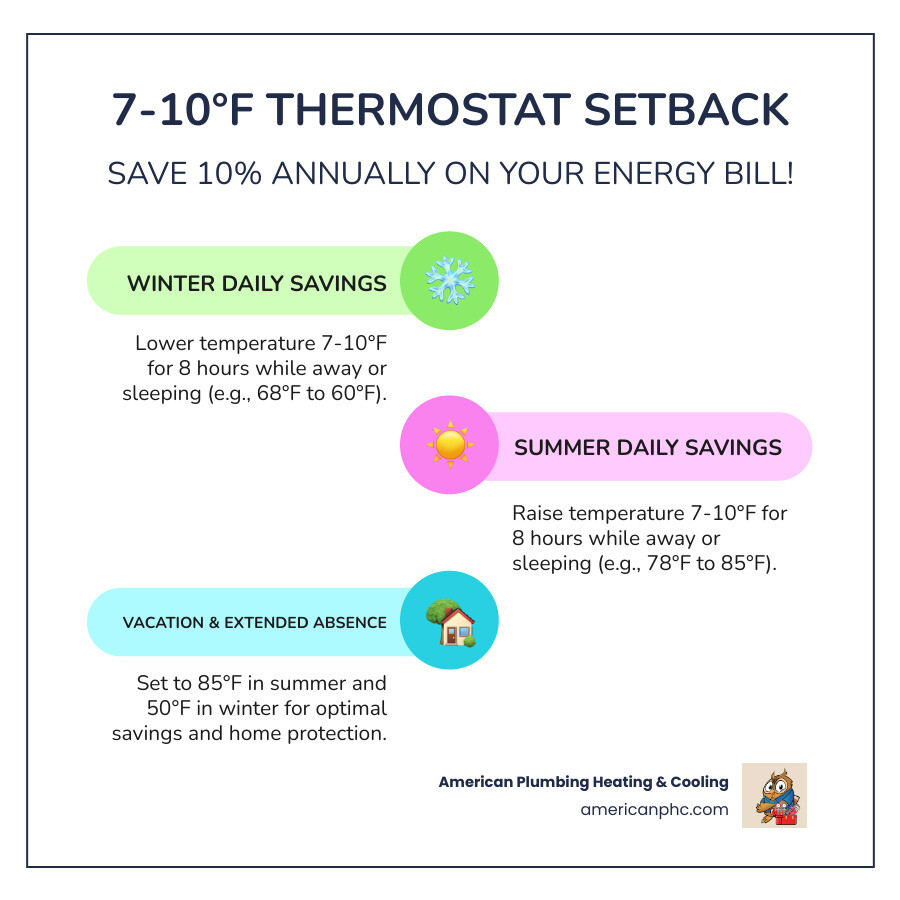
One of the easiest ways to save money is to stop cooling or heating an empty house. The "7-10 degree setback rule" is a game-changer. By adjusting your thermostat by 7 to 10 degrees from its normal setting for just 8 hours a day (like when you are at work), you can save up to 10% on your annual energy bills.
What temperature should I set my thermostat when I'm away from home?
For your daily routine, think about your schedule. If you leave for work at 8:00 AM and return at 5:00 PM, your thermostat should be doing the heavy lifting while you’re gone.
- Summer: If you keep it at 78°F while home, set it to 85°F when you leave.
- Winter: If you keep it at 68°F while home, set it to 60°F when you leave.
Some people worry that the AC will have to "work harder" to cool the house back down, but physics tells us otherwise. It takes less energy to cool a warm house down than it does to keep a house cool all day against the relentless Florida sun. For those in the Bradenton area, keeping your system efficient for these shifts is easier with regular AC Maintenance in Bradenton.
Best practices for long-term travel and property protection
When you're heading out for a long vacation, you can't just turn the system off — especially in Florida.
- Summer Vacations: Do not set your thermostat higher than 85°F. Why? Because your AC’s primary job isn't just cooling; it’s dehumidifying. If the temperature gets too high, the humidity will skyrocket, leading to mold and mildew growth on your furniture and walls. Residents in Navarre should consider AC Maintenance in Navarre before a long trip to ensure the condensate drain line is clear.
- Winter Vacations: Set the thermostat to at least 50°F to 55°F. While we don't get many hard freezes in Cape Coral or Sarasota, a sudden cold snap can threaten pipes in unheated spaces. Furnace Maintenance in Cape Coral or Furnace Maintenance in Bradenton ensures your heating system will actually kick on when that rare frost hits.
Ideal Settings for Infants, Pets, and Houseplants
When you share your home with vulnerable family members — whether they have two legs, four legs, or leaves — the "standard" settings might need a slight tweak.
For Infants: Pediatricians and the National Library of Medicine often recommend a nursery temperature between 65°F and 74°F. Babies cannot regulate their body temperature as well as adults, so keeping the room slightly cooler (but not cold) helps prevent overheating, which is a risk factor for SIDS.
For Pets: Most cats and dogs are comfortable in the same range as humans, roughly 64°F to 78°F. However, breed matters. A thick-coated Siberian Husky will struggle in an 80°F Florida home, while a short-haired Chihuahua might be perfectly happy. Always ensure they have access to fresh water. If you live in Lakewood Ranch or Cape Coral, ensuring your system is running efficiently with AC Maintenance in Lakewood Ranch or AC Maintenance in Cape Coral helps keep your furry friends safe while you're at work.
For Houseplants: Most tropical houseplants thrive in temperatures between 60°F and 75°F. If you let your home get above 85°F while on vacation, you might return to some very unhappy greenery. Avoid placing plants directly in the path of AC vents, as the cold, dry air can damage delicate leaves.
Thermostat Placement and Smart Technology Benefits
Where you put your thermostat is just as important as what you set it to. If your thermostat is in a bad spot, it will "ghost read" the temperature, causing your system to turn on and off at the wrong times.
The Golden Rules of Placement:
- Interior Walls Only: Exterior walls change temperature too much based on the weather outside.
- Center of the Home: It should be in a frequently used room (like the living room) to get an average reading of the house.
- Avoid Direct Sunlight: If the sun hits your thermostat, it will think the house is 90°F and run the AC until your living room is an icebox.
- Stay Away from Vents and Kitchens: Drafts from vents or heat from the oven will trick the sensors.
If you’re still using an old manual slider, 2026 is the year to upgrade. Smart thermostats offer remote control via your phone, meaning you can turn the AC down while you're driving home from the beach. They also "learn" your patterns, automatically adjusting the temperature when they sense you've left the house. For homeowners in Venice, we can help integrate these during your Furnace Maintenance in Venice or AC tune-up.
Common Mistakes and Humidity Factors in Florida
In Florida, we face unique challenges. Here is a breakdown of common errors we see:
| Mistake | Why it’s a Problem | The Better Way |
|---|---|---|
| Cranking the AC to 60°F to "cool faster" | AC units work at one speed. It won't cool faster; it will just run longer and waste energy. | Set it to your desired temp and use a fan for immediate relief. |
| Turning the AC completely off when leaving | The humidity will build up, making it harder and more expensive to cool down later. | Use the 7-10 degree setback rule. |
| Ignoring the Air Filter | A clogged filter restricts airflow, making the thermostat think the goal hasn't been reached. | Change filters every 30-90 days. |
| Leaving Windows Uncovered | The "greenhouse effect" from Florida sun can raise indoor temps by 10 degrees. | Use blackout curtains during the hottest part of the day. |
Humidity is the biggest factor in "perceived" comfort. The World Health Organization (WHO) suggests keeping indoor temperatures below 75.2°F at night for health, but if your home is humid, even 70°F can feel sticky. Regular AC Maintenance in Sarasota ensures your system's "latent cooling" (moisture removal) is working at peak capacity.
Frequently Asked Questions about Home Temperatures
Is 78°F too warm for a Florida summer?
For some, yes. Comfort is subjective. However, 78°F is the point where you maximize energy savings without risking the health of your home. If you find 78°F too warm, try using ceiling fans, which allow you to feel about 4 degrees cooler through the "wind chill" effect.
How much money does lowering the thermostat 7-10 degrees actually save?
The Department of Energy states you can save up to 10% a year on heating and cooling by using this setback for 8 hours a day. In a state like Florida, where AC can account for over 50% of your electric bill, those savings add up to hundreds of dollars annually.
Where is the worst place to install a thermostat?
The absolute worst place is right next to a window in direct sunlight or directly above a supply vent. In both cases, the thermostat will provide a localized reading that doesn't represent the rest of the house, leading to extreme discomfort and high bills.
Conclusion
Finding the right setting for your thermostat doesn't have to be a battle. By following the 78/68 rule and making small adjustments for your specific family needs, you can enjoy a comfortable home in Sarasota, Cape Coral, or Pensacola without breaking the bank.
At American Plumbing Heating and Cooling, we bring over 100 years of combined experience to every home we visit. Whether you need a smart thermostat installation, a quick repair, or a seasonal tune-up to keep your system running efficiently in the Florida humidity, our certified pros are here to help. We offer honest, upfront pricing and 24/7 emergency service because we know that AC failures don't always happen during business hours.
Don't let a poorly tuned system dictate your comfort or your budget. Schedule your seasonal HVAC maintenance today and let us help you find your perfect home temperature.
{"@context": "https://schema.org", "@graph": [{"@type": "Article", "headline": "What Temperature Should I Set My Thermostat? | APHC", "description": "What temperature should I set my thermostat? Learn the best settings for summer, winter, sleep, and travel to save energy. Read now.", "author": {"@type": "Person", "name": "American Plumbing Heating and Cooling"}, "publisher": {"@type": "Organization", "name": "American Plumbing Heating and Cooling", "logo": {"@type": "ImageObject", "url": "https://firebasestorage.googleapis.com/v0/b/ai-templates.appspot.com/o/bot%2FiTB8FxoyvSplQzS7StV8%2Flogo%2FScreenshot%202026-03-16%20at%2012.43.20%E2%80%AFPM.png?alt=media&token=4ae5e171-7bb5-4a27-91f4-47e969b91c80"}}, "datePublished": "2026-04-30T02:46:54+00:00", "dateModified": "2026-04-30T02:47:10.237770", "mainEntityOfPage": {"@type": "WebPage", "@id": "https://pms.ciwebgroup.com/americanphc/2026/04/30/how-to-set-your-thermostat-without-starting-a-family-feud/"}, "image": "https://images.bannerbear.com/direct/4mGpW3zwpg0ZK0AxQw/requests/000/141/621/728/XwJBnmPj46w1x3pqYvLqob2xG/a65d3ae99e34bf16e47529b8405df58979fe5424.jpg"}, {"@type": "FAQPage", "mainEntity": [{"@type": "Question", "name": "What temperature should I set my thermostat to in summer and winter when I'm home?", "acceptedAnswer": {"@type": "Answer", "text": "The U.S. Department of Energy recommends setting your thermostat to 78°F in summer and 68°F in winter when you're home. These settings are designed to balance comfort and energy savings."}}, {"@type": "Question", "name": "What should I set my thermostat to when I'm away from home?", "acceptedAnswer": {"@type": "Answer", "text": "When you're away, the recommended setting is 85–88°F in summer and 62–65°F in winter. For an empty home during vacation, keep it no higher than 85°F in summer and no lower than 50°F in winter."}}, {"@type": "Question", "name": "What is the best thermostat temperature for sleeping?", "acceptedAnswer": {"@type": "Answer", "text": "The recommended sleeping temperature is 60–67°F. This range is listed as the ideal setting for overnight comfort."}}, {"@type": "Question", "name": "How much can the right thermostat settings save on energy bills?", "acceptedAnswer": {"@type": "Answer", "text": "The right thermostat settings can reduce your annual energy bill by up to 10%. The article says these recommendations are meant to deliver both comfort and real savings."}}, {"@type": "Question", "name": "Why does 78°F sometimes feel uncomfortable in Florida?", "acceptedAnswer": {"@type": "Answer", "text": "In Florida, humidity strongly affects how comfortable your home feels. The article explains that 78°F with 45% humidity can feel cooler than 75°F with 65% humidity, so proper dehumidification is important."}}]}]}Need HVAC Help?
Our certified technicians are ready to help with all your heating and cooling needs.
Request ServiceAbout the Author
American Plumbing Heating and Cooling Team
Licensed Florida contractors — HVAC CAC1821761 · Plumbing CFC1431919
More Articles
View All PostsRelated Articles


Ready to Get Started?
Whether you need a repair, maintenance, or a new system installation, our expert team is here to help.