
The Magic of Cold Air and How Your AC Makes It
By the American Plumbing Heating and Cooling Team
Licensed Florida contractors — HVAC CAC1821761 · Plumbing CFC1431919

Learn how your air conditioner works explained simply. Discover the science of cooling and maintenance for your Sarasota home.
Reviewed bythe American Plumbing Heating and Cooling Team — Licensed Florida contractors — HVAC CAC1821761 · Plumbing CFC1431919. Published July 2, 2026 · Last updated July 29, 2026. About American Plumbing Heating and Cooling
Dealing with this problem right now? Call (941) 735-6616 and talk to our local team.
Request ServiceWhy Understanding How Your Air Conditioner Works Explained Simply Can Save You Time, Money, and Comfort
How your air conditioner works explained simply comes down to one core idea: your AC does not create cold air — it removes heat from inside your home and moves it outside.
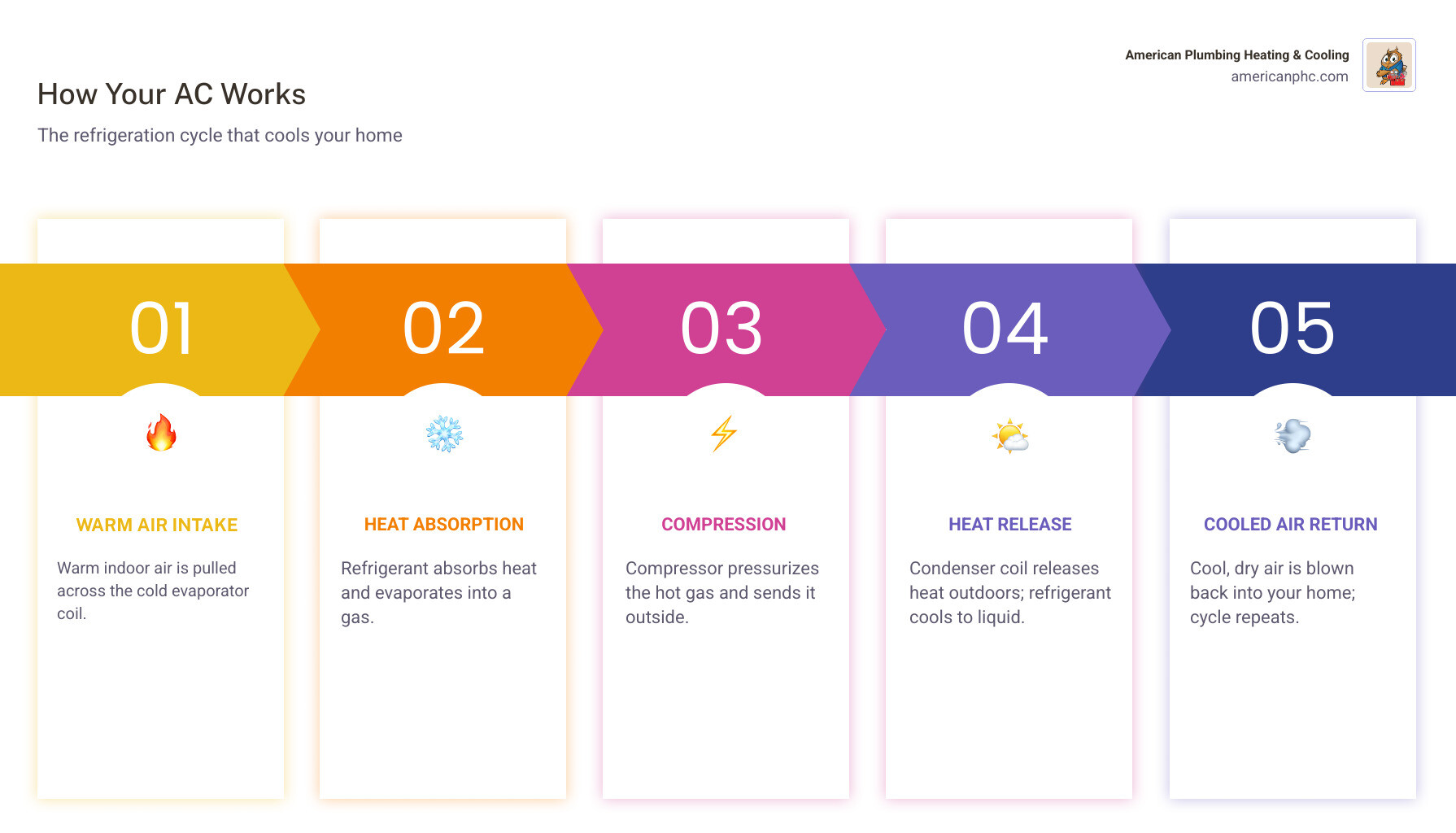
Here is a quick overview of how it works:
- Warm indoor air is pulled across a cold evaporator coil
- Refrigerant inside that coil absorbs the heat and evaporates into a gas
- The compressor pressurizes that gas and pushes it to the outdoor unit
- The condenser coil releases the heat outside, and the refrigerant cools back into a liquid
- The cooled air is blown back into your home, and the cycle repeats
That loop runs continuously until your thermostat tells it to stop.
This process is not new. Back in 1902, an engineer named Willis Carrier designed the first modern air conditioning system — originally to control humidity at a printing plant, not to keep people comfortable. Today, that same basic technology is credited with saving an estimated 190,000 lives worldwide every year by reducing heat-related illness.
For Florida homeowners, understanding how your system works is the first step toward knowing when it needs help — and why regular maintenance matters so much in our climate.
The Science of Heat Removal: How Your Air Conditioner Works Explained Simply
To understand the "magic" of cooling, we have to look at a fundamental rule of science: heat always moves from a warmer object to a cooler one. Your air conditioner is essentially a heat-moving machine. It uses a scientific principle called "phase conversion" to get the job done.
Think of a sponge. When you press a dry sponge into a puddle, it absorbs the water. In your AC system, the refrigerant acts like that sponge, but instead of water, it soaks up heat. When the refrigerant is in a cold, liquid state and passes through the indoor evaporator coil, it absorbs the thermal energy from your home's air. As it absorbs this heat, the refrigerant changes from a liquid into a gas.
This phase change is where the real cooling happens. If you’ve ever noticed how your skin feels cold when water evaporates off it after a swim in the Gulf, you’ve experienced this firsthand. In your home, after the air flows over these freezing-cold coils, its temperature typically drops by about 20 degrees. If your system isn't achieving that temperature drop, it might be time to look into Everything You Need to Know About AC Repair in Sarasota FL.
When the heat is removed, the "cold" air you feel is simply the air that remains after the warmth has been stripped away. If this process breaks down, you’ll likely need professional AC Repair Service Sarasota FL to restore the thermodynamic balance in your home.
The Six Essential Components of Your Cooling System
While the process sounds like a single loop, it requires six specialized parts working in perfect harmony to keep your Florida home comfortable in May 2026.
- Thermostat: The brain of the operation. It monitors the indoor temperature and tells the system when to start and stop.
- Refrigerant: The "blood" of the system. This special chemical moves through the coils, changing from liquid to gas to transport heat.
- Evaporator Coil: Located inside your home (usually in the attic or a closet), this is where the refrigerant absorbs indoor heat.
- Compressor: The "heart" of the system. Located in the outdoor unit, it squeezes the refrigerant gas, raising its pressure and temperature so it can release the heat.
- Condenser Coil: Also located outside, this is where the heat absorbed from your living room is "spat out" into the Florida air.
- Expansion Valve: This acts like a nozzle on a spray bottle. It depressurizes the refrigerant so it can become ice-cold again before heading back inside.
Every part of your Air Conditioning system must be in top shape. If the "heart" (compressor) fails or the "brain" (thermostat) miscommunicates, the whole cycle grinds to a halt.
Step-by-Step: The Refrigeration Cycle in Action
Let’s walk through the cycle as if we were riding along with the refrigerant. This four-stage journey is what keeps us from melting during a Sarasota summer.
- Stage 1: Evaporation (The Heat Soak): Cold liquid refrigerant enters the indoor evaporator coil. The blower fan pushes warm air from your house over the coil. The refrigerant "soaks up" the heat and turns into a vapor.
- Stage 2: Compression (The Pressure Cooker): The now-warm gas travels to the outdoor unit. The compressor squeezes the gas tightly. This makes the gas even hotter—hotter than the outdoor temperature—which is necessary for the next step.
- Stage 3: Condensation (The Heat Dump): The hot gas enters the condenser coil. A large fan blows outdoor air over the coils. Because the gas is hotter than the outside air, the heat naturally moves out of the coils and into the environment. As it loses heat, the refrigerant turns back into a liquid.
- Stage 4: Expansion (The Big Chill): The liquid refrigerant is still under high pressure and is fairly warm. It passes through the expansion valve, which drops the pressure instantly. This causes the temperature to plummet, turning it back into a freezing-cold liquid ready to head back inside.
If your system struggles at any of these stages, it might be reaching the end of its 15–20 year lifespan. In those cases, we often recommend exploring AC Installation and Replacement Sarasota FL to restore efficiency.
Why refrigerant is the secret to how your air conditioner works explained simply
Refrigerant is a specialized chemical compound engineered to have a very low boiling point. While water boils at 212°F, common refrigerants like R410A or the more modern, eco-friendly R32 boil at temperatures far below zero.
This low boiling point allows the refrigerant to evaporate (and thus absorb heat) even when the air in your home is only 75°F. It functions in a closed loop, meaning it should never "run out" like gas in a car. If your AC is low on refrigerant, it means there is a leak. For more on how these systems are set up, check out our New AC Unit Installation in Sarasota: A Step-by-Step Guide.
Dehumidification and how your air conditioner works explained simply
In places like Sarasota and Cape Coral, the heat isn't the only enemy—it’s the humidity. How your air conditioner works explained simply includes its role as a giant dehumidifier.
Think of a cold soda can "sweating" on a porch in July. That moisture isn't leaking from inside the can; it's water vapor from the air turning into liquid when it hits the cold surface. Your AC does the same thing. As warm, humid indoor air hits the cold evaporator coil, the moisture condenses into liquid water. This water drips into a pan and flows out through a condensate drain.
This is why a well-functioning AC makes you feel so much better; drier air allows your sweat to evaporate more easily, which is your body's natural way of cooling down. To keep this drainage system clear of algae and clogs, follow the tips in our guide on Everything You Need to Know About AC Maintenance in Sarasota.
Comparing Split, Packaged, and Ductless Systems
Not every home in Florida uses the same type of setup. Depending on your home's architecture, you might have one of these three common systems:
| System Type | Best For | How It Works |
|---|---|---|
| Split-System | Most Florida Homes | Uses an indoor unit (evaporator) and an outdoor unit (compressor/condenser). |
| Packaged System | Small Yards/Commercial | All components are in one outdoor cabinet, often on the roof or a concrete slab. |
| Ductless Mini-Split | Additions/Zoning | No ducts needed. Small indoor units are mounted on walls in specific rooms. |
If you are unsure which one fits your needs, our The Ultimate Sarasota AC Replacement Survival Guide breaks down the pros and cons of each.
Keeping the Magic Alive: Basic Maintenance Tips
Modern air conditioning accounts for roughly 7% of global electricity consumption. In Florida, that percentage is often much higher for individual households. To keep your system from working too hard (and your bills from soaring), basic maintenance is non-negotiable.
- Change Your Filters: This is the #1 thing you can do. A dirty filter chokes your system, forcing it to run longer and consume more of those 3,000 to 3,500 watts per hour.
- Clear the Perimeter: Ensure your outdoor unit has at least 18 to 24 inches of clearance. Remove weeds, tall grass, or stored items that might block airflow.
- Straighten the Fins: The "fins" on your outdoor unit can get bent by hail or yard debris. You can use a fin comb to straighten them, ensuring maximum heat release.
- The 7-10 Degree Rule: Adjusting your thermostat 7–10 degrees higher when you aren't home is more cost-effective than turning the system off entirely. It’s easier for an AC to maintain a temperature than to cool a "heat-soaked" house from scratch.
For a professional deep clean, we recommend a regular AC Maintenance Tune-Up Sarasota FL to catch small issues before they become expensive midnight emergencies.
Frequently Asked Questions about AC Operation
Does my AC pull fresh air from the outside?
This is a common myth! Most standard split-system air conditioners do not pull air from the outside. Instead, they recirculate the air already inside your home, filtering and cooling it over and over. This is why indoor air quality is so important; if you have dust or allergens inside, your AC will just keep moving them around unless you have high-quality filters or air purifiers.
Is it better to turn the AC off when I'm not home?
Generally, no. In the Florida humidity, turning the AC off allows moisture to build up in your drywall and furniture. It also allows the temperature to spike so high that your AC will have to run for hours at full capacity to catch up. Use a smart thermostat to raise the temperature slightly while you're at work, but keep the system active.
Why is my air conditioner leaking water?
If you see water pooling around your indoor unit, it’s usually a clogged condensate drain line. Algae and "sludge" can grow in the warm, wet environment of the drain. A simple trick is to pour a cup of diluted white vinegar down the drain line once a season to keep it clear. If the leak persists, it could lead to ceiling damage, so call a pro immediately.
Conclusion
Understanding how your air conditioner works explained simply helps you appreciate the hard work your system does every day to battle the Florida sun. From the 1902 invention by Willis Carrier to the modern variable-speed systems that are up to 58% more efficient, AC technology is truly a "forgotten hero" of our modern lives.
At American Plumbing Heating and Cooling, we have over 100 years of combined experience keeping families in Sarasota, Bradenton, and across Florida cool and comfortable. We believe in honest, upfront pricing and certified expertise. Whether you need a quick repair, a seasonal tune-up, or a brand-new installation, we are here to help 24/7.
Ready to ensure your home stays a sanctuary of cool air? Visit our Air Conditioning page today to schedule your service with the local pros who know Florida cooling best.
{"@context": "https://schema.org", "@graph": [{"@type": "Article", "headline": "How Your Air Conditioner Works Explained Simply | APHC", "description": "How your air conditioner works explained simply: learn how AC removes heat, why parts matter, and when to schedule expert service. Call today!", "author": {"@type": "Person", "name": "American Plumbing Heating and Cooling"}, "publisher": {"@type": "Organization", "name": "American Plumbing Heating and Cooling", "logo": {"@type": "ImageObject", "url": "https://firebasestorage.googleapis.com/v0/b/ai-templates.appspot.com/o/bot%2FiTB8FxoyvSplQzS7StV8%2Flogo%2FScreenshot%202026-03-16%20at%2012.43.20%E2%80%AFPM.png?alt=media&token=4ae5e171-7bb5-4a27-91f4-47e969b91c80"}}, "datePublished": "2026-07-02T02:46:36+00:00", "dateModified": "2026-07-02T02:46:52.734974", "mainEntityOfPage": {"@type": "WebPage", "@id": "https://pms.ciwebgroup.com/americanphc/2026/07/02/the-magic-of-cold-air-and-how-your-ac-makes-it/"}, "image": "https://images.bannerbear.com/direct/4mGpW3zwpg0ZK0AxQw/requests/000/144/137/961/OA0Ekvge5YdOkrmaQKqRLpWxX/da5ec3e10168737e6bf3f50dd4a81442a908b100.jpg"}, {"@type": "FAQPage", "mainEntity": [{"@type": "Question", "name": "How does an air conditioner work in simple terms?", "acceptedAnswer": {"@type": "Answer", "text": "An air conditioner does not create cold air; it removes heat from inside your home and moves it outside. Warm indoor air passes over a cold evaporator coil, refrigerant absorbs the heat, and the cooled air is blown back into the home."}}, {"@type": "Question", "name": "What role does refrigerant play in an AC system?", "acceptedAnswer": {"@type": "Answer", "text": "Refrigerant absorbs heat from indoor air as it passes through the evaporator coil. As it absorbs heat, it changes from a cold liquid into a gas, which helps cool the air in your home."}}, {"@type": "Question", "name": "What do the compressor and condenser do in an air conditioner?", "acceptedAnswer": {"@type": "Answer", "text": "The compressor pressurizes the refrigerant gas and sends it to the outdoor unit. The condenser coil then releases the absorbed heat outside and cools the refrigerant back into a liquid so the cycle can repeat."}}, {"@type": "Question", "name": "Why is understanding how your AC works important for homeowners?", "acceptedAnswer": {"@type": "Answer", "text": "Understanding how your AC works helps homeowners recognize when the system may need service and why regular maintenance matters. This is especially important in hot climates like Florida, where air conditioning is essential for comfort and health."}}, {"@type": "Question", "name": "How much should an air conditioner cool the air?", "acceptedAnswer": {"@type": "Answer", "text": "After air flows over the cold evaporator coils, its temperature typically drops by about 20 degrees. If the system is not achieving that temperature drop, it may indicate a problem that needs attention."}}]}]}Need HVAC Help?
Our certified technicians are ready to help with all your heating and cooling needs.
Request ServiceAbout the Author
American Plumbing Heating and Cooling Team
Licensed Florida contractors — HVAC CAC1821761 · Plumbing CFC1431919
More Articles
View All PostsRelated Articles


Ready to Get Started?
Whether you need a repair, maintenance, or a new system installation, our expert team is here to help.