
Best HVAC and Plumbing Setups to Beat the Coastal Heat
By the American Plumbing Heating and Cooling Team
Licensed Florida contractors — HVAC CAC1821761 · Plumbing CFC1431919

Discover how gulf coast climate affects your hvac and plumbing. Protect your systems from salt, humidity and sand for longer life.
Reviewed bythe American Plumbing Heating and Cooling Team — Licensed Florida contractors — HVAC CAC1821761 · Plumbing CFC1431919. Published May 1, 2026 · Last updated July 29, 2026. About American Plumbing Heating and Cooling
Dealing with this problem right now? Call (941) 735-6616 and talk to our local team.
Request ServiceWhy the Gulf Coast Climate Is Harder on Your Home Systems Than Almost Anywhere Else
How Gulf Coast climate affects your HVAC and plumbing comes down to a few relentless forces working against your home systems every single day — salt air, extreme humidity, seasonal storms, and sandy soil. Here is a quick breakdown:
| Climate Factor | Impact on HVAC | Impact on Plumbing |
|---|---|---|
| Salt air | Corrodes coils, fins, and electrical components | Accelerates rust and degradation in metal pipes |
| High humidity | Forces the system to work harder to remove moisture | Promotes mold and pipe-joint deterioration |
| Seasonal flooding | Can damage outdoor units and cause power issues | Overwhelms drains, causes sewer backups |
| Sand | Clogs filters and gets into outdoor units | Accumulates in pipes and causes blockages |
| Near-constant use | Accelerates wear on compressors and motors | Increases strain on water heaters and fixtures |
If you live in Sarasota, Bradenton, Cape Coral, or anywhere along Florida's Gulf Coast, your HVAC and plumbing systems face a level of stress that homeowners in dry, inland climates simply never deal with.
Think about what your air conditioner is up against. It is not just cooling your home — it is pulling gallons of moisture out of the air every single day. At the same time, salt particles carried on the breeze are quietly settling on your outdoor condenser unit, attracting moisture and eating away at metal components. Without the right equipment and regular maintenance, that combination can cut an HVAC system's lifespan nearly in half compared to units in drier climates.
Your plumbing faces its own version of the same battle. Salty, humid air attacks metal pipes from the outside. Sandy soil and storm flooding push debris into drain lines. These are not rare, worst-case scenarios — they are everyday realities for Gulf Coast homeowners.
This guide covers everything you need to know to protect your systems, extend their lifespan, and keep your home comfortable year-round.
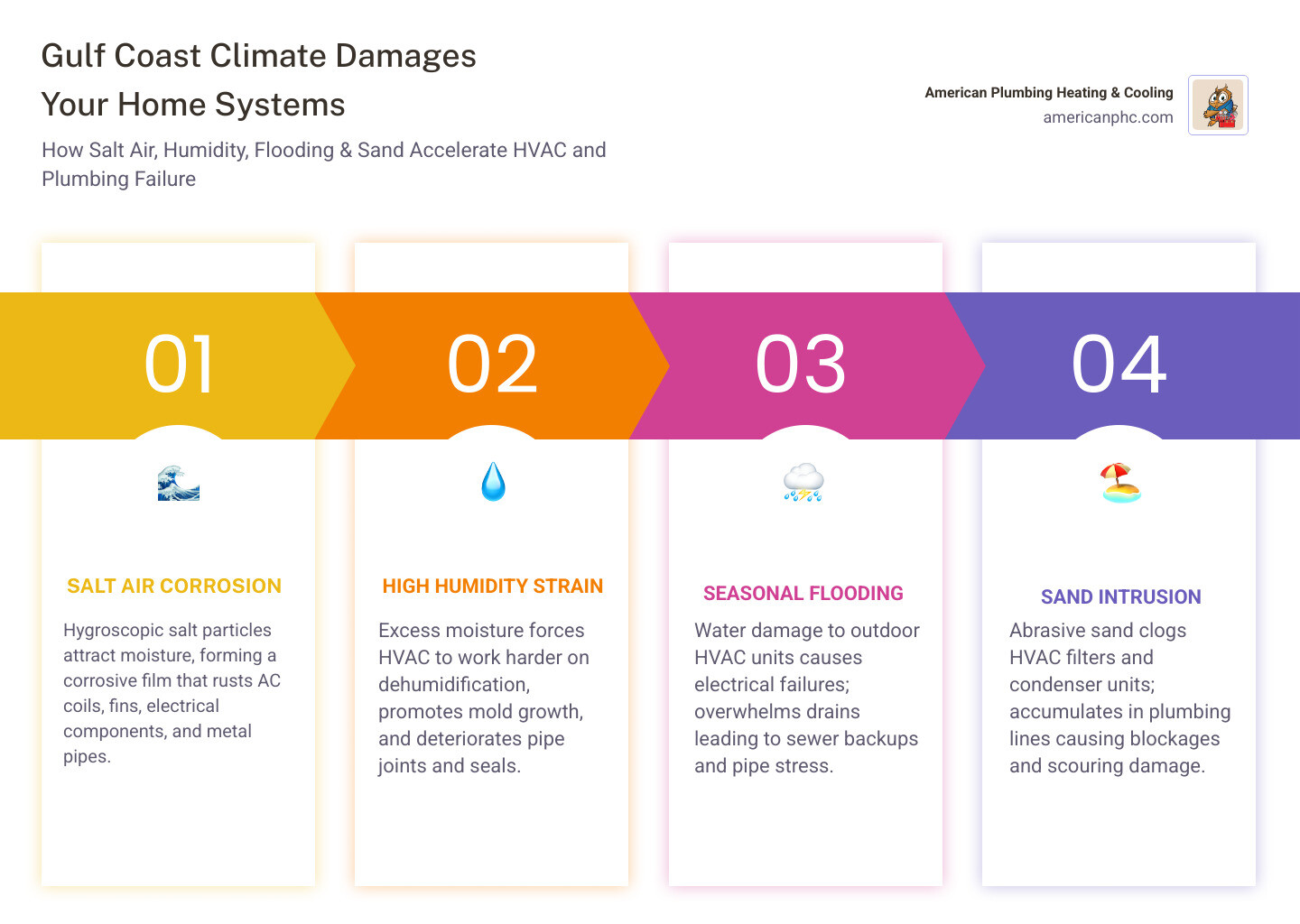
How Gulf Coast climate affects your HVAC and plumbing
Living along the Gulf Coast means enjoying beautiful views, but for your home’s mechanical systems, it is a constant battle against the elements. The primary villain in this story is salt air. While we love the smell of the sea, that air is actually a mixture of moisture and tiny sodium chloride particles. These particles are naturally corrosive, and they don't just stay at the beach; they can travel several miles inland, especially during high winds or storms.
When salt air settles on your outdoor equipment, it triggers metal oxidation. This is a fancy way of saying it causes rust and deterioration at an accelerated rate. Salt particles are hygroscopic, meaning they attract moisture. This creates a damp, salty film on your AC unit and exposed pipes that eats away at aluminum and steel. This is a major part of understanding the hidden impact of humidity on your home.

How Gulf Coast climate affects your HVAC efficiency
In our region, your air conditioner has two jobs: lowering the temperature (sensible heat) and removing moisture (latent heat). Because our air is so thick with moisture, your HVAC system often spends more than half of its cooling capacity simply "drying" the air before it can even begin to lower the temperature.
When humidity levels are extremely high, the evaporator coils can become saturated. If the system is not properly maintained, it may struggle with "short cycling"—turning on and off too frequently. This prevents the unit from running long enough to properly dehumidify the house, leaving you with a home that feels cool but "clammy." To combat this, many homeowners in areas like Sarasota and Cape Coral opt for specialized humidifier and dehumidifier installation in Sarasota, FL to assist their main AC unit.
How Gulf Coast climate affects your plumbing longevity
Plumbing systems are just as vulnerable to the coastal environment. The same salty moisture that attacks your AC unit can cause external corrosion on metal pipes, particularly those in crawlspaces or outdoor areas. We often see galvanic reactions, where the presence of salt and moisture accelerates the degradation of metal joints and fittings.
Over time, this metal degradation leads to pinhole leaks or structural failure of the pipes. Identifying these issues early is key, which is why we recommend reviewing common plumbing problems: identification and troubleshooting to stay ahead of potential disasters.
Essential HVAC Features for Coastal Florida Homes
If you are replacing an HVAC unit in a coastal region, you cannot simply buy the same model someone would use in a dry state. You need equipment built for the "salt life." The best units for our area feature corrosion-resistant coils, often treated with epoxy coatings or specialized "ocean-side" finishes that prevent salt from bonding to the metal.
Look for systems with stainless steel hardware and sealed electrical components. Standard units often have exposed copper and electrical terminals that will corrode and fail within just a few years of coastal exposure. Investing in a professional AC installation ensures you get a unit designed to survive the Florida heat and salt.
HVAC Lifespan Comparison
| Region | Expected Lifespan (Well Maintained) | Lifespan (Neglected) |
|---|---|---|
| Inland / Temperate | 15 to 20 Years | 12 to 15 Years |
| Gulf Coast / Coastal | 12 to 15 Years | 7 to 10 Years |
Maximizing Comfort in High-Humidity Areas
To truly master the Gulf Coast climate, we recommend looking into variable-speed compressors. Unlike standard units that are either "on" or "off," variable-speed systems can run at lower speeds for longer periods. This is much more effective at removing humidity because the air spends more time in contact with the cold evaporator coils.
Pairing your AC with a whole-home dehumidifier is another game-changer. These units work alongside your HVAC to keep indoor humidity between the ideal 45% and 55% range. For residents in our Cape Coral service area, humidifier and dehumidifier installation is one of the most popular upgrades for improving indoor air quality and comfort.
Protecting Your Plumbing from Salt and Sand
Sand is a major headache for coastal plumbing. It finds its way into everything—towels, shoes, and pets. When that sand goes down your shower drain or into your washing machine, it doesn't always wash away. Sand is heavy and can settle in the "P-traps" or low points of your drainage system, leading to stubborn clogs that can eventually scour and damage the inside of your pipes.
Seasonal flooding and heavy tropical rains also pose a threat. High water tables can put pressure on your sewer lines, and if the local drainage system is overwhelmed, you could face nasty sewer backups.
While we don't deal with deep freezes often, the principles in our guide to preventing burst pipes regarding pipe integrity and pressure management are still highly relevant for coastal homeowners facing extreme weather.
Preventing Coastal Pipe Damage
For new installations or repiping projects in our Sarasota, FL service area, we often recommend corrosion-resistant materials like PEX (cross-linked polyethylene). PEX is a flexible plastic that is completely immune to the salt-air corrosion that destroys copper and galvanized steel.
Regular inspections are also vital. Because many Florida homes are built on slabs or have high water tables, a small underground leak can quickly turn into a major foundation issue. We use advanced leak detection to find these "hidden" problems before they cause structural damage.
Proactive Maintenance and System Longevity
The secret to making your systems last on the Gulf Coast is consistency. You cannot "set it and forget it" here. One of the simplest DIY steps you can take is gently rinsing your outdoor condenser unit with a garden hose once a month. This washes away the salt deposits before they have a chance to eat through the metal fins. Just be sure to use a gentle spray—high pressure can bend the delicate fins and restrict airflow.
Other essential steps include:
- Monthly Filter Changes: Sand and dust are more prevalent here; clean filters keep the air flowing and the coils clean.
- Condensate Drain Cleaning: In high humidity, your AC produces gallons of water. This can lead to algae growth in the drain lines. We recommend a professional cleaning at least twice a year.
- Professional Tune-ups: Our HVAC and plumbing maintenance plan is designed specifically for Florida homes, focusing on corrosion checks and electrical testing.
Whether you need Milton AC maintenance or a system check-up in Sarasota, staying proactive is the only way to beat the coastal wear and tear.
Frequently Asked Questions
How long does an HVAC system last on the Gulf Coast?
In a dry, inland climate, a well-maintained AC might last 20 years. On the Gulf Coast, the average lifespan is typically 10 to 12 years. Without regular maintenance and salt-rinsing, some units fail in as little as 7 years. The combination of salt, high humidity, and near-constant operation simply wears components down faster. Following a local guide to HVAC maintenance is essential to push your system toward that 15-year mark.
Why does my home feel "sticky" even when the AC is running?
This "sticky" feeling is usually a sign that your indoor humidity is above 60%. Ideally, you want to stay between 45% and 55%. If your AC is oversized, it might cool the room so fast that it shuts off before it has a chance to remove the moisture. This is a common issue we address in our Sarasota homeowner's guide to indoor air quality.
Can sand actually damage my home's plumbing?
Yes! Sand is abrasive and heavy. It can settle in your pipes, creating a "dam" that catches other debris and leads to major blockages. Over time, the abrasive nature of sand can also wear down the interior lining of metal pipes. We recommend outdoor rinsing stations to keep sand out of the house and using fine-mesh drain covers in all showers.
Conclusion
Understanding how gulf coast climate affects your hvac and plumbing is the first step toward protecting your biggest investment—your home. From the corrosive salt air in Sarasota to the high humidity in Cape Coral and the sandy soils of Navarre, the Florida environment is beautiful but demanding.
By choosing the right equipment, using corrosion-resistant materials, and staying on top of proactive maintenance, you can enjoy coastal living without the constant worry of system failure. At American Plumbing Heating and Cooling, our team has over 100 years of combined experience helping Florida residents navigate these exact challenges.
Whether you need a 24/7 emergency repair or want to discuss a new, salt-resistant HVAC installation, we are here to help. Explore our services or contact us today to schedule your next maintenance visit and keep your home running smoothly through every season.
{"@context": "https://schema.org", "@graph": [{"@type": "Article", "headline": "How Gulf Coast Climate Affects HVAC and Plumbing | APHC", "description": "Learn how Gulf Coast climate affects your HVAC and plumbing, and get tips to protect your home systems. Read the guide today.", "author": {"@type": "Person", "name": "American Plumbing Heating and Cooling"}, "publisher": {"@type": "Organization", "name": "American Plumbing Heating and Cooling", "logo": {"@type": "ImageObject", "url": "https://firebasestorage.googleapis.com/v0/b/ai-templates.appspot.com/o/bot%2FiTB8FxoyvSplQzS7StV8%2Flogo%2FScreenshot%202026-03-16%20at%2012.43.20%E2%80%AFPM.png?alt=media&token=4ae5e171-7bb5-4a27-91f4-47e969b91c80"}}, "datePublished": "2026-05-01T13:44:56+00:00", "dateModified": "2026-05-01T13:45:02.573931", "mainEntityOfPage": {"@type": "WebPage", "@id": "https://pms.ciwebgroup.com/americanphc/2026/05/01/best-hvac-and-plumbing-setups-to-beat-the-coastal-heat/"}, "image": "https://images.bannerbear.com/direct/4mGpW3zwpg0ZK0AxQw/requests/000/141/997/435/MRj52Zwoa6xN18x2YxWkdO3eE/b61f4b4f96fb1fadf7bf0ded35e5ca1a495fecb2.jpg"}, {"@type": "FAQPage", "mainEntity": [{"@type": "Question", "name": "How does the Gulf Coast climate affect HVAC and plumbing systems?", "acceptedAnswer": {"@type": "Answer", "text": "The Gulf Coast climate puts constant stress on home systems through salt air, extreme humidity, seasonal flooding, sandy soil, and near-constant use. These conditions corrode metal parts, force HVAC systems to remove large amounts of moisture, clog drains and filters, and increase wear on compressors, motors, water heaters, and fixtures."}}, {"@type": "Question", "name": "Why is salt air so damaging to HVAC units and plumbing near Florida’s Gulf Coast?", "acceptedAnswer": {"@type": "Answer", "text": "Salt air carries tiny sodium chloride particles mixed with moisture, and those particles are naturally corrosive. They settle on outdoor HVAC components and metal pipes, attracting moisture and accelerating rust, degradation, and damage to electrical and metal parts."}}, {"@type": "Question", "name": "Why do HVAC systems wear out faster on the Gulf Coast than in drier inland climates?", "acceptedAnswer": {"@type": "Answer", "text": "On the Gulf Coast, air conditioners are not only cooling the home but also pulling gallons of moisture from the air every day while being exposed to corrosive salt particles. Without the right equipment and regular maintenance, this combination can cut an HVAC system’s lifespan nearly in half compared to units in drier climates."}}, {"@type": "Question", "name": "What plumbing problems are common in Gulf Coast homes?", "acceptedAnswer": {"@type": "Answer", "text": "Common plumbing issues include rust and deterioration in metal pipes from salty, humid air, as well as blockages and drain problems caused by sandy soil and storm debris. Seasonal flooding can also overwhelm drains and lead to sewer backups."}}, {"@type": "Question", "name": "Which Florida Gulf Coast areas face these HVAC and plumbing challenges?", "acceptedAnswer": {"@type": "Answer", "text": "The article specifically mentions Sarasota, Bradenton, Cape Coral, and other communities along Florida’s Gulf Coast. Homeowners in these areas face more stress on their HVAC and plumbing systems than those in dry, inland climates."}}]}]}Need HVAC Help?
Our certified technicians are ready to help with all your heating and cooling needs.
Request ServiceAbout the Author
American Plumbing Heating and Cooling Team
Licensed Florida contractors — HVAC CAC1821761 · Plumbing CFC1431919
More Articles
View All PostsRelated Articles


Ready to Get Started?
Whether you need a repair, maintenance, or a new system installation, our expert team is here to help.