
Don't Let the Salt Air Kill Your Vibe or Your AC
By the American Plumbing Heating and Cooling Team
Licensed Florida contractors — HVAC CAC1821761 · Plumbing CFC1431919

Discover the average lifespan of an HVAC system in the Gulf Coast: 10-14 years. Learn salt air fixes, maintenance tips and repair vs. replace advice!
Reviewed bythe American Plumbing Heating and Cooling Team — Licensed Florida contractors — HVAC CAC1821761 · Plumbing CFC1431919. Published May 21, 2026. About American Plumbing Heating and Cooling
Dealing with this problem right now? Call (941) 735-6616 and talk to our local team.
Request ServiceHow Long Does an HVAC System Last on the Gulf Coast?
The average lifespan of an hvac system in the gulf coast is significantly shorter than what most manufacturers suggest — and if you live near the water in Florida, that gap can be dramatic.
Here's a quick breakdown by region:
| Location | Estimated HVAC Lifespan |
|---|---|
| National Average | 15-20 years |
| Florida Gulf Coast (general) | 10-14 years |
| Florida coastal (no corrosion protection) | 8-12 years |
| Alabama Gulf Coast (near coast) | 10-12 years |
| Louisiana subtropical coast | 10-15 years |
| Mississippi Gulf Coast | 12-14 years |
| Corpus Christi, TX (no protection) | 7-12 years |
| Texas Gulf Coast (with maintenance) | 12-16 years |
The short answer: expect your Gulf Coast HVAC system to need replacement years sooner than a unit in a northern or inland climate. Salt air, relentless heat, sky-high humidity, and year-round operation all stack up against your equipment in ways that most standard warranty timelines simply don't account for.
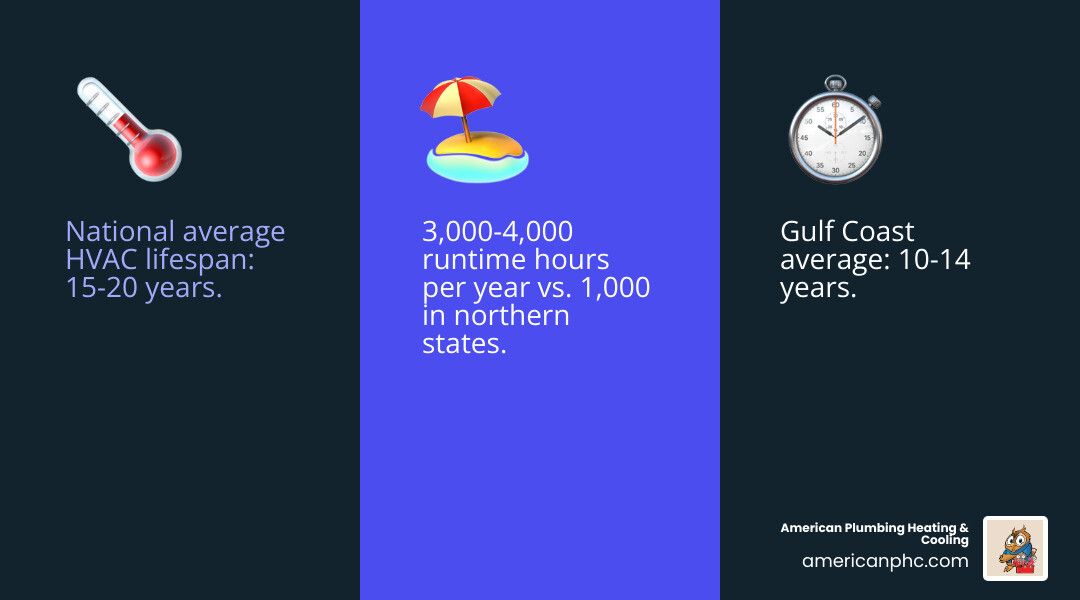
Consider this: a Florida Gulf Coast system can log 3,000 to 4,000 operating hours per year — compared to roughly 1,000 hours in a northern state. That's the equivalent of running three or four northern systems' worth of wear in a single year. Add salt-laden air corroding your condenser coils, and it becomes clear why coastal HVAC units often tap out years ahead of schedule.
Whether you're in Sarasota, Pensacola, Cape Coral, or anywhere along Florida's coastline, knowing what to expect from your system — and what you can do about it — can save you from a sweaty, expensive surprise.
Understanding the Average Lifespan of an HVAC System in the Gulf Coast
When we talk about the longevity of an air conditioner, we often start with the national average of 15 to 20 years. However, as April 2026 rolls around, we’ve seen that the reality for our neighbors in Florida is quite different. In our service areas like Sarasota and Pensacola, the average lifespan of an hvac system in the gulf coast typically lands between 10 and 14 years.
Why the discrepancy? It comes down to "mechanical age" versus "calendar age." While your neighbor in Ohio might only fire up their AC for three months a year, we are running ours for eight to ten months. This year-round demand means a Florida unit logs 3,000 to 4,000 runtime hours annually. By the time a local system reaches its 10th birthday, it has done as much work as a northern unit would do in 30 years!
Furthermore, Coastal Cooling Battles Between Central AC and Mini-Splits often highlight that the type of system you choose matters just as much as where you live. Whether you have a traditional central unit or a modern mini-split, the environmental toll remains a constant factor in our subtropical paradise.
Regional Variations in the Average Lifespan of an HVAC System in the Gulf Coast
While the entire Gulf Coast shares a similar "flavor" of climate, there are subtle differences that affect how long your equipment will last. In the Alabama Gulf Coast, units near the water often see a lifespan of just 10-12 years due to the intense salt spray. Over in Mississippi, the high heat index and humidity levels keep compressors running at maximum capacity, often leading to replacement within 12-14 years.
Louisiana’s subtropical climate introduces sustained thermal stress, often limiting systems to the 10-15 year range. In places like Corpus Christi, Texas, a unit without specific coastal protections might fail in as little as 7 years, though diligent maintenance can push that closer to 12 or 16 years. For us here in Florida, especially in areas like Cape Coral and Fort Myers, we frequently see units hitting their "retirement age" right around the 10-to-12-year mark if they haven't been treated with corrosion-resistant coatings.
Environmental Stressors: Why Coastal Units Fail Faster
It’s not just the heat; it’s the chemistry of the air. If you live within a few miles of the Gulf, your HVAC system is breathing in salt-laden air every single day. Chloride ions from the sea spray are incredibly aggressive. They settle on the thin aluminum fins and copper tubing of your outdoor condenser, leading to "coil pitting."
This isn't just a cosmetic issue. As the metal corrodes, it loses its ability to transfer heat. Your system has to work harder and run longer to achieve the same cooling effect, which leads to "thermal cycling fatigue." Eventually, the refrigerant lines may develop microscopic leaks, or the compressor—the heart of the system—will overheat and fail.
Beyond the salt, we have to deal with:
- High Humidity: This promotes mold and biological growth inside air handlers and ductwork, restricting airflow and increasing strain.
- Galvanic Corrosion: This occurs when salt water acts as an electrolyte between different types of metal in your unit, effectively "eating" the system from the inside out.
- Power Surges and Lightning: Florida is the lightning capital of the U.S. Frequent summer storms can send surges through the grid, frying sensitive capacitors and control boards. If you find yourself in the middle of a sudden breakdown after a storm, knowing What to Expect During an Emergency HVAC Service Call can help lower the stress of an unexpected repair.
Comparing System Longevity: Central AC vs. Mini-Splits
Not all HVAC systems are created equal when it comes to fighting the Gulf Coast elements. The technology under the hood plays a massive role in how many years of service you'll get.
| System Type | Coastal Lifespan (Avg) | Key Longevity Factor |
|---|---|---|
| Central AC | 10-14 Years | Standard on/off cycling wears out compressors faster. |
| Heat Pumps | 8-12 Years | Shorter life due to year-round use (heating and cooling). |
| Ductless Mini-Splits | 12-15 Years | Inverter technology allows for gentler, variable-speed operation. |
| Gas Furnaces | 15-20 Years | Used less frequently in Florida, leading to longer mechanical life. |
Mini-splits often edge out central systems in longevity because they use inverter technology. Instead of slamming "on" and "off" (which causes massive wear), they ramp up and down smoothly. You can learn more about these differences in The Great Chill Debate of Ducted vs. Ductless Systems.
However, heat pumps are the workhorses of the South. Because they provide both cooling in the summer and heat during our brief Florida winters, they never truly get a "break." This constant operation can wear out the reversing valves and compressors slightly faster than a cooling-only unit. When deciding which is right for your home, the Central AC vs Mini-Split Price Tag Showdown provides a great perspective on long-term value versus initial investment.
Proactive Strategies to Extend Your System's Life
While the Gulf Coast is tough on machinery, you aren't powerless. We have seen well-maintained units in Bradenton and Sarasota outlast neglected ones by five years or more.
The most effective weapon against salt air is a protective coating. Modern epoxy or phenolic coatings applied to the coils can provide a barrier against chloride ions, significantly slowing down the corrosion process. If you are buying a new unit, look for "coastal" or "marine-grade" models that come with these protections from the factory.
Other actionable steps include:
- Regular Coil Rinsing: Gently hosing off your outdoor unit with fresh water once a month can remove salt deposits before they have a chance to eat through the metal.
- Surge Protection: Installing a dedicated HVAC surge protector can save your system from the "silent killer" of power fluctuations during tropical storms.
- Filter Changes: In our high-pollen and high-dust environment, filters should be checked every 30 days and replaced at least every 90 days. A clogged filter forces the blower motor to work harder, shortening its life. For a deeper dive into home care, check out Don't Sweat It: A Local Guide to HVAC System Maintenance.
How Maintenance Impacts the Average Lifespan of an HVAC System in the Gulf Coast
We cannot overstate the importance of professional tune-ups. A biannual maintenance schedule (once in the spring and once in the fall) allows a technician to catch small issues like a failing capacitor or a clogged drain line before they lead to a total system meltdown.
In the humid Florida climate, drain lines are notorious for backing up with "algae" or biological slime. If the line clogs, water can back up into your home or cause the system to shut down entirely to prevent flooding. Regular clearing of these lines is a standard part of professional maintenance.
Furthermore, a clean, well-calibrated system is an efficient one. Residents often see 20% to 40% savings on their cooling costs simply by keeping the coils clean and the refrigerant levels precise. If you're in the northern reaches of our service area, understanding Why Your Milton Home Needs Regular AC Maintenance to Survive the Heat is essential. Similarly, for those further south, Everything You Need to Know About AC Maintenance in Sarasota offers localized tips for our unique coastal environment.
Knowing When to Repair vs. Replace
Eventually, every system reaches a point where pouring more money into repairs just doesn't make sense. But how do you know when that day has arrived?
We recommend using the $5,000 Rule. It’s a simple calculation: multiply the age of your system by the cost of the repair. If the total is more than $5,000, it’s usually time to look at a replacement. For example, if your 12-year-old unit needs a $600 repair ($12 \times 600 = 7,200$), the math suggests a new system is the better investment.
Other signs it's time to move on:
- R-22 Refrigerant: If your system still uses R-22 (Freon), repairs involving the refrigerant will be prohibitively expensive because it is no longer being produced.
- SEER2 Standards: As of 2023, new systems in the South must meet a minimum efficiency of 14.3 SEER2. If your old unit is a 10 SEER, a new one will pay for itself in energy savings over just a few years.
- Humidity Issues: If your home feels "clammy" even when the AC is running, the system may have lost its ability to dehumidify effectively due to age.
For those in our newer communities, Why Lakewood Ranch, FL Air Conditioning Maintenance Services Are a Total Breeze explains how to keep a newer system running like new. If you're dealing with an aging unit in a more established neighborhood, Keep Your Cool with Professional AC Maintenance in Bradenton, FL can help you decide if one more repair is worth it.
Frequently Asked Questions about Coastal HVAC
How does salt air affect my AC unit if I live a few miles inland?
You don't have to be beachfront to feel the effects. Wind-borne salt and chloride ions can travel several miles inland, especially during storm season. While the corrosion might be slower than a home on the sand, "inland" Florida units still see accelerated oxidation and cabinet rust compared to units in non-coastal states.
What is the $5,000 rule for HVAC replacement?
It is an economic threshold used to determine if a repair is worth the cost. By multiplying the system's age by the repair estimate, you can see if the "weighted cost" exceeds $5,000. It helps homeowners avoid "throwing good money after bad" on a system that is likely to fail again soon.
Can I wash my outdoor AC unit with a garden hose?
Yes! In fact, we encourage it. A gentle freshwater rinse once a month helps remove salt and sand from the condenser coils. Just be sure to use a normal garden hose—never a pressure washer, as high pressure can bend the delicate aluminum fins and restrict airflow.
Conclusion
Living on the Gulf Coast is a dream, but the environment is undeniably "nightmare" territory for standard HVAC equipment. Between the salt air, the 4,000-hour annual runtimes, and the tropical humidity, the average lifespan of an hvac system in the gulf coast is a hurdle every homeowner will eventually face.
At American Plumbing Heating and Cooling, we bring over 100 years of combined experience to the table. Our certified pros understand the specific challenges of Florida living because we live here too. Whether you are in Sarasota, Pensacola, or Cape Coral, we are dedicated to providing honest, upfront pricing and 24/7 emergency support to keep your home comfortable.
Don't wait for your system to fail on the hottest day of the year. Schedule your coastal HVAC evaluation with American PHC today and let us help you maximize the life of your investment.
Need HVAC Help?
Our certified technicians are ready to help with all your heating and cooling needs.
Request ServiceAbout the Author
American Plumbing Heating and Cooling Team
Licensed Florida contractors — HVAC CAC1821761 · Plumbing CFC1431919
More Articles
View All PostsRelated Articles


Ready to Get Started?
Whether you need a repair, maintenance, or a new system installation, our expert team is here to help.