
Everything You Need to Know About How AC Refrigerant Changes Affect Homeowners
By the American Plumbing Heating and Cooling Team
Licensed Florida contractors — HVAC CAC1821761 · Plumbing CFC1431919

Learn how AC refrigerant changes affect homeowners with the 2026 shift to A2L refrigerants, safety updates, and system options for Florida homes.
Reviewed bythe American Plumbing Heating and Cooling Team — Licensed Florida contractors — HVAC CAC1821761 · Plumbing CFC1431919. Published July 18, 2026 · Last updated July 29, 2026. About American Plumbing Heating and Cooling
Dealing with this problem right now? Call (941) 735-6616 and talk to our local team.
Request ServiceWhat Every Florida Homeowner Should Know About How AC Refrigerant Changes Affect Homeowners
How AC refrigerant changes affect homeowners is one of the most searched HVAC questions right now — and if you own a home in Florida, it directly impacts your next repair or replacement decision.
Here is the short answer most homeowners need:
- Your existing R-410A system is not illegal. You can keep using it and have it repaired.
- New AC systems sold today use A2L refrigerants like R-454B or R-32 with significantly lower climate impact.
- You cannot retrofit an older system to use the new refrigerants — they are not compatible.
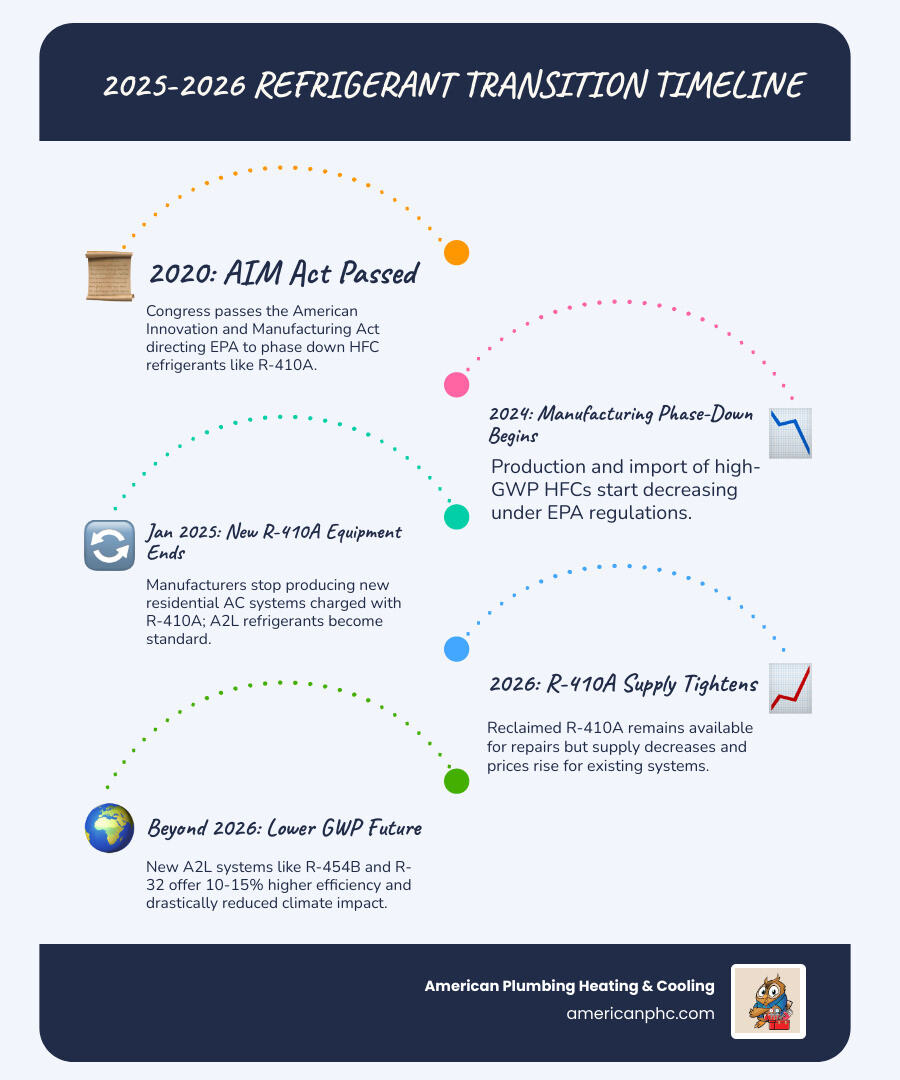
- R-410A will still be available for repairs in 2026, though supply is tightening and costs are rising.
- New A2L systems run 10–15% more efficiently, which can save the average homeowner over $160 per year.
Starting January 1, 2025, manufacturers stopped producing new residential AC equipment charged with R-410A. That is a big industry shift — but it does not mean your current system needs to go anywhere. What it does mean is that the financial math around repairs versus replacement is quietly changing, especially here in Florida where AC systems run harder and longer than almost anywhere else in the country.
Whether your system just needs a recharge or you are weighing a full replacement, understanding this transition helps you make smarter decisions and avoid being caught off guard.
Understanding the 2025-2026 Shift: How AC Refrigerant Changes Affect Homeowners
To understand why these changes are happening in 2026, we have to look back at the federal legislation that set everything in motion. In December 2020, the U.S. Congress passed the American Innovation and Manufacturing (AIM) Act. This law directed the Environmental Protection Agency (EPA) to phase down the production and consumption of hydrofluorocarbons (HFCs)—the chemical compounds used as refrigerants in our home air conditioners.
The primary target of this phase-down is R-410A, which has been the industry-standard refrigerant for residential cooling systems since the late 2000s. While R-410A does not deplete the ozone layer, it is a highly potent greenhouse gas. In fact, R-410A has a Global Warming Potential (GWP) of 2,088. This means it is more than 2,000 times more effective at trapping heat in our atmosphere than carbon dioxide.
To curb this environmental footprint, the EPA mandated a strict phase-down timeline. Following the January 1, 2025 manufacturing ban on new R-410A equipment, the final grace period for installing pre-manufactured R-410A systems ended on January 1, 2026. Now, in mid-2026, any new central air conditioning system installed in Florida must utilize a low-GWP alternative.
This historic transition is designed to protect our planet. Phasing out ozone-depleting substances and high-GWP gases globally is projected to avoid approximately 1.6 million skin cancer deaths and more than 45 million cases of cataracts in the United States alone among individuals born between 1890 and 2100.
For a closer look at how these chemical compounds work inside your home cooling setup, you can read our guide on AC System Basics Florida Homes.
What Are A2L Refrigerants and Are They Safe for Residential Use?
The new class of cooling compounds replacing R-410A is known as A2L refrigerants. The two primary options selected by major HVAC manufacturers are R-454B and R-32.
But what exactly does "A2L" mean? This is a safety classification designed by ASHRAE (the American Society of Heating, Refrigerating and Air-Conditioning Engineers):
- "A" stands for Low Toxicity: These gases are completely safe for humans under normal residential operating conditions.
- "2" stands for Flammability: They have a higher flammability rating than older, non-flammable "Class 1" gases like R-410A.
- "L" stands for Low Burning Velocity: This is the key. While they can technically ignite under highly specific laboratory conditions, they burn incredibly slowly and are exceptionally difficult to light.
In real-world terms, A2L refrigerants are far less flammable than common household items you probably keep under your kitchen sink or in your bathroom, such as hairspray, rubbing alcohol, or aerosol cooking sprays. Extensive laboratory testing has proven that common ignition sources—like a match, a lighter, or a cigarette—are simply not strong enough to ignite these gases.
Furthermore, their environmental benefits are massive. R-454B has a GWP of 466 (78% lower than R-410A), while R-32 has a GWP of 675 (68% lower than R-410A). By transitioning to these alternatives, the industry is cutting the climate impact of residential cooling systems by roughly 65% to 78%.
Safety Features and How AC Refrigerant Changes Affect Homeowners
Even though A2L refrigerants are incredibly stable, safety remains the top priority for manufacturers and regulatory bodies. Because of this, new A2L-compliant air conditioning systems are built with specialized, integrated safety features that older R-410A systems never required.
The most notable upgrade is the inclusion of factory-installed Refrigerant Detection Systems (RDS). These systems utilize highly sensitive leak sensors placed directly inside the indoor evaporator coil cabinet. If a refrigerant leak is detected, the RDS automatically triggers a built-in mitigation sequence:
- Compressor Shutdown: The system immediately turns off the outdoor compressor to stop the flow of refrigerant and prevent further pressure buildup.
- Blower Fan Activation: The indoor blower fan is automatically switched on to its maximum speed. Even if your thermostat is set to "Off," the system will force the fan to run.
- Air Dilution: By circulating a high volume of air through your home's ductwork, the system quickly dilutes the leaking refrigerant, ensuring it never reaches a concentration level where it could pose even a minor flammability risk.
These advanced control boards and safety loops ensure that your family remains perfectly safe, giving you complete peace of mind as we move forward into this new era of home comfort.
Impact on Existing Systems: Do You Need an Immediate Replacement?
If your current air conditioner is running perfectly fine, you can breathe a sigh of relief. There is absolutely no law requiring you to replace a functioning R-410A or R-22 air conditioner. Your existing system remains 100% legal to own, operate, and repair.
However, the transition does change the financial equation for older systems. If your AC is approaching the end of its typical lifespan—which is often 10 to 15 years in humid, coastal Florida climates—you will need to weigh the long-term viability of repairs versus upgrading.
To help you make this decision, we have put together a comprehensive comparison in our guide on AC Repair vs Replacement Florida.
Managing Older Units and How AC Refrigerant Changes Affect Homeowners
While your existing system is legal to keep, managing an older unit will become more challenging and expensive as time goes on. Under the AIM Act, the production of virgin R-410A is being systematically phased down. By 2036, high-GWP HFC production will be reduced by 85% compared to historical baselines.
Because the supply of newly manufactured R-410A is tightening, the market is relying heavily on reclaimed gas to service existing systems. Between 2000 and 2018, refrigerant reclaimers reported reclaiming more than 140 million pounds of HCFC-22 (R-22), which successfully kept older systems running for years. A similar reclamation pipeline is now supporting R-410A. However, as supply shrinks and demand remains high, the cost of R-410A recharges will continue to rise.
If your system develops a major refrigerant leak, simply "topping it off" is no longer a viable or environmentally responsible solution. Under EPA regulations, leaks must be located and permanently repaired. If your older unit faces a leak in a major component, like the evaporator coil, the combined cost of the repair and the expensive R-410A replacement gas may make a full system replacement the smarter financial choice.
Proper maintenance is also critical for managing indoor humidity in our state. You can learn more about this in our article on AC Humidity Control Florida Homes.
To protect your investment and extend the life of your current system, we recommend taking these proactive maintenance steps:
- Schedule Annual Tune-Ups: Professional maintenance keeps your system running at peak efficiency and allows technicians to catch tiny leaks before they turn into major, expensive repairs.
- Change Air Filters Regularly: Clogged filters restrict airflow, causing your system to run longer and placing extra strain on the compressor and coils, which can lead to vibration-induced refrigerant leaks.
- Keep the Outdoor Unit Clear: Ensure that grass, weeds, and debris are kept at least two feet away from your outdoor condenser unit to maintain proper heat transfer.
- Monitor Performance: Keep an eye out for warning signs of a leak, such as weak cooling, ice forming on the copper lines, or sudden, unexplained spikes in your monthly utility bills.
Can I Retrofit My R-410A System to Use R-454B or R-32?
We are frequently asked by homeowners if they can simply drain their old R-410A system and refill it with one of the new, eco-friendly A2L refrigerants. The answer is a definitive no.
A2L refrigerants are not "drop-in" replacements. They operate under different pressures and require entirely different, incompatible compressor lubricants. Furthermore, older R-410A systems lack the specialized electrical wiring, control boards, and integrated safety sensors (like the RDS) required by modern building codes for A2L operation.
Attempting to mix different refrigerant types or put an A2L gas into an older system will instantly destroy the compressor, void your manufacturer warranty, and create a serious safety hazard. To transition to the new refrigerants, you must complete a full system replacement, which includes upgrading both the outdoor condenser unit and the indoor evaporator coil simultaneously.
For a detailed breakdown of your options when upgrading, see our AC Installation Options Comparison Guide.
Financial Incentives and Long-Term Efficiency Benefits
While a refrigerant transition can feel overwhelming, it actually presents a fantastic opportunity for Florida homeowners to save money and upgrade their indoor comfort.
Because A2L refrigerants have superior heat-transfer properties compared to R-410A, new systems are designed to be highly energy-efficient. On average, new A2L cooling systems are 10% to 15% more efficient than older R-410A models. In our demanding Florida climate, upgrading to an ENERGY STAR-certified system can easily save homeowners over $160 per year in electricity costs.
To better understand these efficiency metrics, check out A Homeowner Guide to Efficiency Ratings.
The table below outlines the key differences between the legacy refrigerant and the two primary low-GWP alternatives used in modern systems:
| Refrigerant Type | Global Warming Potential (GWP) | Safety Classification | Operating Pressure | Retrofittable with R-410A? |
|---|---|---|---|---|
| R-410A (Legacy) | 2,088 | A1 (Non-Flammable) | Baseline | N/A |
| R-454B (New) | 466 (78% Lower) | A2L (Mildly Flammable) | ~3% Lower than R-410A | No |
| R-32 (New) | 675 (68% Lower) | A2L (Mildly Flammable) | ~10% Higher than R-410A | No |
To help offset the initial investment of upgrading to a high-efficiency A2L system, there are several incredible financial incentives available right now in 2026. Under the federal Inflation Reduction Act, homeowners can claim substantial tax credits for qualifying high-efficiency equipment. For instance, you can receive up to $2,000 in federal tax credits for qualifying energy-efficient heat pumps, or up to $600 for qualifying central air conditioning units.
To learn how to maximize these savings, read our detailed guides:
- How Florida Homeowners Can Cash In on the Inflation Reduction Act
- The Floridians Guide to High Efficiency Cooling Incentives
- How to Get Paid for Upgrading Your Florida Home
Frequently Asked Questions About Refrigerant Changes
Navigating industry-wide regulatory changes naturally brings up a lot of questions. Here are the answers to the most common concerns we hear from homeowners in Southwest and Northwest Florida.
Will R-410A still be available for AC repairs in Florida?
Yes. While the EPA has banned the manufacture of new R-410A systems, they have not banned the refrigerant itself. R-410A will remain available for servicing and repairing existing systems for many years to come. However, because new production is being phased down, the supply will increasingly rely on reclaimed refrigerant. This tightening supply means that over time, the cost to recharge an older R-410A system will continue to rise.
Do I have to replace my working AC because the laws changed?
No, absolutely not. There is no regulatory requirement to replace a properly functioning air conditioner. You can legally run your current R-410A or R-22 system for its entire natural operating life. The transition only affects you when your system reaches a point where it is no longer cost-effective to repair, and you choose to purchase a new unit.
What should I ask my HVAC contractor when buying a new system?
When you are ready to upgrade your home's cooling system, it is important to work with a professional, licensed contractor who has specialized training in the new refrigerants. We suggest asking your contractor the following questions:
- Are your technicians certified under EPA Section 608 and specifically trained in A2L safety and handling?
- Will you be installing a fully matched system (replacing both the outdoor condenser and indoor evaporator coil) to ensure proper A2L safety sensor integration?
- Does the quoted system qualify for local utility rebates or federal tax credits?
- Do you pull all necessary local municipal permits for the installation?
To prepare for your installation day, check out our Complete Guide AC Installation Step-by-Step Homeowners and our Ultimate Guide AC Installation Sizing Troubleshooting.
Conclusion
The 2025-2026 refrigerant transition represents a major step forward for environmental sustainability and home energy efficiency. While it changes the landscape of residential cooling, it does not have to be a source of stress. By understanding how these changes affect your home, you can make proactive, informed decisions that protect your comfort and your budget.
At American Plumbing Heating and Cooling, we have been serving Florida homeowners since 2014. With over 100 years of combined team experience, our fully licensed and certified pros are ready to help you navigate this transition. Whether you need a reliable repair on your existing system in Sarasota, Bradenton, Venice, and Cape Coral, or you want to explore upgrading to a high-efficiency A2L system in Milton, Navarre, and Pensacola, we provide honest, upfront pricing and guaranteed workmanship.
Don't wait for the summer heat to catch you off guard. Schedule your professional AC service today with American Plumbing Heating and Cooling and let us help you keep your home cool, safe, and highly efficient!
{"@context": "https://schema.org", "@graph": [{"@type": "Article", "headline": "How AC Refrigerant Changes Affect Homeowners | American PHC", "description": "Learn how AC refrigerant changes affect homeowners in Florida, from R-410A repairs to new A2L systems. Call American Plumbing Heating and Cooling today.", "author": {"@type": "Person", "name": "American Plumbing Heating and Cooling"}, "publisher": {"@type": "Organization", "name": "American Plumbing Heating and Cooling", "logo": {"@type": "ImageObject", "url": "https://firebasestorage.googleapis.com/v0/b/ai-templates.appspot.com/o/bot%2FiTB8FxoyvSplQzS7StV8%2Flogo%2FScreenshot%202026-03-16%20at%2012.43.20%E2%80%AFPM.png?alt=media&token=4ae5e171-7bb5-4a27-91f4-47e969b91c80"}}, "datePublished": "2026-07-18T02:47:41+00:00", "dateModified": "2026-07-18T02:48:02.322620", "mainEntityOfPage": {"@type": "WebPage", "@id": "https://pms.ciwebgroup.com/americanphc/2026/07/18/everything-you-need-to-know-about-how-ac-refrigerant-changes-affect-homeowners/"}, "image": "https://images.bannerbear.com/direct/4mGpW3zwpg0ZK0AxQw/requests/000/151/805/869/NnaW7b28GYDeN91wz4VwORxZl/a53a6276175136f2222fb9078884da92d67ff208.jpg"}, {"@type": "FAQPage", "mainEntity": [{"@type": "Question", "name": "Is my existing R-410A air conditioner illegal after the refrigerant changes?", "acceptedAnswer": {"@type": "Answer", "text": "No. Your existing R-410A system is not illegal, and you can continue using it and have it repaired."}}, {"@type": "Question", "name": "Can an older R-410A AC system be retrofitted to use new refrigerants like R-454B or R-32?", "acceptedAnswer": {"@type": "Answer", "text": "No. Older systems cannot be retrofitted to use the new A2L refrigerants because they are not compatible."}}, {"@type": "Question", "name": "Will R-410A refrigerant still be available for AC repairs in 2026?", "acceptedAnswer": {"@type": "Answer", "text": "Yes. R-410A will still be available for repairs in 2026, but supply is tightening and costs are rising."}}, {"@type": "Question", "name": "What refrigerants do new residential AC systems use after the R-410A phase-down?", "acceptedAnswer": {"@type": "Answer", "text": "New residential AC systems now use A2L refrigerants such as R-454B or R-32, which have significantly lower climate impact than R-410A."}}, {"@type": "Question", "name": "How do the new refrigerant changes affect whether homeowners should repair or replace their AC system?", "acceptedAnswer": {"@type": "Answer", "text": "The changes do not require homeowners to replace an existing system, but they are changing the financial math around repair versus replacement. New A2L systems run 10–15% more efficiently, which can save the average homeowner over $160 per year."}}]}]}Need HVAC Help?
Our certified technicians are ready to help with all your heating and cooling needs.
Request ServiceAbout the Author
American Plumbing Heating and Cooling Team
Licensed Florida contractors — HVAC CAC1821761 · Plumbing CFC1431919
More Articles
View All PostsRelated Articles


Ready to Get Started?
Whether you need a repair, maintenance, or a new system installation, our expert team is here to help.