
How the Pros Find Leaks Without Tearing Down Your House
By the American Plumbing Heating and Cooling Team
Licensed Florida contractors — HVAC CAC1821761 · Plumbing CFC1431919

Discover how professional leak detection works with non-invasive tech. Spot hidden leaks fast, avoid damage—learn signs, methods and expert tips!
Reviewed bythe American Plumbing Heating and Cooling Team — Licensed Florida contractors — HVAC CAC1821761 · Plumbing CFC1431919. Published May 14, 2026. About American Plumbing Heating and Cooling
Dealing with this problem right now? Call (941) 735-6616 and talk to our local team.
Request ServiceWhen Water Hides: What You Need to Know About How Professional Leak Detection Works
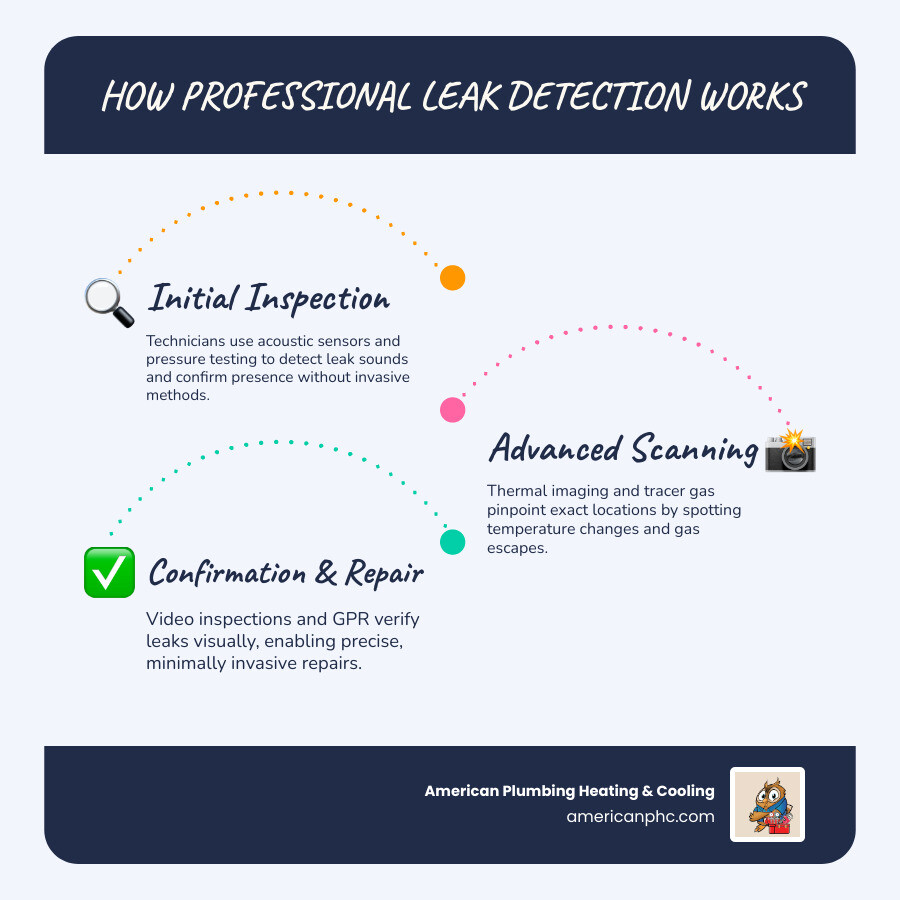
How professional leak detection works comes down to using specialized, non-invasive tools to find exactly where water is escaping — without tearing apart your walls, floors, or foundation. Here's a quick overview:
- Acoustic/Ultrasonic Detection – Sensitive ground microphones pick up the faint sounds of water escaping pressurized pipes, even under concrete slabs.
- Thermal Imaging – Infrared cameras spot temperature changes caused by moisture hiding behind walls or under floors.
- Tracer Gas Testing – A safe mix of nitrogen and hydrogen is pumped into pipes; electronic sniffers detect where the gas escapes.
- Video Pipe Inspection – A small camera travels inside pipes to visually confirm cracks, blockages, or damage.
- Ground Penetrating Radar (GPR) – Radar waves map underground pipes and pinpoint leak locations without any digging.
- Pressure Testing – Pipes are pressurized and monitored; a pressure drop confirms a leak is present.
Water is one of the most destructive forces inside a home — and the real danger is that you often can't see it coming. A hidden leak behind a wall or under a slab can go unnoticed for months, quietly rotting wood, feeding mold growth, and racking up your water bill. By the time visible damage appears, the problem is usually far worse than it looks. In April 2026, with the average U.S. homeowner insurance claim for water damage exceeding $10,000, catching a leak early isn't just smart — it's essential. The good news is that modern professional leak detection makes it possible to find even the smallest hidden leak quickly, accurately, and without unnecessary damage to your home.
Recognizing the Warning Signs of a Hidden Water Leak
Identifying a leak before it causes a catastrophe requires a bit of detective work. While some leaks are obvious—like a geyser in the front yard—most are "silent" or hidden. Statistics show that about 8.1% of homes experience a plumbing leak each year. In Florida, where humidity is already high, these leaks can lead to rapid mold growth and structural decay.
Keep an eye out for these common red flags:
- Spiking Water Bills: If your water usage hasn't changed but your bill is climbing, you likely have a leak. American households waste an average of 10,000 gallons of water annually due to leaks.
- Musty Odors: That "old basement" smell in your living room or bathroom often indicates water is pooling behind drywall or under floorboards.
- Physical Changes: Look for peeling paint, bubbling wallpaper, or warped baseboards. Wet spots on the floor or "warm spots" on a concrete slab are major indicators of a hot water line leak.
- Sound of Running Water: If you hear a faint hissing or rushing sound when all your faucets are turned off, water is moving somewhere it shouldn't be.
The financial stakes are high. With the average insurance claim for water damage sitting at over $10,000, and the U.S. collectively losing over $10 billion to these claims annually, ignoring these signs is a gamble. If you spot these indicators in the Suncoast area, our Leak Detection Service Sarasota FL and Leak Detection Service Venice FL teams are ready to help you pinpoint the source before the damage spreads.
How Professional Leak Detection Works: The Science of Non-Invasive Technology
In the past, finding a leak often involved "search and destroy" missions—plumbers would tear out sections of drywall or jackhammer concrete just to find a pinhole leak. Today, how professional leak detection works is much more sophisticated. We use a combination of physics and electronic sensors to "see" and "hear" through solid objects.
| System Type | Primary Technology | Best Use Case | Benefit |
|---|---|---|---|
| Mechanical | Turbines/Pressure Gauges | Initial diagnosis and confirmation | Simple and reliable |
| Ultrasonic | High-frequency sound waves | Pinhole leaks in pressurized lines | Extremely precise |
| Smart Systems | Wi-Fi enabled flow monitors | 24/7 monitoring and auto-shutoff | Preventative protection |
By using these non-invasive tools, we can locate a leak within inches. This precision means we only need to make a small, targeted repair rather than a massive renovation. For residents in Manatee County, our Leak Detection Service Bradenton FL utilizes these advanced electronic sensors to keep your home intact during the diagnostic process.
How professional leak detection works using acoustic and ultrasonic sensors
Acoustic detection is essentially "superhuman hearing." When water escapes a pressurized pipe, it creates a distinct vibration or hissing sound. While this sound is too faint for the human ear to hear through a concrete slab, professional ground microphones and ultrasonic sensors can pick it up.
Our technicians use high-quality headphones and amplifiers to scan the floor or walls. We use frequency filtering to drown out background noise—like traffic or air conditioners—allowing us to focus solely on the "hiss" of the leak. As we move closer to the source, the sound intensity increases on our digital display. This method is incredibly effective for pressurized water lines. For those in growing communities like Leak Detection Service Lakewood Ranch FL, this technology ensures that your modern flooring and finishes aren't ruined in the search for a rogue pipe.
How professional leak detection works with thermal imaging and tracer gas
Sometimes sound isn't enough, especially for slow drips or leaks in non-pressurized lines. This is where thermal imaging and tracer gas come into play.
Thermal Imaging: Infrared cameras allow us to see temperature signatures. Water leaks often cause a "cool spot" due to evaporative cooling (or a "hot spot" if it's a water heater line). By scanning your walls or floors, we can see moisture patterns that are invisible to the naked eye. This is particularly useful for identifying leaks behind tiled shower walls or under hardwood floors.
Tracer Gas Testing: This is one of the most clever methods in our toolkit. We drain the water from the suspected line and pump in a safe, non-toxic mixture of 95% nitrogen and 5% hydrogen. Because hydrogen is the lightest element on earth, it escapes through the tiniest cracks in the pipe and rises through soil or concrete. Our technicians then use "electronic sniffers" to detect where the gas is emerging. If you are in the Florida Panhandle, our Leak Detection Service Milton FL experts often use this method for complex residential systems where traditional methods might struggle.
Advanced Methods for Underground and Slab Leak Detection
Underground leaks are particularly "sneaky" because the water can travel long distances through the soil before ever surfacing. In many Florida homes, plumbing is buried beneath a thick concrete slab foundation.
To tackle these, we use:
- Ground Penetrating Radar (GPR): This uses radar pulses to image the subsurface. It can identify voids in the soil caused by water erosion and locate the exact path of buried pipes.
- Video Pipe Inspections: We feed a high-definition, waterproof camera into your sewer or drain lines. This provides a live "eyes-on" view of the pipe's interior, allowing us to see cracks, root intrusions, or collapsed sections.
- Slab Leak Pinpointing: By combining acoustic sensors with tracer gas, we can find a leak under your home's foundation with surgical precision.
For homeowners in Santa Rosa County, our Leak Detection Service Navarre FL uses these advanced methods to protect your property's structural integrity. Finding a slab leak early can prevent the foundation from shifting or cracking, which is a much more expensive problem to fix later.
Why Professional Expertise is Essential for Florida Homeowners
You might be tempted to try a DIY approach, but professional leak detection is almost always more cost-effective in the long run. Professional tools are significantly more sensitive than anything available at a hardware store. Furthermore, water follows the path of least resistance—where you see a wet spot on the ceiling is rarely where the actual leak is located.
In Florida, the risks of "waiting and seeing" are amplified. Undetected leaks contribute to:
- Structural Integrity Issues: Constant moisture weakens wood framing and can cause concrete to deteriorate.
- Health Risks: Mold can begin to grow within 24 to 48 hours in our humid climate, leading to respiratory issues and allergies.
- Massive Water Waste: The United States loses over two trillion gallons of water a year to infrastructure leaks. On a smaller scale, that's 10,000 gallons per household.
Whether you are in Southwest Florida or the Panhandle, our Leak Detection Service Cape Coral FL provides the peace of mind that comes with a certified diagnosis. We don't just find the leak; we provide the documentation you need for insurance claims, helping you recover from the over $10 billion in annual damages water leaks cause across the country.
Frequently Asked Questions about Professional Leak Detection
What are silent leaks and how are they identified?
Silent leaks are those that don't cause immediate puddles. They are often identified by a persistent musty smell or an unexplained increase in your water bill. Professionals find them by checking the "leak indicator" (a small propeller) on your water meter while all faucets are off. We also use tracer dyes in toilets or smoke testing in drainage systems to see where air or water is escaping.
How do smart leak detection systems monitor and shut off water?
Modern smart systems use ultrasonic waves or mechanical turbines to measure the flow of water into your home. They "learn" your typical usage patterns. If the system detects a constant flow (like a burst pipe) or an unusual drip, it can automatically close a motorized valve at your main water line and send an alert to your smartphone via Wi-Fi.
What should homeowners do immediately if they suspect a leak?
If you suspect a leak, your first step should be to shut off the main water valve to prevent further damage. Next, take photos of any visible dampness or damage for insurance purposes. Finally, check your water meter to confirm the leak is active and call a professional technician immediately. Do not wait for the spot to get bigger; early intervention is the key to minimizing costs.
Conclusion
Understanding how professional leak detection works helps you appreciate the technology and skill required to protect your home. At American Plumbing Heating and Cooling, we bring over 100 years of combined experience to every job. We are a locally owned and operated team that understands the unique challenges Florida homeowners face, from sandy soils to high humidity.
We pride ourselves on honest, upfront pricing and a 100% satisfaction guarantee. Whether you are dealing with a suspected slab leak in Sarasota or a hidden pipe burst in Milton, our certified pros are available 24/7 for emergencies. Don't let a small drip become a $10,000 disaster. Contact our experts for professional services today and let us find the problem without tearing down your house.
Need HVAC Help?
Our certified technicians are ready to help with all your heating and cooling needs.
Request ServiceAbout the Author
American Plumbing Heating and Cooling Team
Licensed Florida contractors — HVAC CAC1821761 · Plumbing CFC1431919
More Articles
View All PostsRelated Articles


Ready to Get Started?
Whether you need a repair, maintenance, or a new system installation, our expert team is here to help.