
How to Determine HVAC Maintenance Frequency for Gulf Coast Homes
By the American Plumbing Heating and Cooling Team
Licensed Florida contractors — HVAC CAC1821761 · Plumbing CFC1431919

Discover the right HVAC maintenance frequency for Gulf Coast homes to fight salt air, humidity, and extend system life.
Reviewed bythe American Plumbing Heating and Cooling Team — Licensed Florida contractors — HVAC CAC1821761 · Plumbing CFC1431919. Published June 24, 2026. About American Plumbing Heating and Cooling
Dealing with this problem right now? Call (941) 735-6616 and talk to our local team.
Request ServiceWhy HVAC Maintenance Frequency for Gulf Coast Homes Is Nothing Like the National Standard
Understanding the right HVAC maintenance frequency for the Gulf Coast homes you live in could be the difference between a system that lasts 15 years and one that gives out in 8. Across most of the country, a once-a-year professional tune-up is considered standard. On the Gulf Coast, that baseline simply isn't enough.
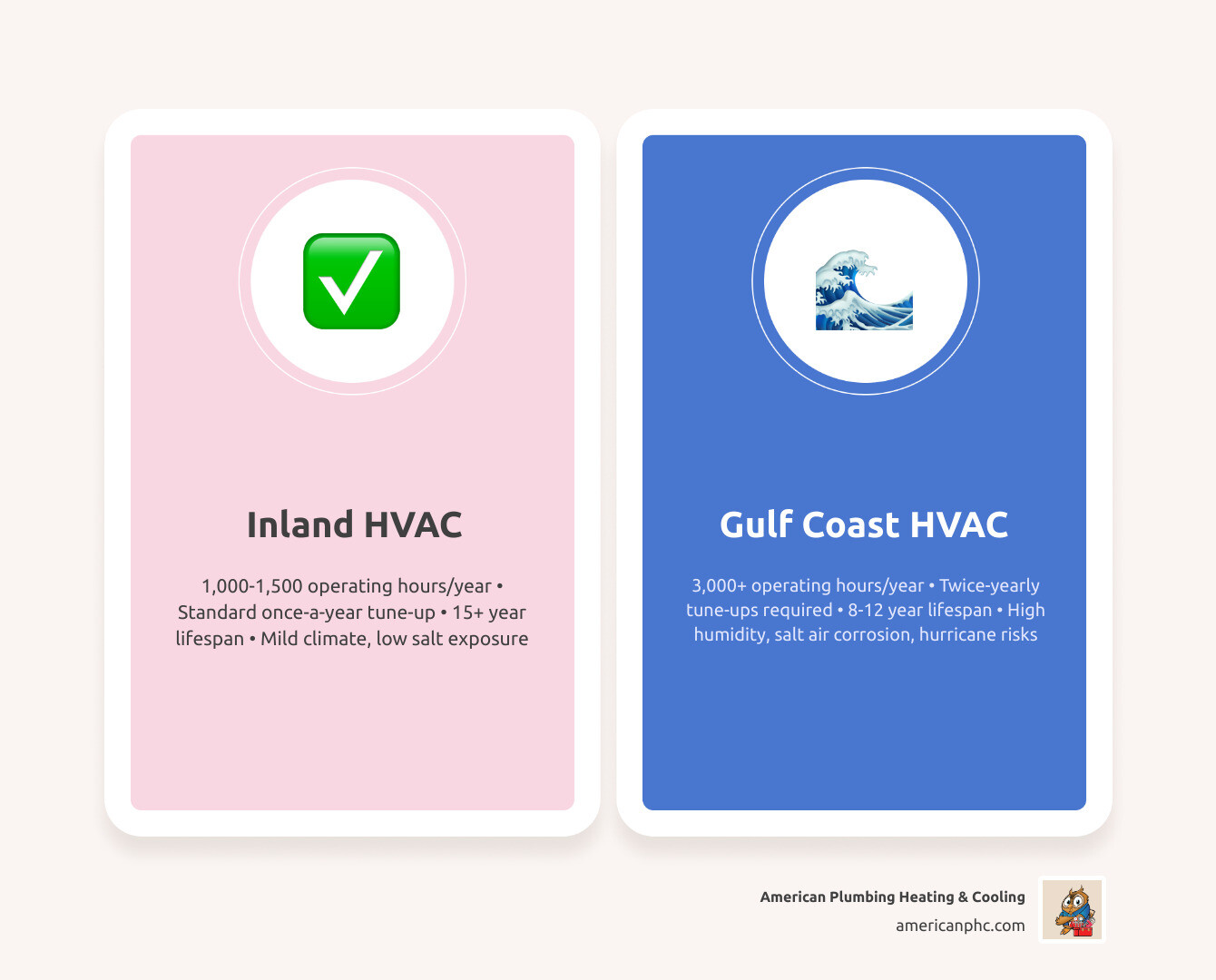
Gulf Coast HVAC systems run 8 to 12 months per year — logging over 3,000 operating hours annually compared to roughly 1,000 to 1,500 hours in milder inland climates. Add in average humidity levels around 74 to 75%, salt-laden coastal air, and the threat of hurricane season, and your system is working in one of the most punishing environments in the country.
Here's a quick-reference breakdown of what Gulf Coast homeowners should follow:
| Task | Frequency |
|---|---|
| Air filter inspection and replacement | Every 30 days |
| Condensate drain line flush | Monthly |
| Outdoor unit rinse (fresh water) | Every 2–4 weeks in peak season |
| Outdoor unit debris clearance | Monthly |
| Professional tune-up (standard AC) | Twice per year (spring + fall) |
| Professional tune-up (heat pump) | Twice per year minimum |
| Duct inspection | Every 2–3 years |
| Protective coil coating check | Annually |
| Post-hurricane inspection | After every named storm |
The bottom line: most Gulf Coast homeowners should schedule professional HVAC maintenance twice a year — once in spring (March–April) before peak cooling season, and once in fall (October–November) after the summer grind. Heat pump owners and those within a few miles of the coast may need a third visit annually for older systems.
The sections below explain why this schedule matters, what to do yourself each month, and how to protect your system from salt air, humidity, and storm damage.
Why HVAC Maintenance Frequency for the Gulf Coast Homes Differs from National Standards
When we talk about the "national standard" for HVAC care, we're usually looking at guidelines written for temperate climates—places where the AC takes a long nap from October to May. In areas like Sarasota, Bradenton, or Pensacola, our air conditioners don't get that luxury.
The hvac maintenance frequency for the gulf coast homes must account for what we call "thermal stress." Because our units run nearly year-round, they accumulate three times the wear and tear of a system in the Midwest. Imagine driving your car 30,000 miles a year versus 10,000; you wouldn't wait three years for an oil change, right?
Beyond the sheer runtime, we have to deal with the "Coastal Clock." In a dry, inland climate, a well-maintained AC might last 20 years. Along the Gulf Coast, a neglected unit may gasp its last breath in just 8 to 10 years. Salt air is a silent killer, causing galvanic corrosion that eats away at aluminum fins and copper tubing. This leads to refrigerant leaks that are often too expensive to repair on an aging unit.
Furthermore, our systems aren't just cooling the air; they are massive dehumidifiers. When humidity levels stay above 70%, your HVAC works overtime to pull gallons of water out of the air every day. This constant moisture creates a breeding ground for biological growth inside your ducts and drain lines. By following Don't Sweat It: A Local Guide to HVAC System Maintenance, you can fight back against these local environmental stressors.
The Ideal HVAC Maintenance Frequency for the Gulf Coast Homes: A Seasonal Breakdown
For those of us living in Southwest and Northwest Florida, we recommend a biannual service schedule. This "twice-a-year" approach ensures your system is prepared for the two distinct phases of our climate.
The Spring Tune-Up (March–April)
This is your most critical appointment. Before the 95-degree days arrive in Cape Coral or Fort Myers, a professional needs to ensure your system is at peak efficiency. Neglected systems in hot, humid climates can consume up to 25% more energy while delivering 30% less cooling capacity. A spring visit focuses on cleaning the coils and checking refrigerant levels to ensure you aren't paying for electricity that isn't actually cooling your home.
The Fall Recovery (October–November)
After a brutal Florida summer, your system is tired. The fall visit is about "recovery." We check for the wear and tear caused by three months of non-stop operation. This is also the time we focus on indoor air quality, checking for mold or mildew that may have started to form in the damp environment of your air handler. If you use a heat pump—which many of our neighbors in Milton and Navarre do—this visit is essential because that same system is about to switch gears to provide warmth during our occasional chilly winter nights.
To understand why this timing is so specific, check out The Magic Number for HVAC Maintenance Success.
Monthly DIY Tasks to Support HVAC Maintenance Frequency for the Gulf Coast Homes
While professional visits are the backbone of system health, there are things we need you to do every month to keep the "Gulf Coast Grime" at bay.
- Filter Replacement: This is the single most important DIY task. A dirty filter can increase your energy consumption by 15% immediately because the blower has to work much harder to pull air through the blockage. In our humid climate, dust turns into a sticky "sludge" when it hits the moist coils. Change your 1-inch filters every 30 days. If you have pets or live near a construction site in Lakewood Ranch, check them every two weeks.
- The Vinegar Flush: Algae and slime love Florida drain lines. Once a month, pour a cup of distilled white vinegar down your condensate drain line. This kills the "bio-sludge" that causes 90% of our emergency service calls.
- Outdoor Clearance: Keep at least two feet of clearance around your outdoor condenser. Trim back the hibiscus and palm fronds. If the unit can't "breathe," it can't dump the heat from your house, which leads to compressor failure.
For more tips on getting ahead of the heat, read One Simple Way to Spring AC Maintenance Before Florida Heat.
Professional Checkpoints for HVAC Maintenance Frequency for the Gulf Coast Homes
When our certified pros come out for your biannual visit, we aren't just looking at the unit—we’re performing a deep-dive diagnostic. Here is what we cover:
- Refrigerant Levels: Even a 10% deficiency in refrigerant can spike your energy bills by 20%. We check for tiny leaks caused by salt air corrosion.
- Electrical Connections: Heat causes wires to expand and contract, which can loosen terminals. We tighten everything and test the capacitors—the parts most likely to fail during a July heatwave.
- Coil Cleaning: We use specialized cleaners to remove the salt and dirt buildup that prevents heat transfer.
- Blower Calibration: We ensure the motor is pulling the correct amperage. Proper maintenance can extend motor life by 5 to 8 years.
If you’re wondering if it’s really worth the call, here are 20 Reasons to Schedule Your HVAC Tune-Up Today.
Protecting Your System from Salt Air and High Humidity
Living in places like Siesta Key or Venice means your HVAC is constantly "breathing" salt air. Salt is highly corrosive to the delicate aluminum fins on your outdoor unit. Over time, this leads to "pitting," which destroys the coil's ability to release heat.

To combat this, we recommend:
- Fresh Water Rinses: Every few weeks, use a garden hose (not a pressure washer!) to gently rinse the salt off your outdoor unit.
- Protective Coatings: For homes within five miles of the coast, we can apply epoxy-based anti-corrosion coatings to the coils. This can extend the life of a coastal unit from 7 years to 12 or more.
- Whole-Home Dehumidifiers: If your home feels "clammy" even when the AC is running, your humidity is likely above 60%. This is the "danger zone" for mold. A dedicated dehumidifier takes the load off your AC, allowing it to focus on cooling while the dehumidifier handles the moisture.
For a deeper look at how we prep for the unique Florida environment, see our guide on Spring AC Tune-Up in Florida 101.
Hurricane Season and Emergency Preparedness
In Florida, "maintenance" also includes storm prep. Hurricane season (June through November) poses a double threat: physical damage and electrical surges.
Before the Storm:
- Surge Protection: Lightning and power grid fluctuations are common here. We recommend installing a dedicated HVAC surge protector to save your expensive control boards.
- Tie-Downs: Ensure your unit is securely bolted to its hurricane pad. Florida building codes are strict about this for a reason.
After the Storm: Never turn your AC back on immediately if it was submerged or if there is visible debris inside the fan. Saltwater is highly conductive; turning on a wet unit can cause an instant electrical short. Always schedule a post-storm inspection to clear debris and check for pressure leaks.
Regular care is your best defense against the unexpected. Learn more about Preventing HVAC Emergencies with Regular Maintenance and follow these How to Prepare AC for Florida Heat in 7 Easy Steps.
Warning Signs Your Coastal System Needs Immediate Attention
Sometimes, your system won't wait for its scheduled visit. If you notice these signs, your hvac maintenance frequency for the gulf coast homes needs an emergency adjustment:
- The "Dirty Sock" Smell: This musty odor usually indicates biological growth on your evaporator coil or inside your ducts. It’s common in humid areas like Port Charlotte and Cape Coral.
- Humidity Spikes: If your windows are fogging up inside or your skin feels sticky, your AC is no longer effectively removing moisture.
- Short-Cycling: If the unit turns on and off every few minutes, it’s likely overheating or has a failing capacitor.
- Weak Airflow: This could be a clogged filter, but in our area, it’s often a sign of a frozen coil or a blower motor nearing the end of its life.
Don't wait for a total breakdown. Check out How to Get Your Cooling System Ready for Hot Weather to spot these issues early.
Frequently Asked Questions about Coastal HVAC Care
How often should I change my air filter in Florida?
In the Florida climate, we recommend a monthly inspection. While some filters claim to last 90 days, the high pollen counts (especially oak and pine in the spring) and constant runtime mean most filters are "full" after 30 to 45 days. If you have pets that shed, you might even need to change them every 3 weeks during the peak of summer.
Do heat pumps require more frequent service than central AC?
Yes, because they never get a break! A standard furnace/AC combo lets the AC rest in the winter. A heat pump works in the summer to cool and in the winter to heat. This year-round operation requires a strict biannual schedule to check the reversing valve and the defrost cycle, which are critical for winter performance.
How does salt air affect my warranty?
Many manufacturers require proof of annual or biannual professional maintenance to honor a warranty claim. If your coils fail due to corrosion and you haven't had them professionally cleaned or maintained, the manufacturer may deny the claim, citing "environmental neglect." Keeping your service records from American Plumbing Heating and Cooling is your best insurance policy.
Conclusion
Living on the Gulf Coast is a dream, but the climate is a nightmare for mechanical equipment. By adjusting your hvac maintenance frequency for the gulf coast homes to a biannual schedule and staying diligent with your monthly DIY tasks, you can protect your investment and ensure your home remains a cool sanctuary.
At American Plumbing Heating and Cooling, we’ve seen it all—from salt-corroded coils in Siesta Key to lightning-struck compressors in Pensacola. With over 100 years of combined experience and a team of certified pros, we’re here to help you navigate the unique challenges of Florida homeownership. Whether you need a spring tune-up in Sarasota or an emergency repair in Cape Coral, our honest, upfront pricing and 24/7 availability mean you’re never left in the heat.
Ready to take the guesswork out of your AC care? Explore our Maintenance Plan and let us handle the "Coastal Clock" for you. We’ll keep your system running efficiently, your bills low, and your air clean—no matter how high the humidity climbs. Give us a call today and experience the peace of mind that comes with expert, local service.
Need HVAC Help?
Our certified technicians are ready to help with all your heating and cooling needs.
Request ServiceAbout the Author
American Plumbing Heating and Cooling Team
Licensed Florida contractors — HVAC CAC1821761 · Plumbing CFC1431919
More Articles
View All PostsRelated Articles


Ready to Get Started?
Whether you need a repair, maintenance, or a new system installation, our expert team is here to help.