
How to Size Your Gulf Coast AC Without Breaking a Sweat
By the American Plumbing Heating and Cooling Team
Licensed Florida contractors — HVAC CAC1821761 · Plumbing CFC1431919

How to Size Your Gulf Coast AC Without Breaking a Sweat - Learn about getting the right size hvac for the gulf coast homes
Reviewed bythe American Plumbing Heating and Cooling Team — Licensed Florida contractors — HVAC CAC1821761 · Plumbing CFC1431919. Published May 8, 2026 · Last updated July 29, 2026. About American Plumbing Heating and Cooling
Dealing with this problem right now? Call (941) 735-6616 and talk to our local team.
Request ServiceI'm Looking for an AC That Can Handle the Sarasota Humidity. How Do I Know What Size I Need?
Getting the right size hvac for the gulf coast homes comes down to one core principle: square footage alone won't cut it. Here's a quick answer to get you started:
Quick Sizing Guide for Gulf Coast Homes:
- Get a Manual J load calculation — this is the industry standard, not a rule of thumb
- Account for humidity (latent load) — in Florida, moisture can make up 30–50% of your total cooling load
- Factor in your specific home — insulation, windows, sun exposure, and attic conditions all shift your tonnage requirement
- Meet the 2026 minimum — new Gulf Coast AC installations must meet at least SEER2 14.3
- Choose the right system type — heat pumps and variable-speed systems handle coastal humidity far better than standard single-stage units
Living on the Gulf Coast is beautiful — the beaches, the warm weather, the salt air. But that same environment is relentless on your home's cooling system. Summers in Sarasota, Cape Coral, Pensacola, and Milton push heat indices well past what most national HVAC sizing charts are built for. High humidity doesn't just make your home feel hot — it adds an invisible layer of cooling demand called latent load that a wrongly sized system simply cannot manage.
Too big, and your AC shuts off before it ever pulls enough moisture out of the air — leaving you cool but clammy. Too small, and it runs nonstop, struggles to keep up, and wears out fast. Neither is comfortable, and both cost you more in the long run.
This guide walks you through exactly how to size your system the right way for Gulf Coast conditions — so you stay comfortable, avoid mold problems, and get the most out of your investment.
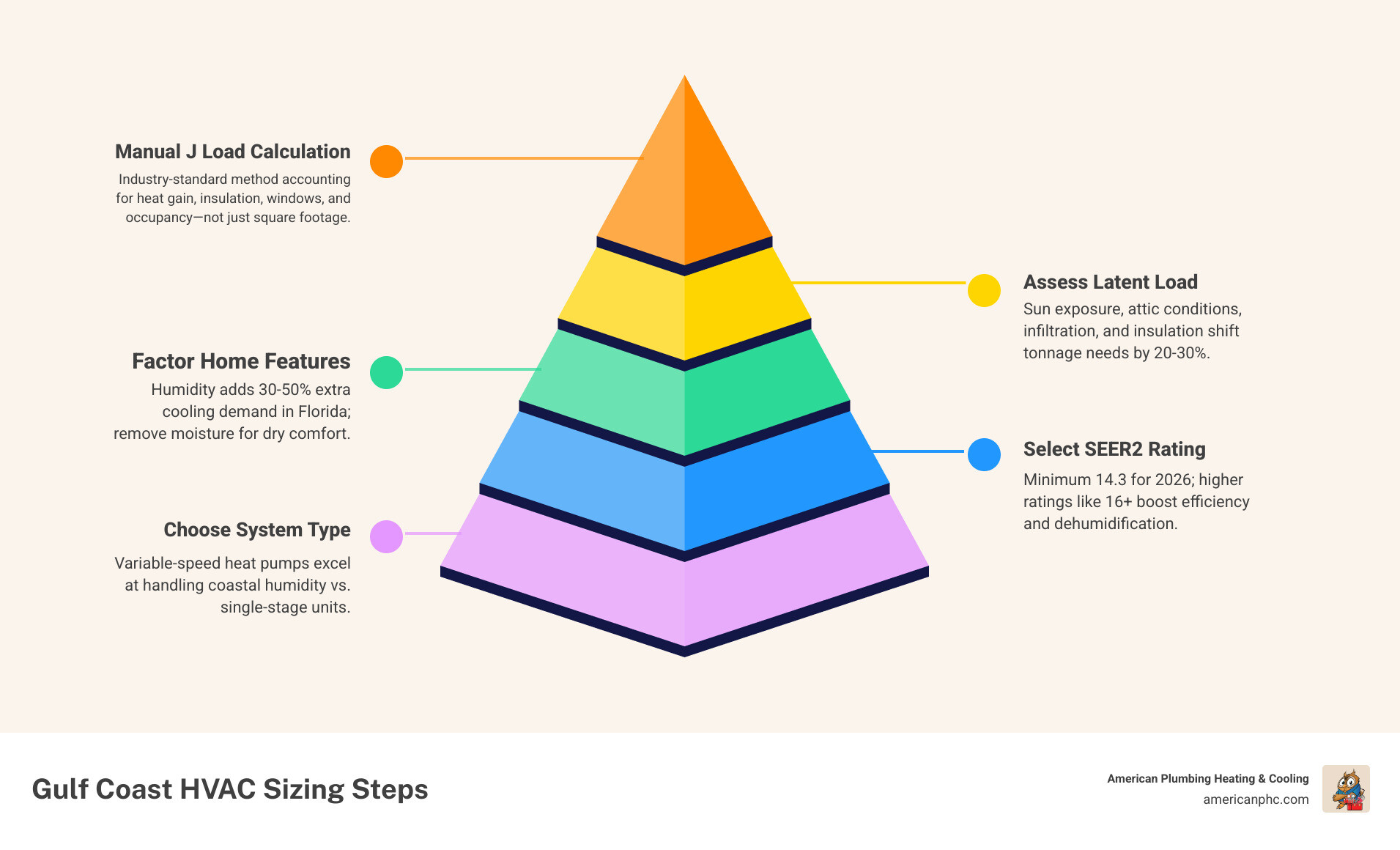
Getting the right size HVAC for the Gulf Coast homes: Why square footage is a myth
If you’ve ever heard someone say, "You need one ton of cooling for every 500 square feet," you’ve heard the most common myth in the industry. While that might work in a climate with low humidity and mild summers, it is a recipe for disaster here in Florida.
HVAC "size" actually refers to cooling capacity, measured in BTUs (British Thermal Units) or Tonnage. One ton of cooling equals 12,000 BTUs per hour. For a home in Sarasota or Bradenton, the cooling capacity isn't just about the floor space; it’s about how much heat and moisture the system can remove in an hour.
When getting the right size hvac for the gulf coast homes, relying on a "rule of thumb" ignores the reality of our 2026 climate. Two houses with identical square footage can have completely different cooling needs. One might have brand-new impact windows and a shaded backyard, while the other has older single-pane glass and sits in the direct afternoon sun. If you put the same 3-ton unit in both, one family will be comfortable while the other faces sky-high energy bills and a "sticky" living room.
The role of Manual J in getting the right size HVAC for the Gulf Coast homes
To get it right, we use the industry-standard engineering calculation: the ACCA Manual J Load Calculation. This isn't a guess; it's a deep dive into the physics of your home. A professional Sarasota AC Installation and Replacement should always begin with this assessment.
A Manual J calculation looks at several critical factors:
- The Building Envelope: What are your walls made of? How much insulation is in your attic?
- Fenestration: The number, size, and orientation of your windows (West-facing windows in Florida are heat magnets!).
- Infiltration: how much "leakage" or outside air enters the home.
- Internal Gains: How many people live there? Do you have high-heat appliances?
- Orientation: Which way does the house face in relation to the sun?
By calculating these variables, we determine the exact tonnage needed to keep you cool without wasting energy. In many Florida jurisdictions, providing this calculation is even a requirement for the permitting process.
How getting the right size HVAC for the Gulf Coast homes stops the "cool but clammy" feeling
Have you ever walked into a house where the thermostat says 72 degrees, but you still feel sweaty or "sticky"? That is the classic sign of an oversized AC unit. This happens because of a phenomenon called "short cycling."
An oversized unit is so powerful that it cools the air temperature in your home very quickly. It hits the target temperature and shuts off within 8 to 10 minutes. However, it takes about 15 to 20 minutes of continuous running for the evaporator coils to get cold enough to effectively pull moisture out of the air.
When the system shuts off too soon, the temperature is low, but the relative humidity remains high. This leads to that "cool but clammy" feeling and, worse, creates a breeding ground for mold. Getting the right size hvac for the gulf coast homes ensures the system runs in longer, steadier cycles that properly dehumidify your space.
What specific coastal factors in Cape Coral and Milton influence my system's capacity?

If you live in Cape Coral, Milton, or Navarre, you face environmental challenges that inland homeowners don't. These factors directly influence your cooling load and the lifespan of your equipment.
Solar Gain and Windows Florida receives intense solar radiation. If your home has significant west-facing glazing (more than 15% window-to-wall ratio), your cooling load spikes in the afternoon. Many homeowners in our service areas have upgraded to impact-resistant, low-E windows for hurricane protection. These windows actually reduce the tonnage you need because they block so much heat. If you replace an old AC unit with the same size it was 15 years ago but you've since upgraded your windows, your old "correct" size might now be oversized!
Insulation and Attic Heat In the Florida Panhandle and Southwest Florida, attic temperatures can reach a staggering 140°F to 150°F. If your ductwork is located in an unconditioned attic, that heat "bleeds" into your cool air. Modern standards often recommend R-49 insulation to combat this. Our pros at American Plumbing Heating and Cooling look at your specific attic ventilation and insulation levels during Cape Coral AC Installation and Replacement to ensure the unit can overcome that attic heat.
Salt Air and Corrosion Living within five miles of the coast means your AC unit is essentially being sandblasted by salt air. Salt attracts moisture and accelerates rust on coils and electrical components. This doesn't just shorten the unit's life; it reduces its efficiency over time. As the coils corrode, they can't transfer heat as well, meaning a 3-ton unit might eventually perform like a 2.5-ton unit. This is why we prioritize units with factory-applied epoxy or polymer coatings for our coastal customers.
Which energy-efficient systems and maintenance plans are best for Pensacola?
Choosing the right size is the first step, but choosing the right technology is how you truly beat the heat. As of 2023, the Department of Energy requires a minimum of 14.3 SEER2 (equivalent to the old 15 SEER) for new installations in Florida.
| System Type | Best For | Humidity Control |
|---|---|---|
| Central Air (Single-Stage) | Budget-conscious, simple layouts | Standard |
| Variable-Speed Systems | Maximum comfort, high humidity | Excellent |
| Heat Pumps | Year-round efficiency in Florida | High |
| Ductless Mini-Splits | Additions, stilt homes, sunrooms | Exceptional |
The Power of Variable-Speed In places like Pensacola and Milton, we highly recommend variable-speed (inverter) compressors. Unlike a standard AC that is either "on" or "off," a variable-speed system can run at 30% capacity or 100% capacity. This allows it to run for much longer periods at a lower power level, which is the "Goldilocks" zone for removing humidity. It keeps the air moving and the moisture disappearing without breaking the bank on energy.
Coastal Maintenance is Non-Negotiable In a salt-air environment, your system's lifespan can drop to just 5–7 years without care. With a proper HVAC Maintenance Plan, you can push that back to 10–15 years. This includes professional coil cleanings and checking for the "pitting" that salt causes.
Whether you are deciding between Ducted vs. Ductless HVAC Systems or simply need a tune-up before the July heat hits, having a local expert who understands the Gulf Coast climate is vital.
Frequently Asked Questions about Coastal AC Sizing
What are the risks of an oversized HVAC system in Florida?
The biggest risk is poor indoor air quality. Because the unit "short cycles" (turns on and off too frequently), it never removes enough humidity. This leads to high relative humidity (above 60%), which is the primary cause of mold growth in Florida homes. Additionally, starting and stopping the compressor frequently causes significant wear and tear, leading to premature component failure and higher energy bills.
What SEER rating is required for Gulf Coast homes in 2026?
Currently, the federal minimum for our region is 14.3 SEER2. However, for most homeowners in Sarasota and Cape Coral, we recommend 16 SEER2 or higher. While the upfront cost is different, the "payback period" in Florida is very short—typically 3 to 5 years—because we run our air conditioners almost year-round. High-efficiency ENERGY STAR systems can save you up to 30% on your monthly cooling costs.
How often should I rinse my coastal HVAC unit to prevent rust?
If you live within a mile of the Gulf, we recommend a gentle rinse of your outdoor condenser unit with fresh water every 2 to 3 weeks. This helps wash away the salt deposits before they can "eat" into the metal fins. Just be sure to use a gentle stream—never a pressure washer, which can bend the delicate fins and restrict airflow.
Conclusion
Getting the right size hvac for the gulf coast homes is about more than just staying cool; it’s about protecting your home from mold, ensuring your family’s comfort, and keeping your energy bills manageable in our intense Florida climate. From the white sands of Pensacola to the canals of Cape Coral and the vibrant streets of Sarasota, every home has a unique "cooling fingerprint" that requires a professional touch.
At American Plumbing Heating and Cooling, we bring over 100 years of combined experience to every job. We don't believe in "rules of thumb" or high-pressure sales. We believe in honest, upfront pricing and engineering-backed solutions that work for the long haul. Whether you need a 24/7 emergency repair or a precision Manual J calculation for a new installation, our certified pros are ready to help.
Don't sweat the sizing process. Let us handle the calculations so you can get back to enjoying the Gulf Coast life.
Ready to find your perfect fit? Explore Our Services or call us today for an expert consultation!
{"@context": "https://schema.org", "@graph": [{"@type": "Article", "headline": "Getting the Right Size HVAC for Gulf Coast Homes", "description": "Getting the right size HVAC for Gulf Coast homes starts with Manual J, humidity, and home details. Read the guide and size your AC right.", "author": {"@type": "Person", "name": "American Plumbing Heating and Cooling"}, "publisher": {"@type": "Organization", "name": "American Plumbing Heating and Cooling", "logo": {"@type": "ImageObject", "url": "https://firebasestorage.googleapis.com/v0/b/ai-templates.appspot.com/o/bot%2FiTB8FxoyvSplQzS7StV8%2Flogo%2FScreenshot%202026-03-16%20at%2012.43.20%E2%80%AFPM.png?alt=media&token=4ae5e171-7bb5-4a27-91f4-47e969b91c80"}}, "datePublished": "2026-05-08T02:46:28+00:00", "dateModified": "2026-05-08T02:46:31.963469", "mainEntityOfPage": {"@type": "WebPage", "@id": "https://pms.ciwebgroup.com/americanphc/2026/05/08/how-to-size-your-gulf-coast-ac-without-breaking-a-sweat/"}, "image": "https://images.unsplash.com/photo-1566661528035-18c5fa4bc1c9?crop=entropy&cs=tinysrgb&fit=max&fm=jpg&ixid=M3w2MTMxNjF8MHwxfHNlYXJjaHwxfHxHdWxmJTIwQ29hc3QlMjBob21lJTIwd2l0aCUyMEhWQUMlMjB1bml0fGVufDB8MHx8fDE3NzY3NDA2ODZ8MA&ixlib=rb-4.1.0&q=80&w=1080"}, {"@type": "FAQPage", "mainEntity": [{"@type": "Question", "name": "How do I know what size AC I need for a Gulf Coast home?", "acceptedAnswer": {"@type": "Answer", "text": "The right AC size should be based on a Manual J load calculation, not square footage alone. In Gulf Coast homes, humidity, insulation, windows, sun exposure, and attic conditions all affect how much cooling capacity you need."}}, {"@type": "Question", "name": "Why isn't square footage enough to size an AC in Florida?", "acceptedAnswer": {"@type": "Answer", "text": "Square footage alone misses the impact of heat and moisture, which are major factors in Gulf Coast climates. Florida homes need systems sized for both temperature control and humidity removal, or comfort and efficiency can suffer."}}, {"@type": "Question", "name": "How does Gulf Coast humidity affect AC sizing?", "acceptedAnswer": {"@type": "Answer", "text": "Humidity adds latent load, which can make up about 30–50% of the total cooling load in Florida. If the system is oversized, it may cool the air too quickly without removing enough moisture; if undersized, it can run constantly and still struggle to keep up."}}, {"@type": "Question", "name": "What happens if my AC is too big or too small for my home?", "acceptedAnswer": {"@type": "Answer", "text": "An oversized AC can shut off before it removes enough humidity, leaving the home cool but clammy. An undersized system may run nonstop, wear out faster, and still fail to maintain comfort."}}, {"@type": "Question", "name": "What type of AC system works best for Gulf Coast humidity?", "acceptedAnswer": {"@type": "Answer", "text": "The article says heat pumps and variable-speed systems handle coastal humidity better than standard single-stage units. It also notes that new Gulf Coast AC installations must meet at least SEER2 14.3 by 2026."}}]}]}Need HVAC Help?
Our certified technicians are ready to help with all your heating and cooling needs.
Request ServiceAbout the Author
American Plumbing Heating and Cooling Team
Licensed Florida contractors — HVAC CAC1821761 · Plumbing CFC1431919
More Articles
View All PostsRelated Articles


Ready to Get Started?
Whether you need a repair, maintenance, or a new system installation, our expert team is here to help.