
Stop the Sweat to Stop the Spores
By the American Plumbing Heating and Cooling Team
Licensed Florida contractors — HVAC CAC1821761 · Plumbing CFC1431919

Learn how humidity control prevents mold in your home. Protect your Florida home from spores, health risks, and moisture damage.
Reviewed bythe American Plumbing Heating and Cooling Team — Licensed Florida contractors — HVAC CAC1821761 · Plumbing CFC1431919. Published May 22, 2026 · Last updated July 29, 2026. About American Plumbing Heating and Cooling
Dealing with this problem right now? Call (941) 735-6616 and talk to our local team.
Request ServiceWhy Knowing How Humidity Control Prevents Mold in Your Home Could Save You Thousands
How humidity control prevents mold in your home comes down to one simple principle: mold spores need moisture to grow, and keeping your indoor humidity below 60% — ideally between 30% and 50% — starves them of what they need.
Here's a quick breakdown of how it works:
- Keep humidity in the 30–50% range using a dehumidifier, air conditioner, or proper ventilation
- Fix leaks and dry wet areas within 24–48 hours — mold can begin forming in as little as one to two days
- Ventilate high-moisture areas like bathrooms, kitchens, and laundry rooms to push humid air outside
- Monitor humidity levels with a hygrometer and act when readings climb above 60%
- Maintain your HVAC system so it removes moisture from the air efficiently
In Florida, this is not just a best practice — it's a year-round necessity. The heat, frequent rain, and sticky outdoor air create the perfect conditions for mold to take hold inside your home fast. In fact, mold spores are always present in the air around us. They only become a problem when they land on a moist surface and start to multiply.
Left unchecked, high indoor humidity does more than grow mold. It can warp wood, peel paint, damage drywall, attract pests, and trigger serious respiratory problems — especially for children, older adults, and anyone with asthma or allergies.
The good news? Moisture is the one factor you can actually control.
The Science of How Humidity Control Prevents Mold in Your Home
To understand how humidity control prevents mold in your home, we have to look at the biology of the mold spore. Mold is a type of fungus that reproduces by releasing tiny, invisible spores into the air. These spores are everywhere—they are a natural part of our environment in places like Sarasota and Cape Coral. However, they only become a "mold problem" when they find a hospitable place to land and grow.
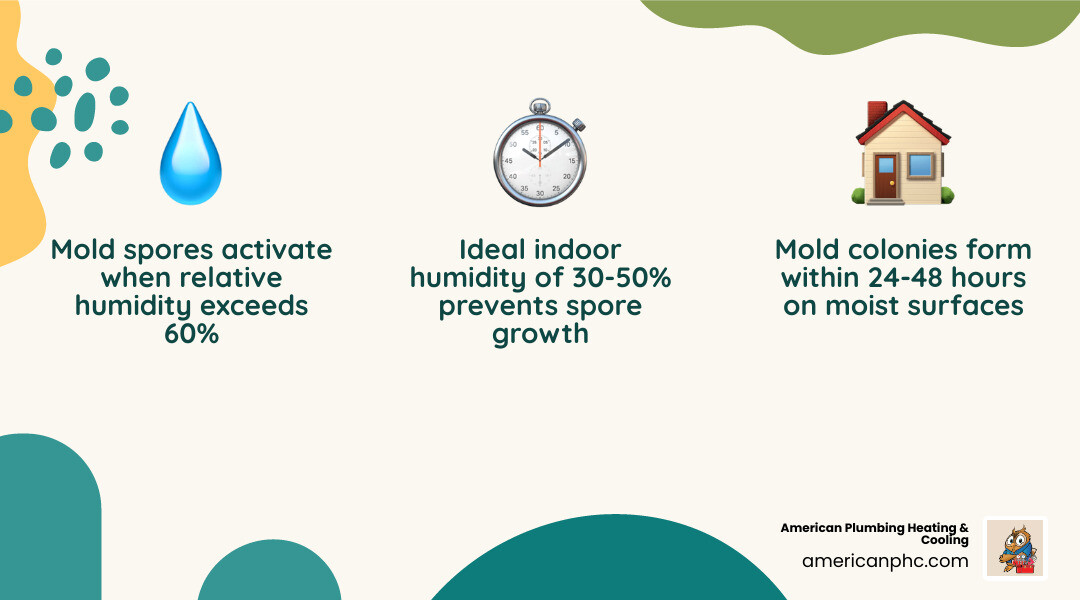
The most critical ingredient for mold growth is moisture. Scientific research, including guidelines from the EPA, confirms that mold thrives in environments where relative humidity consistently exceeds 60%. When humidity levels reach 70% or higher, fungal growth becomes almost inevitable. By maintaining a moisture balance within the 30-50% range, you effectively create a desert environment for these spores, preventing them from colonizing your walls, carpets, and ceilings.
Time is also a factor. Once a surface becomes wet—whether from a leak or heavy condensation—mold can trigger growth within a narrow 24-48 hour window. This is why immediate Indoor Air Quality management is so vital. If you can keep the air dry and surfaces clear of standing water, the spores remain dormant and harmless.
Why Humidity Control Prevents Mold in Your Home During Florida Summers
Living in Florida in April 2026 means we are already feeling the climb toward the sweltering summer months. In regions like Sarasota and Cape Coral, the outdoor humidity is often high enough to make the air feel thick. When that warm, moist air enters your home and hits a cool surface—like an AC vent or a window pane—it creates condensation.
Condensation provides the perfect "drink" for mold spores. Furthermore, our homes are full of organic food sources: drywall paper, wood framing, dust, and even some paints. When you combine stagnant air with Florida heat and moisture, you’ve essentially built a mold incubator. This is why How to Keep Your Florida Home Mold-Free and Cool is such a frequent topic of conversation for us. Without active humidity control, your home’s structural integrity is at risk.
Health Risks of Mold Exposure
We don’t just care about mold because it looks ugly or smells musty; we care because of the health of your family. Mold exposure is linked to a variety of respiratory issues. For many, it starts with "cold-like" symptoms: sneezing, a runny nose, red eyes, and skin rashes.
However, for vulnerable populations—such as young children, the elderly, or those with compromised immune systems—the risks are higher. Mold can trigger severe asthma attacks and chronic sinus infections. Inhaling these spores regularly can lead to long-term lung irritation. Ensuring your Air Conditioning system is properly removing moisture isn't just about comfort; it's a health priority for every household in Southwest Florida.
Practical Strategies for Moisture Management
If we want to stop the spores, we have to be proactive. You can’t manage what you don’t measure. We recommend every homeowner in our service areas—from Port Charlotte to Pensacola—invest in a digital hygrometer. These inexpensive devices act like a "radar system" for your home, giving you real-time data on your indoor humidity levels.
Once you identify that your humidity is creeping above that 50% safety mark, it’s time to implement physical changes. This includes using exhaust fans every time you cook or shower and ensuring that air is moving freely through your home. If your current setup isn't cutting it, professional Humidifier and Dehumidifier Installation Sarasota, FL or Humidifier and Dehumidifier Installation Cape Coral, FL can provide a permanent solution.
How Humidity Control Prevents Mold in Your Home Through Proper Ventilation
Ventilation is the process of replacing "stale," moist indoor air with "fresh," drier air. In many modern Florida homes, the construction is so tight and energy-efficient that moisture gets trapped inside.
- Kitchen Fans: Always run the range hood when boiling water or steaming food.
- Bathroom Vents: These should run during your shower and for at least 15-20 minutes afterward.
- Dryer Vents: Ensure your dryer vents directly to the outside, not into an attic or crawlspace.
- Attic Airflow: Proper soffit and ridge vents prevent heat and moisture from building up under your roof.
If you are noticing persistent dampness in areas like Bradenton or Venice, it might be time for an upgrade. We specialize in Humidifier and Dehumidifier Installation Bradenton, FL and Humidifier and Dehumidifier Installation Venice, FL to ensure your ventilation systems are working in harmony with your climate.
Using Dehumidifiers for Effective Spore Prevention
While air conditioners do remove some moisture, they aren't always enough in the deep humidity of the Florida Panhandle or the Gulf Coast. Sometimes the AC reaches the target temperature and shuts off before it has removed enough water from the air. This is where dehumidifiers come in.
For residents in Milton or Navarre, a dedicated unit can make a world of difference. We offer Humidifier and Dehumidifier Installation Milton, FL and Humidifier and Dehumidifier Installation Navarre, FL. In larger homes, such as those in Lakewood Ranch, a whole-home system integrated into your HVAC is often the most efficient choice. You can learn more about Humidifier and Dehumidifier Installation Lakewood Ranch, FL to see how these systems automatically maintain the perfect 30-50% RH range.
Maintaining Home Systems to Stop Spore Growth
Preventing mold isn't just about the air; it's about the structure. If water is leaking into your home, no amount of ventilation will solve the problem. Regular maintenance of your home's Services—from plumbing to gutters—is your first line of defense.
One often overlooked area is pipe insulation. In the humid Florida air, cold water pipes can "sweat," dripping moisture onto drywall or into cabinets. Simple foam insulation can stop this condensation. Additionally, ensure your foundation is graded so that rainwater flows at least 10 feet away from your home.
Comparison: Portable vs. Whole-Home Dehumidifiers
| Feature | Portable Dehumidifier | Whole-Home Dehumidifier |
|---|---|---|
| Coverage | Single room or small area | Entire house via HVAC ducts |
| Maintenance | Must empty water bucket daily | Drains automatically; annual service |
| Noise | Can be loud in the living space | Quiet (located in attic/closet) |
| Control | Manual settings | Integrated with smart thermostat |
| Installation | Plug-and-play | Requires professional installation |
HVAC Maintenance and Humidity Control
Your air conditioner is actually your home’s primary dehumidifier. As warm air passes over the cold evaporator coils, moisture condenses and drips into a drain pan. If your system is poorly maintained, this process breaks down.
Dirty filters or clogged drain lines can cause water to back up, creating a mold breeding ground right inside your AC unit. Our Don't Sweat It: A Local Guide to HVAC System Maintenance emphasizes the importance of seasonal tune-ups. We also check for "short-cycling"—if your AC is oversized, it will cool the room too fast and shut off before it removes the humidity, leaving you feeling clammy and sticky.
Fixing Leaks and Improving Drainage
A single leaky pipe under a sink can cause a massive mold colony in a matter of days. As part of a proactive Maintenance Plan, we look for the "hidden" signs of moisture:
- Roof Leaks: Water staining on ceilings or in the attic.
- Plumbing Drips: Slow leaks in crawlspaces or behind appliances.
- Gutter Failures: Clogged gutters that allow water to seep into the foundation or basement walls.
- Crawlspace Management: We recommend vapor barriers (plastic covers) over dirt floors to stop ground moisture from rising into your living space.
Seasonal Humidity Management in Florida
Florida doesn't have traditional seasons, but we do have moisture cycles. In the summer, we battle tropical storms and extreme heat. In the winter, although it’s drier outside, we often seal our homes tight. This can lead to window condensation when the warm indoor air hits the glass chilled by the night air.
Following the steps in How to Prepare AC for Florida Heat in 7 Easy Steps is a great way to stay ahead of the curve. You should be especially vigilant in these high-moisture areas:
- Bathrooms (around the tub and behind the toilet)
- Kitchens (under the sink and behind the refrigerator)
- Laundry rooms (behind the washer)
- Basements or crawlspaces
- Closets on exterior walls with poor airflow
Common Mistakes in Humidity Control
We see the same mistakes over and over again that lead to mold growth. One of the biggest is using the "Constant Fan" setting on your thermostat. While it might seem like a good idea to keep air moving, this setting can actually pull moisture off the wet evaporator coils and blow it back into your home before it has a chance to drain. Always use the "Auto" setting.
Another mistake is ignoring that "musty" or "earthy" smell. That odor is literally the scent of mold off-gassing. If you smell it, you likely already have a growth problem. Finally, never just paint over mold. Paint does not kill mold; it just hides it while the fungus continues to eat your drywall from the inside out. For better sleep and a healthier home, Why Your Thermostat is the Secret to a Better Night's Sleep involves managing both temperature and humidity.
Frequently Asked Questions about Humidity and Mold
What is the ideal indoor humidity level to prevent mold growth?
According to the EPA and ASHRAE, the "sweet spot" is between 30% and 50% relative humidity. Once you cross the 60% threshold, the risk of mold growth and dust mite activity increases significantly. Keeping it in this range ensures both your health and the structural safety of your home.
How do I monitor indoor humidity levels at home?
The most effective way is to use a digital hygrometer, which you can place in high-risk areas like the basement or laundry room. Many modern "smart" thermostats also have built-in humidity sensors that can alert your phone if levels get too high. Red flags to watch for include condensation on windows, peeling wallpaper, or a "sticky" feeling to the air.
When should you seek professional help for humidity or mold issues?
If you have visible mold covering an area larger than 10 square feet, or if you can smell mold but can’t find it, it’s time to call in the pros. Persistent high humidity (above 60%) that won't go down even with your AC running is often a sign of an HVAC mechanical failure or an oversized system that needs professional adjustment.
Conclusion
At American Plumbing Heating and Cooling, we’ve spent over a decade helping our neighbors across Florida—from Sarasota to Milton—breathe easier. We know that how humidity control prevents mold in your home is a science, and we have the certified pros and 100+ years of combined experience to get it right.
Whether you need a 24/7 emergency repair for a leaky pipe or a new whole-home dehumidification system, we provide honest, upfront pricing and a 100% satisfaction guarantee. Don't let the Florida humidity win the battle for your home's health.
Protect your home with expert Indoor Air Quality solutions and stop the spores before they start.
{"@context": "https://schema.org", "@graph": [{"@type": "Article", "headline": "How Humidity Control Prevents Mold in Your Home", "description": "Learn how humidity control prevents mold in your home. Keep indoor moisture in check and protect your home—read expert tips now.", "author": {"@type": "Person", "name": "American Plumbing Heating and Cooling"}, "publisher": {"@type": "Organization", "name": "American Plumbing Heating and Cooling", "logo": {"@type": "ImageObject", "url": "https://firebasestorage.googleapis.com/v0/b/ai-templates.appspot.com/o/bot%2FiTB8FxoyvSplQzS7StV8%2Flogo%2FScreenshot%202026-03-16%20at%2012.43.20%E2%80%AFPM.png?alt=media&token=4ae5e171-7bb5-4a27-91f4-47e969b91c80"}}, "datePublished": "2026-05-22T02:46:59+00:00", "dateModified": "2026-05-22T02:47:02.841602", "mainEntityOfPage": {"@type": "WebPage", "@id": "https://pms.ciwebgroup.com/americanphc/2026/05/22/stop-the-sweat-to-stop-the-spores/"}, "image": "https://images.bannerbear.com/direct/4mGpW3zwpg0ZK0AxQw/requests/000/143/620/108/5nDZ3xmVezb2AM9Bzy2qpdWj9/8e5ad784c428558fadf55e17db47a9d4efbd343e.jpg"}, {"@type": "FAQPage", "mainEntity": [{"@type": "Question", "name": "How does humidity control prevent mold in your home?", "acceptedAnswer": {"@type": "Answer", "text": "Humidity control prevents mold by keeping indoor relative humidity below 60%, ideally between 30% and 50%, so mold spores do not have the moisture they need to grow. Since spores are always present in the air, controlling moisture is the key factor that stops them from colonizing surfaces."}}, {"@type": "Question", "name": "What humidity level should a house be to prevent mold?", "acceptedAnswer": {"@type": "Answer", "text": "A home should be kept below 60% relative humidity to reduce mold risk, with an ideal range of 30% to 50%. The article notes that mold thrives above 60% and becomes especially likely when humidity reaches 70% or higher."}}, {"@type": "Question", "name": "How quickly can mold grow after something gets wet?", "acceptedAnswer": {"@type": "Answer", "text": "Mold can begin forming in as little as one to two days after a surface becomes wet. That is why the article recommends fixing leaks and drying wet areas within 24 to 48 hours."}}, {"@type": "Question", "name": "What are the best ways to reduce indoor humidity and stop mold?", "acceptedAnswer": {"@type": "Answer", "text": "The article recommends using a dehumidifier, air conditioner, or proper ventilation to keep humidity in the 30% to 50% range. It also advises ventilating bathrooms, kitchens, and laundry rooms, monitoring humidity with a hygrometer, and maintaining your HVAC system so it removes moisture efficiently."}}, {"@type": "Question", "name": "Why is humidity control especially important in Florida homes?", "acceptedAnswer": {"@type": "Answer", "text": "In Florida, humidity control is a year-round necessity because heat, frequent rain, and humid outdoor air create ideal conditions for mold to grow quickly indoors. The article says this moisture can also lead to warped wood, peeling paint, damaged drywall, pests, and respiratory problems if left unchecked."}}]}]}Need HVAC Help?
Our certified technicians are ready to help with all your heating and cooling needs.
Request ServiceAbout the Author
American Plumbing Heating and Cooling Team
Licensed Florida contractors — HVAC CAC1821761 · Plumbing CFC1431919
More Articles
View All PostsRelated Articles


Ready to Get Started?
Whether you need a repair, maintenance, or a new system installation, our expert team is here to help.