
The No-Sweat Guide to What Your AC Technician Should Check
By the American Plumbing Heating and Cooling Team
Licensed Florida contractors — HVAC CAC1821761 · Plumbing CFC1431919

Use this ac tune up checklist what your technician should check to boost efficiency and prevent Florida AC breakdowns.
Reviewed bythe American Plumbing Heating and Cooling Team — Licensed Florida contractors — HVAC CAC1821761 · Plumbing CFC1431919. Published May 27, 2026 · Last updated July 29, 2026. About American Plumbing Heating and Cooling
Dealing with this problem right now? Call (941) 735-6616 and talk to our local team.
Request ServiceWhat Your AC Technician Should Check: A Complete AC Tune-Up Checklist
The ac tune up checklist what your technician should check covers more than a quick filter swap — a proper service includes a full inspection of electrical components, refrigerant levels, coils, condensate drainage, thermostat calibration, and a final system performance test.
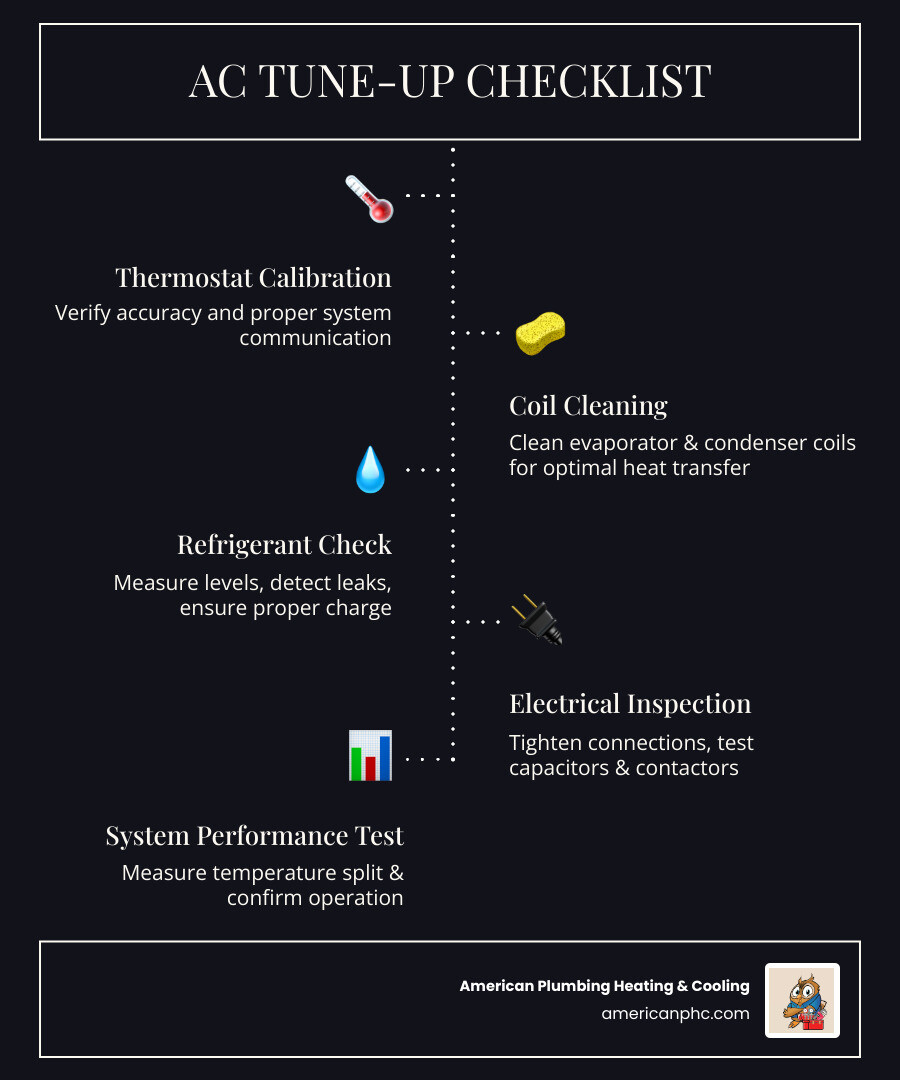
Here is a quick overview of what a professional AC tune-up should include:
- Thermostat calibration - verify accuracy and proper communication with the system
- Air filter inspection and replacement - check for restriction and airflow impact
- Evaporator coil inspection and cleaning - remove buildup that reduces heat absorption
- Condenser coil inspection and cleaning - clear debris blocking heat release
- Refrigerant level check - measure for leaks and proper charge
- Electrical connections - tighten loose wires, inspect for arcing or corrosion
- Capacitor and contactor testing - verify charge and contact condition
- Blower motor and fan inspection - check for wear, measure amperage draw
- Condensate drain clearing - flush line and prevent mold or water damage
- System performance test - measure temperature split and confirm proper operation
A dirty or neglected AC system does not just cool poorly — it works harder, burns more energy, and wears out faster. According to the U.S. Department of Energy, neglecting routine maintenance can increase energy use by 5% to 15% over time. In Florida's heat and humidity, that adds up fast.
For homeowners in Sarasota, Bradenton, Cape Coral, and across Florida, a skipped tune-up often turns into an emergency repair call on the hottest weekend of the year. The good news? Most of those failures are completely preventable with a thorough, professional inspection before peak season hits.
This guide walks you through exactly what a qualified AC technician should check — and why each step matters.
Why Florida Homeowners Need a Professional AC Tune-Up Checklist
Living in Florida means our air conditioners aren't just a luxury; they are a lifeline. From the coastal humidity of Sarasota and Cape Coral to the inland heat of Milton, your HVAC system works harder than almost anywhere else in the country. This constant operation makes a professional ac tune up checklist what your technician should check vital for several reasons.
First, consider your energy bills. A well-maintained system can reduce energy consumption by up to 15%. When your system is clean and calibrated, it reaches the desired temperature faster and stays off longer. Conversely, neglecting maintenance leads to a decline in performance and increased energy use.
Second, there is the matter of humidity control. In Florida, an AC unit’s job is as much about removing moisture as it is about lowering the temperature. If your coils are dirty or your refrigerant is low, the system can't effectively dehumidify your home, leading to that sticky, "swampy" feeling indoors. This is why we recommend learning how to prepare AC for Florida heat in 7 easy steps to stay ahead of the curve.
Finally, regular maintenance is often a requirement for your manufacturer’s warranty. Many companies specify that professional service must be performed annually to keep the warranty valid. As of May 2026, we are seeing more insurance claims being scrutinized based on whether the homeowner performed due diligence in maintaining their equipment. A documented checklist provides the proof you need that you’ve cared for your investment.
The Comprehensive AC Tune-Up Checklist: What Your Technician Should Check
When we arrive at your home in Lakewood Ranch or Venice, we don't just "look" at the unit. A professional 20-point inspection involves deep technical analysis. We use precision tools, such as digital manifold gauges, to get exact readings on system pressure and temperature.
A core part of Don't Sweat It: A Local Guide to HVAC System Maintenance is understanding the "brain" of the system: the thermostat. We calibrate it to ensure that when it says 74 degrees, your home actually is 74 degrees. Even a few degrees of calibration error can result in significant energy waste over a month.
We also focus heavily on the condensate drain. In our humid climate, these lines can easily become clogged with algae or "slime," leading to water backups that can cause thousands of dollars in water damage to your drywall or floors. A professional flush and an algaecide treatment are non-negotiable parts of the service.
Other critical checks include:
- Blower Motor Assessment: We check for debris and measure the amperage to ensure the motor isn't "struggling" or overheating.
- Fan Blades: We inspect for balance and cleanliness. Dirty blades can cause vibrations that lead to mechanical failure.
- Safety Controls: We test all high-pressure and low-pressure switches to ensure the system will shut down safely if a major problem occurs.
Electrical Systems and the AC Tune-Up Checklist: What Your Technician Should Check
The electrical components are often the "silent" reason for a system failure. During our AC Maintenance Tune-Up Sarasota FL visits, we pay special attention to capacitors and contactors.
Capacitors are like small batteries that give your motors the "kick" they need to start. In the Florida heat, these are the most common parts to fail. We test their stored charge to see if they are within the manufacturer's specified range. If they are weak, we replace them before they leave you stranded in 95-degree weather.
We also tighten all electrical connections. Over time, the vibration of the unit can loosen wires. Loose connections lead to "arcing," which generates extreme heat and can melt wires or even start a fire. By measuring the voltage and amperage draw of your compressor and fan motors, we can tell if a component is nearing the end of its life before it actually breaks.
Refrigerant and Coils: Vital Parts of the AC Tune-Up Checklist: What Your Technician Should Check
Your AC doesn't "use up" refrigerant like a car uses gas. It circulates it in a closed loop. If your refrigerant is low, it means you have a leak. During a tune-up, we measure "subcooling" and "superheat"—technical metrics that tell us exactly how the refrigerant is performing.
This is essential for keeping your cool with professional AC maintenance in Bradenton, FL. If the levels are off by even 10%, your efficiency can drop by 20%.
We also inspect the evaporator and condenser coils. Even a thin layer of dust on these coils acts as an insulator, preventing the system from absorbing or releasing heat effectively. If we find bent "fins" on your outdoor unit—often caused by hail, pressure washers, or even lawn mowers—we use a specialized fin comb to straighten them, restoring proper airflow.
Maintenance vs. Repair: Knowing the Difference
It is important to distinguish between a routine tune-up and a repair. A tune-up is proactive; a repair is reactive.
Think of a tune-up like an oil change for your car. You do it while the car is running fine to keep it running fine. A repair is like taking the car to the shop because the engine is smoking. While we provide tips on how to fix AC unit in 5 simple steps for basic troubleshooting, most internal issues require professional tools.
| Feature | Routine AC Tune-Up | AC Repair Service |
|---|---|---|
| Goal | Prevent breakdowns and optimize efficiency | Fix a specific broken component |
| Timing | Scheduled annually or twice-yearly | Emergency or when the system fails |
| Cost | Fixed, predictable maintenance fee | Varies based on parts and labor |
| Tasks | Cleaning, calibrating, and inspecting | Replacing motors, compressors, or boards |
| Lifespan | Extends system life by years | Resolves the immediate crisis |
DIY vs. Professional Maintenance: What to Leave to the Experts
Many Florida homeowners take pride in maintaining their homes, and there are certainly tasks you can handle. However, for safety and technical accuracy, the heavy lifting should be left to a pro.
What You Can Do (DIY):
- Change the Filter: This is the #1 thing you can do. A dirty filter can increase energy use by 15%. Check it every 30 days.
- Clear Debris: Ensure there is at least a 2-foot clearance around your outdoor unit. Trim back bushes and remove grass clippings.
- Clean Vents: Dust your supply and return grilles to keep indoor air quality high.
What We Do (Professional): For more complex needs, refer to The Cape Coral Homeowner's Guide to Professional AC Maintenance Services. Professional tasks include handling refrigerant (which requires EPA certification), testing high-voltage electrical circuits, and deep-cleaning coils with specialized chemicals.
Working with electricity and pressurized gases carries significant safety hazards. Furthermore, we use specialized tools like anemometers to measure airflow and megohmmeters to test compressor health—tools that the average homeowner doesn't have in their garage.
Frequently Asked Questions about AC Maintenance
How long does a typical professional AC tune-up take to complete?
A thorough ac tune up checklist what your technician should check generally takes between 60 and 90 minutes. This gives us enough time to inspect both the indoor and outdoor units, flush the drain lines, test all electrical components, and run the system through a full cooling cycle to verify the "temperature split" (the difference in temperature between the air going in and the air coming out).
What are the signs that my air conditioner needs a tune-up immediately?
If you notice your energy bills creeping up without a change in weather, it’s a major red flag. Other signs include:
- Strange Noises: Squealing, grinding, or banging sounds often indicate a motor or belt issue.
- Weak Airflow: If the air coming out of the vents feels "lazy," you likely have a blower or ductwork problem.
- Frequent Cycling: If the unit turns on and off every few minutes, it is struggling to maintain the set temperature.
- Uneven Cooling: If the living room is a freezer but the bedroom is a sauna, your system needs calibration or duct inspection.
How often should I schedule an AC tune-up in Florida?
In a climate as demanding as ours, we recommend a tune-up twice a year. Ideally, you should schedule a spring visit to prepare for the summer heat and a fall visit to ensure your heating components (like heat strips or heat pumps) are ready for our occasional chilly nights. Regular service is one simple way to spring AC maintenance before Florida heat becomes unbearable.
Conclusion
At American Plumbing Heating and Cooling, we believe that an informed homeowner is a comfortable homeowner. With over 100 years of combined experience, our team has seen exactly what happens when maintenance is ignored—and how much money homeowners save when they stay proactive.
Whether you are in Sarasota, Bradenton, Cape Coral, or Milton, we provide honest, upfront pricing and certified expertise to keep your home running smoothly. Don't wait for the mercury to hit 100 degrees to find out your system is struggling.
Ready to ensure your system is in top shape? Explore our full range of Air Conditioning services and schedule your professional tune-up today. We are here 24/7 for emergencies, but our goal is to make sure you never have one!
{"@context": "https://schema.org", "@graph": [{"@type": "Article", "headline": "AC Tune-Up Checklist: What Techs Should Check | APHC", "description": "See the AC tune-up checklist and what your technician should check. Learn key inspection steps and schedule professional service today.", "author": {"@type": "Person", "name": "American Plumbing Heating and Cooling"}, "publisher": {"@type": "Organization", "name": "American Plumbing Heating and Cooling", "logo": {"@type": "ImageObject", "url": "https://firebasestorage.googleapis.com/v0/b/ai-templates.appspot.com/o/bot%2FiTB8FxoyvSplQzS7StV8%2Flogo%2FScreenshot%202026-03-16%20at%2012.43.20%E2%80%AFPM.png?alt=media&token=4ae5e171-7bb5-4a27-91f4-47e969b91c80"}}, "datePublished": "2026-05-27T02:46:52+00:00", "dateModified": "2026-05-27T02:46:54.654208", "mainEntityOfPage": {"@type": "WebPage", "@id": "https://pms.ciwebgroup.com/americanphc/2026/05/27/the-no-sweat-guide-to-what-your-ac-technician-should-check/"}, "image": "https://images.bannerbear.com/direct/4mGpW3zwpg0ZK0AxQw/requests/000/144/048/448/w0gWbdEPaYaBmRv8zrVklOA5j/7fc3352ef345a16ab7e820baeed6801bc516d63c.jpg"}, {"@type": "FAQPage", "mainEntity": [{"@type": "Question", "name": "What should an AC technician check during a professional tune-up?", "acceptedAnswer": {"@type": "Answer", "text": "A proper AC tune-up should include thermostat calibration, air filter inspection or replacement, evaporator and condenser coil inspection and cleaning, refrigerant level checks, electrical connection inspection, capacitor and contactor testing, blower motor and fan inspection, condensate drain clearing, and a final system performance test."}}, {"@type": "Question", "name": "Why is regular AC maintenance important for Florida homeowners?", "acceptedAnswer": {"@type": "Answer", "text": "In Florida's heat and humidity, air conditioners run harder and longer, which increases wear and the risk of breakdowns. A professional tune-up helps prevent emergency repairs, especially during peak season when failures are more likely to happen."}}, {"@type": "Question", "name": "How does skipping AC maintenance affect energy use?", "acceptedAnswer": {"@type": "Answer", "text": "Neglecting routine AC maintenance can increase energy use by 5% to 15% over time, according to the U.S. Department of Energy. A well-maintained system can reduce energy consumption by up to 15%."}}, {"@type": "Question", "name": "What does an AC system performance test include?", "acceptedAnswer": {"@type": "Answer", "text": "The final system performance test measures the temperature split and confirms that the system is operating properly. This helps verify that the AC is cooling effectively after the inspection and service steps are completed."}}, {"@type": "Question", "name": "What problems can dirty coils, clogged drains, or restricted filters cause in an AC system?", "acceptedAnswer": {"@type": "Answer", "text": "A dirty or neglected AC system cools poorly, works harder, uses more energy, and wears out faster. Issues like buildup on coils, blocked condensate drains, and restricted airflow can also contribute to preventable system failures."}}]}]}Need HVAC Help?
Our certified technicians are ready to help with all your heating and cooling needs.
Request ServiceAbout the Author
American Plumbing Heating and Cooling Team
Licensed Florida contractors — HVAC CAC1821761 · Plumbing CFC1431919
More Articles
View All PostsRelated Articles


Ready to Get Started?
Whether you need a repair, maintenance, or a new system installation, our expert team is here to help.