
Is Your AC Ghosting You? Try These Simple Checks First
By the American Plumbing Heating and Cooling Team
Licensed Florida contractors — HVAC CAC1821761 · Plumbing CFC1431919

Fix your AC fast with ac troubleshooting tips before calling a professional: check thermostat, filters, coils and more!
Reviewed bythe American Plumbing Heating and Cooling Team — Licensed Florida contractors — HVAC CAC1821761 · Plumbing CFC1431919. Published May 26, 2026 · Last updated July 29, 2026. About American Plumbing Heating and Cooling
Dealing with this problem right now? Call (941) 735-6616 and talk to our local team.
Request ServiceIs Your AC Actually Broken — Or Just Needs a Quick Fix?
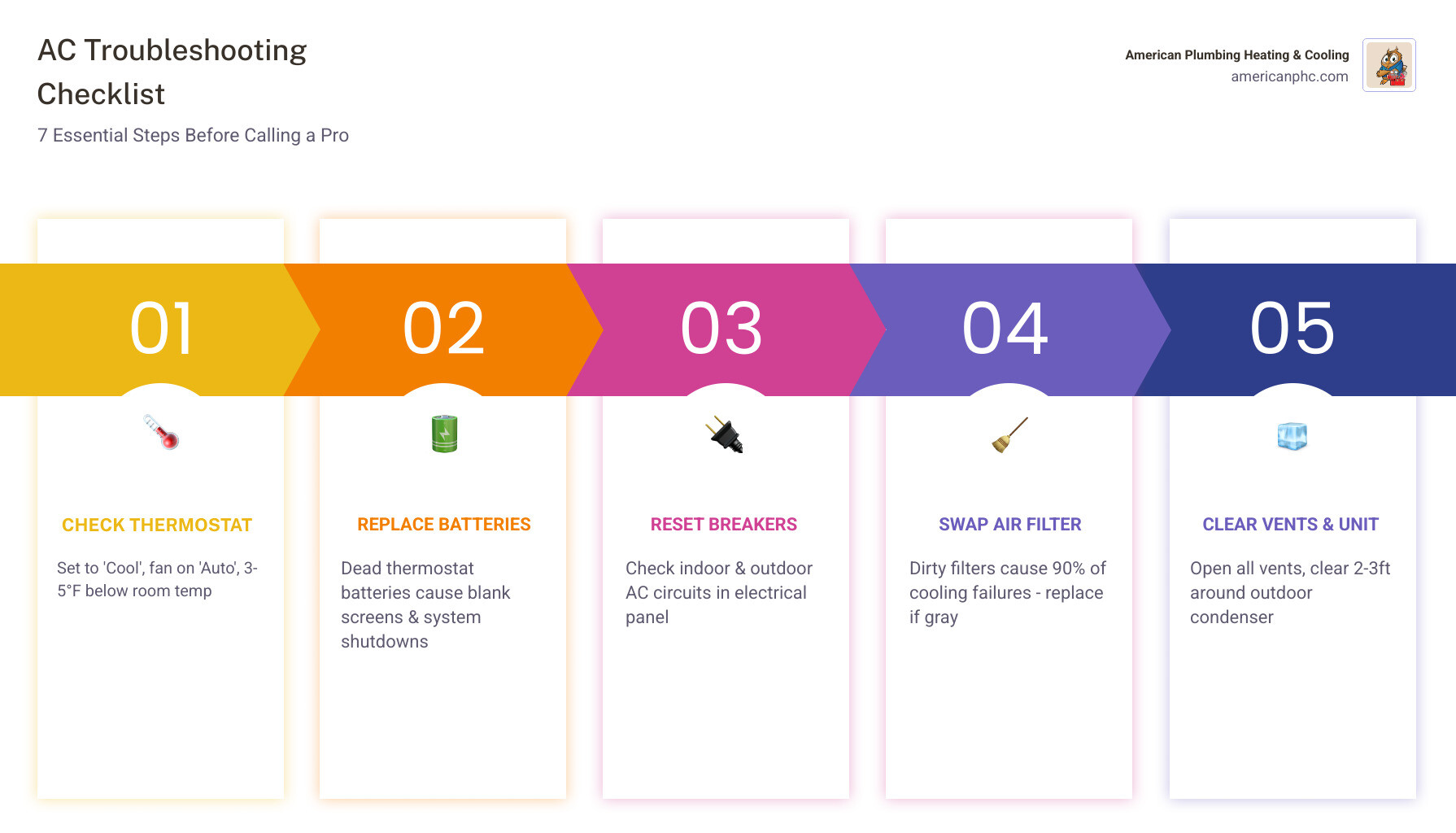
If you're searching for ac troubleshooting tips before calling a professional, here's the short answer: most AC problems can be traced back to a handful of simple, fixable issues. Check these first:
- Thermostat settings — Make sure it's set to "Cool," the fan is on "Auto," and the temperature is at least 3–5 degrees below the current room temperature.
- Dead thermostat batteries — A blank thermostat screen can shut down your entire system.
- Tripped circuit breaker — Check your electrical panel for both the indoor and outdoor AC circuits.
- Dirty air filter — This is the single most common cause of AC problems. If it's gray and clogged, replace it.
- Blocked or closed vents — Make sure all supply and return vents are open and unobstructed.
- Debris around the outdoor unit — Clear leaves, dirt, and overgrowth within 2–3 feet of the condenser.
- Frozen evaporator coil — If you see ice buildup, turn the system off and let it thaw before restarting.
In Florida, when your AC stops working, it's not just uncomfortable — it's urgent. Humidity levels can make a home feel unbearable within minutes of a cooling failure, especially in the peak summer months. The good news? Experts say that nine times out of ten, a central AC unit that isn't cooling well comes down to something simple, like a dirty filter or a misconfigured thermostat.
Before you pick up the phone and schedule a service call, it's worth taking ten minutes to run through a few basic checks. Many homeowners are surprised to find the fix is something they can handle themselves — no tools required. And even when the problem does need a pro, knowing what you've already ruled out helps your technician diagnose the issue faster.
This guide walks you through the most practical ac troubleshooting tips before calling a professional, so you can stay cool, save time, and avoid unnecessary service visits.
Start with the Basics: Power and Thermostat Checks
When the temperature starts climbing in Sarasota or Cape Coral, the first instinct is to assume the worst. However, your cooling system is a complex network of electrical components and sensors. Often, the "ghosting" isn't a mechanical failure but a communication breakdown.
Start by looking at the brain of your system: the thermostat. It is responsible for more "broken AC" service calls than almost any other component. If the screen is blank, your system has no way of knowing it needs to run. Many modern thermostats rely on batteries; if these die, the connection to your HVAC unit is severed. Replacing these batteries and waiting about 60 seconds for a reboot can often solve the problem instantly.
If the screen is on, it’s time to look at the power supply. Your AC system typically runs on two separate circuits: one for the indoor air handler and one for the outdoor condenser. If either one trips, the system won't function. You can find detailed guidance on these initial steps in our guide on How to Fix AC Unit in 5 Simple Steps.
Why Thermostat Settings are Key AC Troubleshooting Tips Before Calling a Professional
It sounds overly simple, but you would be surprised how often a thermostat is accidentally bumped or changed by a family member. Ensure your system is set to "Cool" rather than "Heat" or "Heat Pump." If you have a programmable thermostat, check the schedule to ensure it hasn't defaulted to an "Away" mode that allows the house to warm up significantly.
Another critical check is the fan setting. We recommend keeping the fan on "Auto." If it is set to "On," the fan will blow air continuously, even when the cooling cycle isn't running. This can lead to higher humidity levels and the sensation of warm air coming from the vents. Furthermore, ensure the set temperature is at least 3 to 5 degrees below the current room temperature to trigger a cooling cycle. If you're in the Bradenton area and your settings look correct but the house remains hot, you might need AC Repair Service Bradenton FL.
Inspecting Your Electrical Panel and Breakers
If the thermostat is set correctly but nothing is happening, head to your electrical panel. Circuit breakers trip to prevent electrical fires or damage from power surges. Look for a breaker that is in the "off" position or stuck in the middle. To reset it, flip it all the way to "off" and then back to "on."
If the breaker trips again immediately, do not keep resetting it. This indicates a serious electrical fault or a failing component that requires professional attention. For those in Sarasota, our AC Repair Service Sarasota FL team can safely diagnose these electrical issues. Don't forget to check the outdoor disconnect switch as well; this is a small box near your outdoor unit that can sometimes be accidentally flipped off during yard work.
The #1 Culprit: Air Filter and Airflow Maintenance
Industry data shows that 9 times out of 10, a central air unit that isn't working well is suffering because of a dirty filter. In fact, a dirty air filter is the single most common cause of all AC problems. When the filter is clogged with dust, pet hair, and Florida allergens, the blower motor has to work twice as hard to pull air through. This leads to restricted airflow, poor cooling, and eventually, a total system shutdown.
When airflow is restricted, the "cooling" part of the cycle happens too inside the unit because there isn't enough warm house air to balance it out. This often leads to the evaporator coil freezing into a solid block of ice. Regular maintenance is the best defense here, and you can learn more about our AC Maintenance Tune-Up Bradenton FL services to keep your airflow pristine.
How to Inspect and Replace a Dirty Air Filter
You should check your air filter every 30 days, especially during a hot 2026 Florida summer when the unit is running constantly. Hold your filter up to a light source; if you can't see light through it, it's time for a change. For homes with pets or allergy sufferers, monthly changes are mandatory.
When buying a replacement, look at the MERV rating. While higher MERV ratings catch smaller particles, they also restrict airflow more. For most residential systems, a MERV 8 to 11 is the "sweet spot" for efficiency and air quality. For a deeper dive into maintenance, check out Everything You Need to Know About AC Repair in Sarasota FL.
Clearing Vents and Registers for Better Airflow
Even with a clean filter, your AC can't cool your home if the air can't move. Walk through your house and ensure that all supply vents (where the cold air comes out) and return grilles (where the air is sucked back in) are open and unobstructed.
It is a common myth that closing vents in unused rooms saves energy. In reality, it creates "positive pressure" that can cause duct leaks and strain the blower motor. Keep furniture and heavy drapes at least two feet away from all vents. If you notice certain rooms are much warmer than others, it may be a sign of a kinked flexible duct in the attic. This is a common issue we see in our Navarre AC Repair Guide for Hot Florida Days.
Essential AC Troubleshooting Tips Before Calling a Professional
If you’ve checked the power and the filters but your home is still a sauna, it’s time to look for more specific symptoms. Two of the most common issues involve ice where it shouldn't be and noises that sound like a haunted house.
Identifying and Safely Thawing a Frozen Evaporator Coil
If you see frost on the copper pipes leading to your indoor unit or on the unit itself, your evaporator coil is likely frozen. This usually happens due to low refrigerant or—more commonly—poor airflow from a dirty filter.
Steps to thaw your AC:
- Turn the thermostat to "Off."
- Switch the fan setting to "On" (not Auto). This blows warm air over the ice to melt it.
- Place towels around the indoor unit to catch the meltwater.
- Wait 2 to 4 hours for the ice to disappear completely.
Once thawed, replace the filter and try the cooling mode again. If it freezes back up, you likely have a refrigerant leak, which is a situation When Your HVAC Failure Is a True Emergency. For residents in Milton, we offer specialized AC Repair in Milton FL for People Who Hate Sweating to handle these stubborn freeze-ups.
Decoding Unusual AC Noises and Smells
Your AC should hum, not scream. Unusual sounds are often your system's way of asking for help:
- Screeching: Often indicates a failing fan motor bearing or a compressor issue.
- Buzzing: Usually points to an electrical problem, such as a failing capacitor or a relay.
- Clicking: If you hear constant clicking but the unit won't start, it’s likely a control or electrical issue.
- Burning Smells: This is an immediate red flag. Turn off the power at the breaker and call a pro.
If you are hearing these sounds in Lakewood Ranch, refer to our Lakewood Ranch AC Repair Guide Finding Experts Who Wont Leave You Steaming.
Outdoor Unit and Condensate Drain Line Care
The outdoor portion of your AC, the condenser, is the workhorse that dumps the heat from your home into the outside air. If it’s "suffocating" under a pile of leaves or dirt, it can't do its job. Similarly, the water your AC pulls out of the air has to go somewhere. If that "somewhere" is blocked, your system might shut down entirely.
Cleaning the Outdoor Condenser Unit

Your outdoor unit needs a "breathing room" of at least 2 to 3 feet on all sides. Overgrown bushes, stacked firewood, or tall grass can block airflow, causing the compressor to overheat and fail.
Once or twice a season, turn off the power to the unit and gently wash the metal fins with a garden hose. Do not use a pressure washer, as it will bend the delicate aluminum fins and ruin the unit. Keeping this area clear is a key part of The Ultimate Cape Coral AC Repair Survival Guide. If you're looking for more ways to save, check our guide on how to Chill Out a Guide to Finding Affordable AC Repair Services in Bradenton FL.
Identifying and Clearing a Clogged Condensate Drain Line
In the humid Florida climate, your AC produces gallons of water every day. This water drains through a PVC pipe. Over time, algae and "sludge" can grow inside this pipe, causing a clog. Most modern units have a "float switch" that will shut the system down if the drain pan fills with water to prevent a flood in your home.
You can often clear a clog by using a wet/dry vacuum on the end of the drain line outside. To prevent future clogs, pour a quarter cup of white vinegar down the drain line every month. This is one of the How to Prepare AC for Florida Heat in 7 Easy Steps we recommend to all our clients.
When to Stop DIY and Call the Experts
While we love empowering homeowners with ac troubleshooting tips before calling a professional, safety must come first. There are three areas where DIY ends and professional repair begins: Refrigerant, high-voltage electricity, and the compressor.
Refrigerant handling is regulated by the EPA. If your system is low, it means there is a leak. Simply "topping it off" is like putting air in a tire with a nail in it—it won't last and it harms the environment. If you suspect a leak or an electrical fault, it's time to Keep Your Cool with Professional AC Maintenance in Bradenton FL.
Signs of Refrigerant Leaks or Electrical Faults
If you hear a hissing or bubbling sound coming from the unit, or if the air coming out of the vents is room-temperature despite a clean filter and clear outdoor unit, you likely have a refrigerant issue. Electrical faults often manifest as a humming outdoor unit where the fan isn't spinning, which usually means a bad capacitor. For Cape Coral residents, we have a specific The Cape Coral Homeowners Guide to Professional AC Maintenance Services to help you navigate these complex repairs.
When Your AC Troubleshooting Tips Before Calling a Professional Reveal a Bigger Problem
How do you know when to stop tinkering and start calling? Use this comparison:
| Issue | DIY Fix | Professional Needed |
|---|---|---|
| No Power | Check breaker/batteries | Wiring repair/transformer replacement |
| Warm Air | Change filter/clean condenser | Refrigerant leak repair/compressor fix |
| Water Leaks | Vacuum drain line | Replace cracked drain pan/pump |
| Noises | Tighten loose panel screws | Replace motor/bearings/compressor |
| Short Cycling | Clean filter/check thermostat | Calibration/refrigerant charge check |
If your system is over 12–15 years old and requires frequent repairs, it may be more cost-effective to consider a replacement. You can find more about making this decision in our guide: Everything You Need to Know About AC Maintenance in Sarasota.
Preventive Maintenance to Avoid Future Breakdowns
The best way to troubleshoot an AC is to ensure it never breaks in the first place. Annual professional maintenance can improve efficiency by 5% to 15% and extend the life of your unit by years. During a tune-up, a technician will check refrigerant levels, tighten electrical connections, and clean the coils—things that go beyond basic DIY.
For residents in the Panhandle, understanding Why Your Milton Home Needs Regular AC Maintenance to Survive the Heat is crucial for those 95-degree days. Don't wait for a breakdown; use our Don't Sweat It a Local Guide to HVAC System Maintenance to stay ahead of the curve.
Frequently Asked Questions about AC Troubleshooting
Why is my AC running but not blowing cold air?
This is usually a result of restricted airflow or a heat transfer issue. Check your air filter first. If it's clean, check the outdoor unit for debris. If both are clear, you may have a refrigerant leak or a failing compressor. If you're unsure, check out What to Expect During an Emergency HVAC Service Call.
How often should I really change my air filter in Florida?
In Florida, the "90-day" rule rarely applies. Due to high humidity and constant run times, we recommend checking your filter every 30 days. In places like Lakewood Ranch, where construction or pets might be common, Why Lakewood Ranch FL Air Conditioning Maintenance Services Are a Total Breeze explains why the 30-day rule is your best friend.
What should I do if my AC unit is making a loud buzzing sound?
A loud buzzing sound is often an electrical component—like a contactor or capacitor—struggling to work. This is a sign that a part is about to fail. Turn off the system to prevent a total electrical short and call a professional. This qualifies as a situation When Your HVAC Failure Is a True Emergency.
Conclusion
At American Plumbing Heating and Cooling, we’ve seen it all—from the simplest dead batteries to the most complex compressor failures. Our goal is to keep your Florida home comfortable and safe. If these ac troubleshooting tips before calling a professional helped you get your cool back, that's a win! But if your system is still giving you the cold shoulder (or rather, the warm one), don't stay in the heat.
With over 100 years of combined experience and a commitment to honest, upfront pricing, we are ready to help 24/7. Whether you are in Sarasota, Bradenton, Cape Coral, or Milton, our certified pros are just a call away.
Schedule your professional AC service today with American Plumbing Heating and Cooling
{"@context": "https://schema.org", "@graph": [{"@type": "Article", "headline": "AC Troubleshooting Tips Before Calling a Pro | APHC", "description": "Use these AC troubleshooting tips before calling a professional. Check thermostat, filter, breaker, and vents first—read now.", "author": {"@type": "Person", "name": "American Plumbing Heating and Cooling"}, "publisher": {"@type": "Organization", "name": "American Plumbing Heating and Cooling", "logo": {"@type": "ImageObject", "url": "https://firebasestorage.googleapis.com/v0/b/ai-templates.appspot.com/o/bot%2FiTB8FxoyvSplQzS7StV8%2Flogo%2FScreenshot%202026-03-16%20at%2012.43.20%E2%80%AFPM.png?alt=media&token=4ae5e171-7bb5-4a27-91f4-47e969b91c80"}}, "datePublished": "2026-05-26T02:47:17+00:00", "dateModified": "2026-05-26T02:47:19.666209", "mainEntityOfPage": {"@type": "WebPage", "@id": "https://pms.ciwebgroup.com/americanphc/2026/05/26/is-your-ac-ghosting-you-try-these-simple-checks-first/"}, "image": "https://images.bannerbear.com/direct/4mGpW3zwpg0ZK0AxQw/requests/000/143/491/806/kW7yv9eBdzp7w5O8YNLRwa5Px/c2557db7457a72d5d8c2efdf61bc35ecd93d8e56.jpg"}, {"@type": "FAQPage", "mainEntity": [{"@type": "Question", "name": "What should I check before calling a professional for AC problems?", "acceptedAnswer": {"@type": "Answer", "text": "Start with simple checks: confirm the thermostat is set to Cool, the fan is on Auto, and the temperature is 3–5 degrees below room temperature. Then check for dead thermostat batteries, tripped breakers, a dirty air filter, blocked vents, debris around the outdoor unit, and any ice on the evaporator coil."}}, {"@type": "Question", "name": "Can a dirty air filter cause my AC to stop cooling properly?", "acceptedAnswer": {"@type": "Answer", "text": "Yes. The article says a dirty air filter is the single most common cause of AC problems, and if it looks gray and clogged, it should be replaced."}}, {"@type": "Question", "name": "Why is my thermostat blank and my AC not turning on?", "acceptedAnswer": {"@type": "Answer", "text": "A blank thermostat screen can shut down your entire system because the thermostat controls communication with the AC. The article notes that dead thermostat batteries are a common cause and should be checked first."}}, {"@type": "Question", "name": "What thermostat settings should my AC be on to cool properly?", "acceptedAnswer": {"@type": "Answer", "text": "Make sure the thermostat is set to Cool, the fan is set to Auto, and the target temperature is at least 3–5 degrees lower than the current room temperature. Incorrect settings can make it seem like the AC is broken when it is not."}}, {"@type": "Question", "name": "What should I do if my AC evaporator coil is frozen?", "acceptedAnswer": {"@type": "Answer", "text": "If you see ice buildup on the evaporator coil, turn the system off and let it thaw before restarting it. The article includes this as one of the key troubleshooting steps to try before calling a professional."}}]}]}Need HVAC Help?
Our certified technicians are ready to help with all your heating and cooling needs.
Request ServiceAbout the Author
American Plumbing Heating and Cooling Team
Licensed Florida contractors — HVAC CAC1821761 · Plumbing CFC1431919
More Articles
View All PostsRelated Articles


Ready to Get Started?
Whether you need a repair, maintenance, or a new system installation, our expert team is here to help.