
The Ultimate Gulf Coast Guide to Choosing Your Next AC
By the American Plumbing Heating and Cooling Team
Licensed Florida contractors — HVAC CAC1821761 · Plumbing CFC1431919

Compare central air vs mini split for gulf coast homes to maximize efficiency and manage humidity. Find your perfect AC today.
Reviewed bythe American Plumbing Heating and Cooling Team — Licensed Florida contractors — HVAC CAC1821761 · Plumbing CFC1431919. Published May 29, 2026. About American Plumbing Heating and Cooling
Dealing with this problem right now? Call (941) 735-6616 and talk to our local team.
Request ServiceWhy Choosing Between Central Air vs Mini Split for Gulf Coast Homes Is One of the Most Important Decisions You'll Make
central air vs mini split for gulf coast homes is a decision that can mean the difference between a comfortable, energy-efficient house and one that runs up sky-high electric bills while still feeling sticky and uneven. If you live along the Gulf Coast — whether in Sarasota, Pensacola, Cape Coral, or anywhere in between — your cooling system faces a uniquely punishing combination of heat, humidity, and long seasons that can stretch eight to ten months a year.
Here is a quick side-by-side to help you compare the two systems at a glance:
| Factor | Central AC | Ductless Mini Split |
|---|---|---|
| Best for | Larger homes with existing ductwork | Older homes, additions, no ductwork |
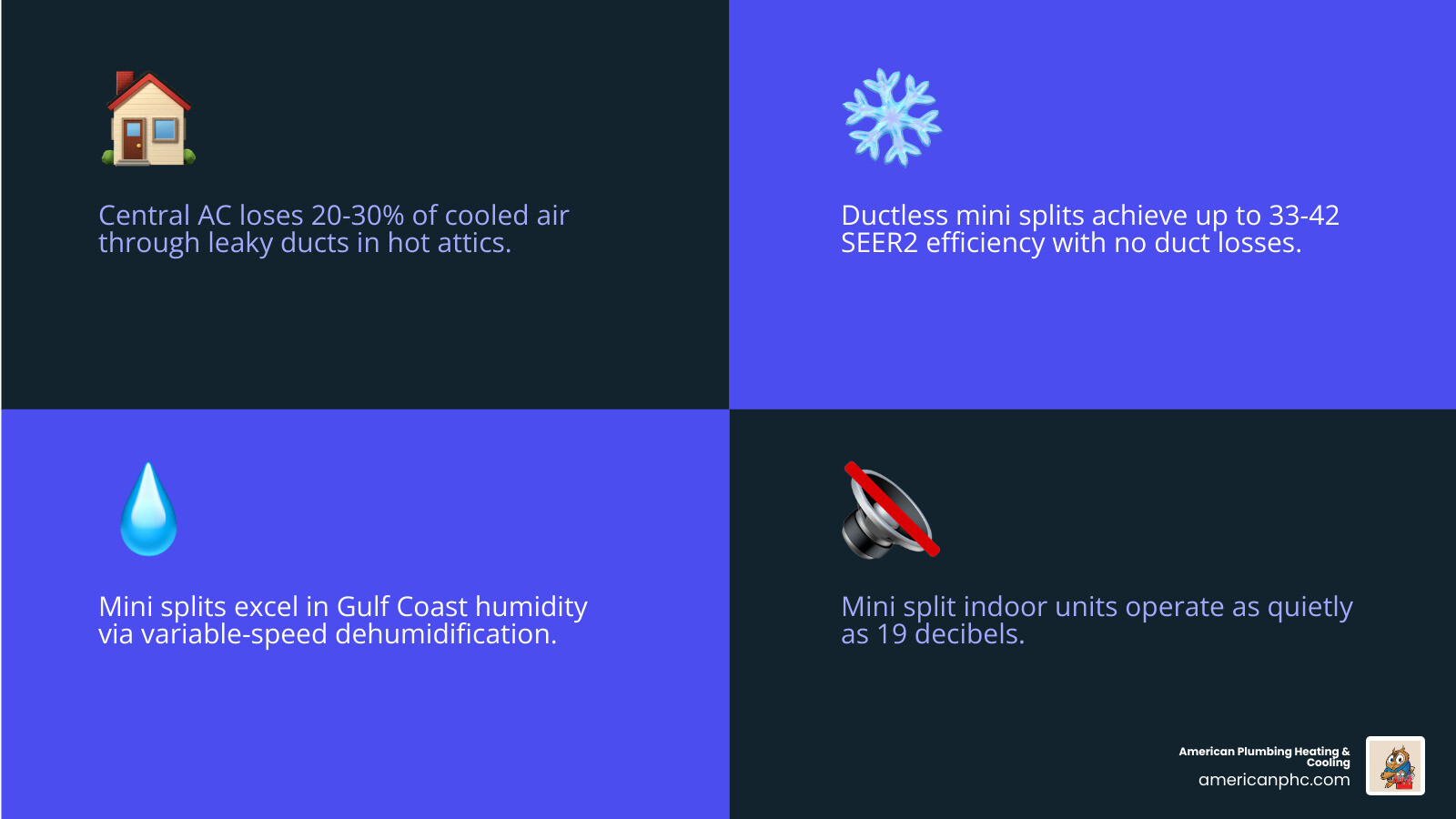
| SEER2 efficiency range | Up to 21–26 SEER2 | Up to 33–42 SEER2 |
| Duct energy loss | 20–30% loss possible | None |
| Humidity control | Strong with whole-home setup | Excellent with variable-speed operation |
| Zoning | Limited (unless upgraded) | Built-in, room by room |
| Noise level | Moderate (duct airflow audible) | As low as 19 decibels indoors |
| Ideal property type | New construction, large open-concept homes | Historic homes, garages, room additions |
The short answer: if your home already has good ductwork, central AC can be the right fit. If your ducts are leaky, in a hot attic, or nonexistent, a mini split will almost certainly perform better and cost less to run.
But the full answer depends on your home's layout, age, and how you actually use the space. Gulf Coast homes have specific challenges — blistering attic temperatures, salt air near the coast, and humidity that never really lets up — that make this choice more consequential than it would be in a drier, milder climate.
This guide breaks down everything you need to know so you can make a confident, well-informed decision.
Easy central air vs mini split for gulf coast homes glossary:
Understanding the Mechanics: Central Air vs Mini Split for Gulf Coast Homes
To choose the right system for your home in Sarasota or Milton, it helps to understand how these two technologies actually move heat. Both systems rely on a similar scientific principle: they don't "create" cold; they remove heat from your indoor air and dump it outside.
A traditional central AC system uses a large outdoor condenser unit paired with an indoor evaporator coil, typically housed in a closet or attic. A heavy-duty blower fan pushes air through a network of ducts to every room in the house. It’s a "whole-home" approach that relies on a single thermostat to tell the system when to kick on.
In contrast, a ductless mini split system skips the ductwork entirely. It uses an outdoor compressor connected to one or more sleek indoor air handlers via small refrigerant lines. These lines only require a tiny three-inch hole in your wall. Because each indoor unit operates independently, you get precise "zoned" control. As we discuss in The Great Chill Debate Of Ducted Vs Ductless Systems, this allows you to cool the kitchen while leaving the guest room off, saving a significant amount of energy.

Efficiency and Performance in the Florida Heat
When we talk about efficiency in May 2026, the gold standard is the SEER2 (Seasonal Energy Efficiency Ratio 2) rating. This rating tells you how much cooling you get for every dollar of electricity you spend. On the Gulf Coast, where AC accounts for a massive 19% of residential electricity use, these numbers matter.
High-end central AC units usually top out between 21 and 26 SEER2. While that’s impressive, premium ductless mini splits are in a different league, with some systems achieving ratings between 33 and 42 SEER2. This is largely due to inverter technology. Think of a traditional AC like a car that only has two speeds: stopped or floored. Inverter-driven mini splits act more like a modern gas pedal, "sipping" just enough energy to maintain a steady temperature.
The Coastal Cooling Battles Between Central Ac And Mini Splits often come down to how much energy is wasted before the air even reaches your living room.
| Performance Metric | Central AC (Ducted) | Mini Split (Ductless) |
|---|---|---|
| Typical SEER2 | 14–22 | 18–30+ |
| Max SEER2 | ~26 | ~42 |
| Duct Energy Loss | 20% to 30% | 0% |
| Inverter Tech | Available on high-end models | Standard on most units |
Why a mini split for Gulf Coast homes beats the "Attic Oven" effect
In places like Navarre and Fort Myers, many homes are built with ductwork running through the attic. In the peak of a Florida summer, attic temperatures can soar to 130 or 140 degrees. This creates what we call the "Attic Oven" effect.
Even if you have a high-efficiency central unit, you are essentially trying to push 55-degree air through a 140-degree space. Research shows that central systems can lose 20% to 30% of their cooling capacity through duct leakage and thermal transfer in these unconditioned spaces. By choosing a ductless option, you eliminate this loss entirely. As noted in our guide on Everything You Need To Know About Ductless Air Conditioning, this "non-invasive" approach is often the most effective way to combat the unique thermal challenges of Florida architecture.
Choosing the Right System for Your Property Layout
The layout of your home is often the deciding factor. If you live in a historic bungalow in Sarasota or a 1920s Craftsman in Pensacola, your home likely wasn't designed for bulky ductwork. Installing ducts in these homes can be a nightmare — it often requires dropping ceilings or losing precious closet space.
Mini splits are the ultimate problem solvers for:
- Historic Homes: Preserving the architectural integrity while providing modern comfort.
- Room Additions: Cooling a new sunroom or mother-in-law suite without overtaxing your existing central system.
- Garage Conversions: Turning a "man cave" or workshop into a livable space.
- Bonus Rooms: Fixing that one room over the garage that never seems to get cool enough.
You can learn more about the basics of these versatile systems in Mini Split Air Conditioning 101.
When to prioritize central air vs mini split for Gulf Coast homes
Despite the efficiency of ductless systems, central air remains the "reigning champ" for many Florida homeowners. We often recommend prioritizing central AC in the following scenarios:
- Existing Infrastructure: If your home already has a well-designed, well-insulated duct network in good condition, replacing the central unit is usually the most straightforward path.
- Aesthetics: Some homeowners prefer the "invisible" look of central AC. You only see small, discreet vents rather than an air handler mounted on the wall.
- Open-Concept Layouts: In very large, open-plan homes, a central system can sometimes provide more uniform air distribution than a single mini split head.
- Initial Investment: If you are cooling a large multi-room home and already have ducts, the Central Ac Vs Mini Split Price Tag Showdown often shows that central AC is more budget-friendly upfront than installing a multi-zone mini split system with five or six indoor heads.
Maintenance, Humidity, and Coastal Longevity
Living near the Gulf means dealing with salt air. Salt is a major catalyst for corrosion, especially on the thin aluminum fins of your outdoor condenser. Whether you choose central or ductless, your outdoor unit needs to be built for the coast. We look for units with specialized corrosion-resistant coatings to ensure they don't crumble after just a few seasons of salt spray.
Humidity control is the other half of the comfort equation. In Florida, "it’s not just the heat, it’s the humidity" is a way of life. Mini splits excel here because their variable-speed compressors run for longer, slower cycles. This allows them to pull more moisture out of the air consistently, eliminating that "sticky" feeling. Central systems can also handle humidity well, but they often require the addition of a whole-home dehumidifier or a high-end variable-speed blower to match the performance of a mini split.
Long-term reliability of central air vs mini split for Gulf Coast homes
With proper professional maintenance, both systems typically last between 15 and 20 years. However, the maintenance routines differ.
- Central AC: You’ll need to change your MERV-rated filters every 1 to 3 months and have your ducts inspected for leaks or mold growth every few years.
- Mini Splits: These use built-in, washable mesh filters. On the Gulf Coast, where pollen and dust are common, you should rinse these every 2 to 4 weeks. They also require a professional deep cleaning of the internal blower wheels every year or two to prevent "dirty sock syndrome."
As of 2026, new environmental standards have shifted the industry toward more eco-friendly refrigerants. Whether you go ducted or ductless, our team at American Plumbing Heating and Cooling ensures your new installation meets all current 2026 safety and efficiency regulations.
Frequently Asked Questions about Coastal Cooling
Can a mini-split handle the extreme humidity in Sarasota and Pensacola?
Absolutely. In fact, many homeowners find they handle it better than traditional systems. Because they don't just "blast" air and then shut off, their constant, low-speed operation acts as a continuous dehumidifier. This keeps your indoor comfort levels stable and prevents the mold-friendly environments that high humidity creates.
How long do these systems last in a salty coastal environment?
In areas like Siesta Key or Pensacola Beach, salt air can cut an unprotected unit's life in half. However, with coastal-grade coatings, regular rinsing of the outdoor coils to remove salt buildup, and proper elevation to protect against storm surges, you can still expect a 15-year lifespan.
Are there tax incentives for upgrading to a heat pump in 2026?
Yes! Under the Inflation Reduction Act, many homeowners are eligible for federal tax credits of up to $2,000 for qualifying heat pump installations. Since most modern mini splits and many high-efficiency central units are technically heat pumps (they can provide heat during our few chilly weeks in January), they often qualify for these significant savings.
Conclusion
Choosing between central air vs mini split for gulf coast homes doesn't have to be a headache. At American Plumbing Heating and Cooling, we’ve seen it all — from historic Siesta Key cottages to sprawling modern estates in Lakewood Ranch. With over 100 years of combined experience, our certified pros are here to help you navigate the "Attic Oven," the salt air, and the humidity.
Whether you need a 24/7 emergency repair or a complete system upgrade, we provide honest, upfront pricing and workmanship backed by a 100% satisfaction guarantee. Don't spend another summer battling uneven temperatures and high bills.
Schedule your professional cooling assessment today and let us help you find the perfect chill for your Florida home.
Need HVAC Help?
Our certified technicians are ready to help with all your heating and cooling needs.
Request ServiceAbout the Author
American Plumbing Heating and Cooling Team
Licensed Florida contractors — HVAC CAC1821761 · Plumbing CFC1431919
More Articles
View All PostsRelated Articles


Ready to Get Started?
Whether you need a repair, maintenance, or a new system installation, our expert team is here to help.