
Ultimate Checklist for HVAC Maintenance in Tropical Coastal Florida
By the American Plumbing Heating and Cooling Team
Licensed Florida contractors — HVAC CAC1821761 · Plumbing CFC1431919

Protect your Florida home with this hvac maintenance checklist for tropical coastal florida covering salt air, humidity, and hurricane prep.
Reviewed bythe American Plumbing Heating and Cooling Team — Licensed Florida contractors — HVAC CAC1821761 · Plumbing CFC1431919. Published June 25, 2026 · Last updated July 29, 2026. About American Plumbing Heating and Cooling
Dealing with this problem right now? Call (941) 735-6616 and talk to our local team.
Request ServiceWhy Your HVAC Needs Extra Attention in Tropical Coastal Florida
Following an HVAC maintenance checklist for tropical coastal Florida is not optional — it is one of the most important things you can do to protect your home and your comfort. Florida's combination of salt air, near-constant humidity, and hurricane-force storms puts more stress on air conditioning systems than almost anywhere else in the country. In fact, Florida AC systems can run over 2,500 hours per year, compared to roughly 1,200 hours in northern states. That kind of runtime accelerates wear on every component.
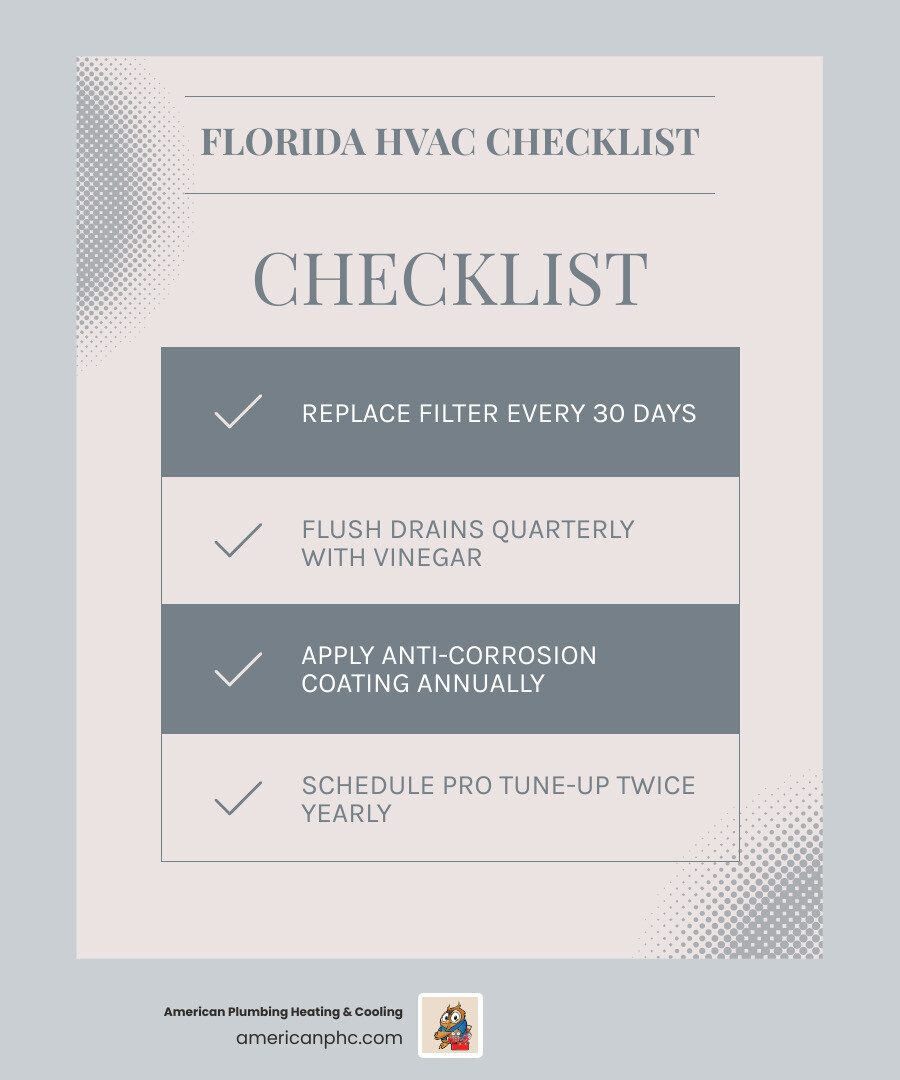
Here is a quick-reference checklist to get you started:
Florida HVAC Maintenance Checklist at a Glance
| Frequency | Task |
|---|---|
| Monthly | Replace air filter (every 30 days in coastal homes) |
| Monthly | Check condensate drain pan for standing water |
| Monthly | Inspect outdoor unit clearance (2 ft on all sides) |
| Every 2-3 months | Rinse outdoor condenser coils with a garden hose |
| Quarterly | Flush condensate drain line with vinegar or diluted bleach |
| Quarterly | Check thermostat operation |
| Twice yearly | Schedule professional tune-up (spring and fall) |
| Twice yearly | Professional coil cleaning, refrigerant check, electrical inspection |
| Annually | Inspect ductwork for leaks |
| Annually | Check outdoor unit for salt corrosion and apply protective coating |
| Before storms | Shut system off, cover outdoor unit, clear debris |
| After storms | Inspect unit for damage before restarting |
Salt air can corrode HVAC coils and electrical parts up to ten times faster than normal conditions — and that corrosion can reach properties sitting two to three miles inland. Add in Florida's relentless humidity, which creates ideal conditions for mold growth in ductwork and drain lines, and it becomes clear why standard maintenance advice written for other climates simply does not apply here. Without a consistent, Florida-specific plan, systems fail earlier, energy bills climb, and small problems quietly turn into expensive repairs.
This guide walks you through everything — month by month, task by task — so your system stays reliable through every season.
Why Coastal Florida Homes Need a Specialized Maintenance Plan
Living in paradise comes with a price, and for your HVAC system, that price is "environmental stress." In cities like Sarasota, Cape Coral, and Pensacola, the air is thick with moisture and microscopic salt particles. This creates a double-whammy: the humidity forces your system to work overtime to keep the air dry, while the salt air eats away at the metal components.
Standard manufacturer guidelines are often written for mild climates. In Florida, we have to "tighten" the schedule. For instance, while a filter might last three months in Ohio, it’s often clogged with dust and pollen in 30 days here. Furthermore, Don't Sweat It: A Local Guide to HVAC System Maintenance highlights that regular care is the only way to combat the 2,500+ hours of annual runtime our units endure. Neglect leads to leaky ductwork, which can cause up to 30% of your cooled air to escape, directly impacting energy efficiency and your home value connection.
Managing Humidity and Air Quality in Sarasota
In the tropical coastal environment, your AC isn't just a cooler; it's a giant dehumidifier. If the humidity inside your home stays above 50%, you are essentially inviting mold and mildew to move in. High humidity makes the air feel warmer than it actually is, leading many homeowners to drop the thermostat even lower, which spikes energy bills and puts even more strain on the compressor.
To combat this, we often recommend specialized solutions. An air purifier installation in Sarasota, FL can help remove allergens and mold spores that thrive in our damp air. For homes that struggle with "sticky" indoor air even when the AC is running, a humidifier dehumidifier installation in Cape Coral, FL provides a dedicated way to pull moisture from the air without overworking your cooling system.
Monthly and Quarterly HVAC Maintenance Checklist for Tropical Coastal Florida

Consistency is the secret to a long-lasting HVAC system. You don't need a degree in mechanical engineering to keep things running; you just need a calendar and a few basic supplies. By staying on top of monthly and quarterly tasks, you can prevent the "mid-July meltdown" that happens when a neglected system finally gives up under the Florida sun.
Understanding the magic number for HVAC maintenance success starts with your own eyes and ears. Every month, take ten minutes to walk around your unit. Listen for odd clicking or grinding sounds and look for any signs of water leaking around the indoor air handler. If you're in the Venice or Siesta Key area, scheduling a professional AC maintenance tune-up in Sarasota, FL at least twice a year ensures that the things you can't see—like refrigerant levels and electrical torque—are in top shape.
Essential Steps in Your HVAC Maintenance Checklist for Tropical Coastal Florida
When building your hvac maintenance checklist for tropical coastal florida, these three tasks should be at the very top:
- The 30-60 Day Filter Rule: In Florida’s pollen-heavy climate, filters get dirty fast. Check them every 30 days. If you have pets or live near the beach where sand can blow in, replace them monthly. A dirty filter forces the blower motor to work harder, which can lead to a frozen evaporator coil.
- The Condensate Drain Flush: This is the #1 cause of service calls in Florida. Algae and "slime" love to grow in the warm, wet environment of your drain line. Every quarter, pour a cup of distilled white vinegar or a diluted bleach solution (1 cup bleach to 1 gallon water) down the drain line clean-out port. This prevents clogs that can cause water to back up and damage your ceiling or floors.
- Outdoor Coil Rinsing: Salt air is a silent killer. Every few months, use a garden hose on a gentle setting to rinse the salt and sand off your outdoor condenser coils. Never use a pressure washer, as it will bend the delicate aluminum fins and ruin your airflow.
Residents looking for an AC maintenance tune-up in Bradenton, FL or an AC maintenance tune-up in Milton, FL should prioritize these steps to avoid the common "clogged drain" emergency.
Seasonal Adjustments for Your HVAC Maintenance Checklist for Tropical Coastal Florida
Florida doesn't have four seasons; we have "Hot," "Very Hot," "Hurricane," and "Two Weeks of Winter." Your maintenance should reflect that.
- Spring (March-April): This is the most critical time for a tune-up. You want to get your system ready for the 90-degree days ahead. This is when you should check your cooling system to get ready for hot weather by testing the thermostat and ensuring the outdoor unit has at least two feet of clearance from tropical plants that grew over the winter.
- Fall (October-November): After the brutal summer, your system needs a "recovery" check. This is a great time for an AC maintenance tune-up in Navarre, FL to clean out the salt and debris left behind by summer storms and ensure the heating elements (if you have them) are ready for those rare chilly nights.
How Can I Protect My Outdoor Unit From Salt Air and Hurricane Damage?
In coastal areas like Siesta Key and Fort Myers, salt air can reduce the lifespan of an AC unit from 15 years down to 5 if it isn't protected. The salt causes "pitting" on the coils, which eventually leads to refrigerant leaks.
To protect your investment, consider applying a professional anti-corrosion coating to the coils. These coatings act as a barrier against the salt spray. Additionally, ensure your unit is properly elevated on a sturdy pad to keep it out of minor floodwaters. For those in high-wind areas, hurricane straps are a must to keep the unit from shifting or blowing over during a storm. We also highly recommend surge protection; Florida is the lightning capital of the world, and a single strike near your home can fry the expensive control boards in your AC. Learn more about how hurricane season affects your HVAC and plumbing systems to stay ahead of the weather. Residents in Venice should consider an AC maintenance tune-up in Venice, FL to verify their unit's physical security before storm season peaks.
Preparing for Storm Season in Cape Coral
Hurricane season (June through November) requires its own specialized hvac maintenance checklist for tropical coastal florida. If a major storm is approaching, follow these steps:
- Pre-Storm: Turn the AC off at the thermostat and the breaker. This prevents the unit from trying to run if the power flickers, which can damage the compressor. If you have a custom-fit cover, put it on to keep debris out, but never run the unit with the cover on.
- Clear the Area: Trim back palm fronds and remove patio furniture or "lawn art" that could become a projectile and smash into your condenser.
- Post-Storm: Before turning the power back on, inspect the unit. Is it leaning? Are there branches stuck in the fan? If the unit was submerged in water, do not turn it on. Call a professional for a post-storm inspection.
Preventing HVAC emergencies with regular maintenance is much easier than dealing with a total system replacement after a hurricane. Homeowners in Lakewood Ranch can benefit from a specialized AC maintenance tune-up in Lakewood Ranch, FL to ensure their surge protection and tie-downs are ready for the winds.
Is Professional Maintenance Better Than DIY for My Florida Home?
While there is plenty you can do yourself—like changing filters and rinsing coils—there are technical tasks that require a certified pro. Florida law is very strict regarding refrigerant; only EPA-certified technicians can handle the gases that make your home cool.
Here is a quick look at the breakdown:
| Task | DIY | Professional |
|---|---|---|
| Replace air filters | X | |
| Rinse outdoor coils (gentle) | X | |
| Flush condensate drain | X | |
| Clear debris around unit | X | |
| Check refrigerant levels | X | |
| Clean evaporator coils (indoor) | X | |
| Inspect electrical connections | X | |
| Test safety float switches | X | |
| Deep chemical coil cleaning | X |
Professional service offers 20 reasons to schedule your HVAC tune-up today, including maintaining your manufacturer's warranty. Most warranties actually require documented annual maintenance to remain valid. Furthermore, a professional can provide the ultimate guide to keeping your ducts and air clean, ensuring that the air circulating in your home isn't full of dust or mold.
Maintenance for Seasonal and Part-Time Residents
If you are a "snowbird" who leaves your Florida home for several months, your HVAC system needs a "departure protocol." Many people make the mistake of turning the AC completely off. In the Florida humidity, this is a recipe for a "mold bomb." Within weeks, your home will be covered in mildew.
Instead, set your thermostat to 78°F or 80°F. This is cool enough to keep the humidity low but high enough to save on energy. We highly recommend installing a smart thermostat so you can monitor your home's temperature and humidity from your phone while you're away. If you see the humidity spike, you know there might be a problem. For residents in the Venice area, a humidifier dehumidifier installation in Venice, FL can be a lifesaver for seasonal homes, as it can run independently of the AC to keep moisture in check.
Frequently Asked Questions about Florida HVAC Care
How often should I change my AC filter in Florida?
In our tropical climate, we recommend checking your filter every 30 days. During high-pollen months (March-May) or if you have pets, you should replace it every single month. At a minimum, never go longer than 60 days.
Does salt air really damage my AC unit?
Yes. Salt is highly corrosive to the metals used in HVAC systems. It can eat through the copper and aluminum in your coils, leading to leaks and system failure. Regular rinsing and professional anti-corrosion coatings are the best defenses for homes within 5 miles of the coast.
What temperature should I set my AC to when I'm away?
If you're just out for the day, raising the temp by 5-7 degrees is efficient. If you're leaving for the season, set it to 78°F-80°F. The goal is to keep the indoor humidity below 55% to prevent mold growth.
Conclusion
Maintaining your HVAC system in the tropical coastal Florida environment is a year-round commitment, but it pays off in lower bills, fewer emergencies, and a much longer system life. From the white sands of Sarasota and Siesta Key to the growing communities of Cape Coral, Lakewood Ranch, and Navarre, our unique climate demands a specialized approach.
At American Plumbing Heating and Cooling, we bring over 100 years of combined experience to every home. We understand the specific challenges of salt air and high humidity because we live and work here too. Whether you need a routine spring tune-up, a post-storm inspection, or a new dehumidification system, our certified pros are here to help.
Don't wait for the heat to become unbearable. Schedule your professional HVAC maintenance today and breathe easy knowing your home is protected.
{"@context": "https://schema.org", "@graph": [{"@type": "Article", "headline": "Florida HVAC Maintenance Checklist | American Plumbing", "description": "Use our HVAC maintenance checklist for tropical coastal Florida to prevent salt, humidity and storm damage. Protect your AC—schedule service today!", "author": {"@type": "Person", "name": "American Plumbing Heating and Cooling"}, "publisher": {"@type": "Organization", "name": "American Plumbing Heating and Cooling", "logo": {"@type": "ImageObject", "url": "https://firebasestorage.googleapis.com/v0/b/ai-templates.appspot.com/o/bot%2FiTB8FxoyvSplQzS7StV8%2Flogo%2FScreenshot%202026-03-16%20at%2012.43.20%E2%80%AFPM.png?alt=media&token=4ae5e171-7bb5-4a27-91f4-47e969b91c80"}}, "datePublished": "2026-06-25T02:47:18+00:00", "dateModified": "2026-06-25T02:47:41.167575", "mainEntityOfPage": {"@type": "WebPage", "@id": "https://pms.ciwebgroup.com/americanphc/2026/06/25/ultimate-checklist-for-hvac-maintenance-in-tropical-coastal-florida/"}, "image": "https://images.pexels.com/photos/32981344/pexels-photo-32981344.jpeg?auto=compress&cs=tinysrgb&h=650&w=940"}, {"@type": "FAQPage", "mainEntity": [{"@type": "Question", "name": "Why does HVAC maintenance matter more in tropical coastal Florida?", "acceptedAnswer": {"@type": "Answer", "text": "Tropical coastal Florida’s salt air, constant humidity, and hurricane-force storms put extra stress on HVAC systems. Florida AC systems can run over 2,500 hours per year, which accelerates wear compared with systems in northern states."}}, {"@type": "Question", "name": "How often should I replace my HVAC air filter in a coastal Florida home?", "acceptedAnswer": {"@type": "Answer", "text": "In coastal Florida homes, the air filter should be replaced every 30 days. This monthly schedule helps the system handle the heavy humidity, salt exposure, and long runtime common in the region."}}, {"@type": "Question", "name": "What HVAC maintenance tasks should Florida homeowners do monthly?", "acceptedAnswer": {"@type": "Answer", "text": "Monthly HVAC tasks include replacing the air filter, checking the condensate drain pan for standing water, and inspecting outdoor unit clearance. The outdoor unit should have about 2 feet of clearance on all sides."}}, {"@type": "Question", "name": "How often should HVAC systems in coastal Florida get professional maintenance?", "acceptedAnswer": {"@type": "Answer", "text": "Coastal Florida HVAC systems should receive professional tune-ups twice a year, ideally in spring and fall. These visits should include coil cleaning, refrigerant checks, and electrical inspections."}}, {"@type": "Question", "name": "How does salt air affect HVAC systems in coastal Florida?", "acceptedAnswer": {"@type": "Answer", "text": "Salt air can corrode HVAC coils and electrical parts up to ten times faster than normal conditions. This corrosion can affect properties located two to three miles inland, making regular inspection and protective maintenance important."}}]}]}Need HVAC Help?
Our certified technicians are ready to help with all your heating and cooling needs.
Request ServiceAbout the Author
American Plumbing Heating and Cooling Team
Licensed Florida contractors — HVAC CAC1821761 · Plumbing CFC1431919
More Articles
View All PostsRelated Articles


Ready to Get Started?
Whether you need a repair, maintenance, or a new system installation, our expert team is here to help.