
Summer Efficiency Tips for Tropical Coastal Florida Homes
By the American Plumbing Heating and Cooling Team
Licensed Florida contractors — HVAC CAC1821761 · Plumbing CFC1431919

Discover summer efficiency tips for tropical coastal Florida homes that cut energy bills and fight salt air corrosion with smart HVAC strategies.
Reviewed bythe American Plumbing Heating and Cooling Team — Licensed Florida contractors — HVAC CAC1821761 · Plumbing CFC1431919. Published June 1, 2026. About American Plumbing Heating and Cooling
Dealing with this problem right now? Call (941) 735-6616 and talk to our local team.
Request ServiceWhy Summer Energy Bills Hit So Hard in Tropical Coastal Florida Homes
Applying summer efficiency tips for tropical coastal Florida homes can mean the difference between a manageable power bill and one that leaves you wondering what went wrong. Cooling alone typically accounts for around 60% of a Florida homeowner's electricity costs — and that number only climbs as summers get hotter. In the 1960s, South Florida saw 90-degree days about a quarter of the year. Today, it's closer to a third. By 2050, scientists expect those sweltering days to stretch past the halfway mark of the year.
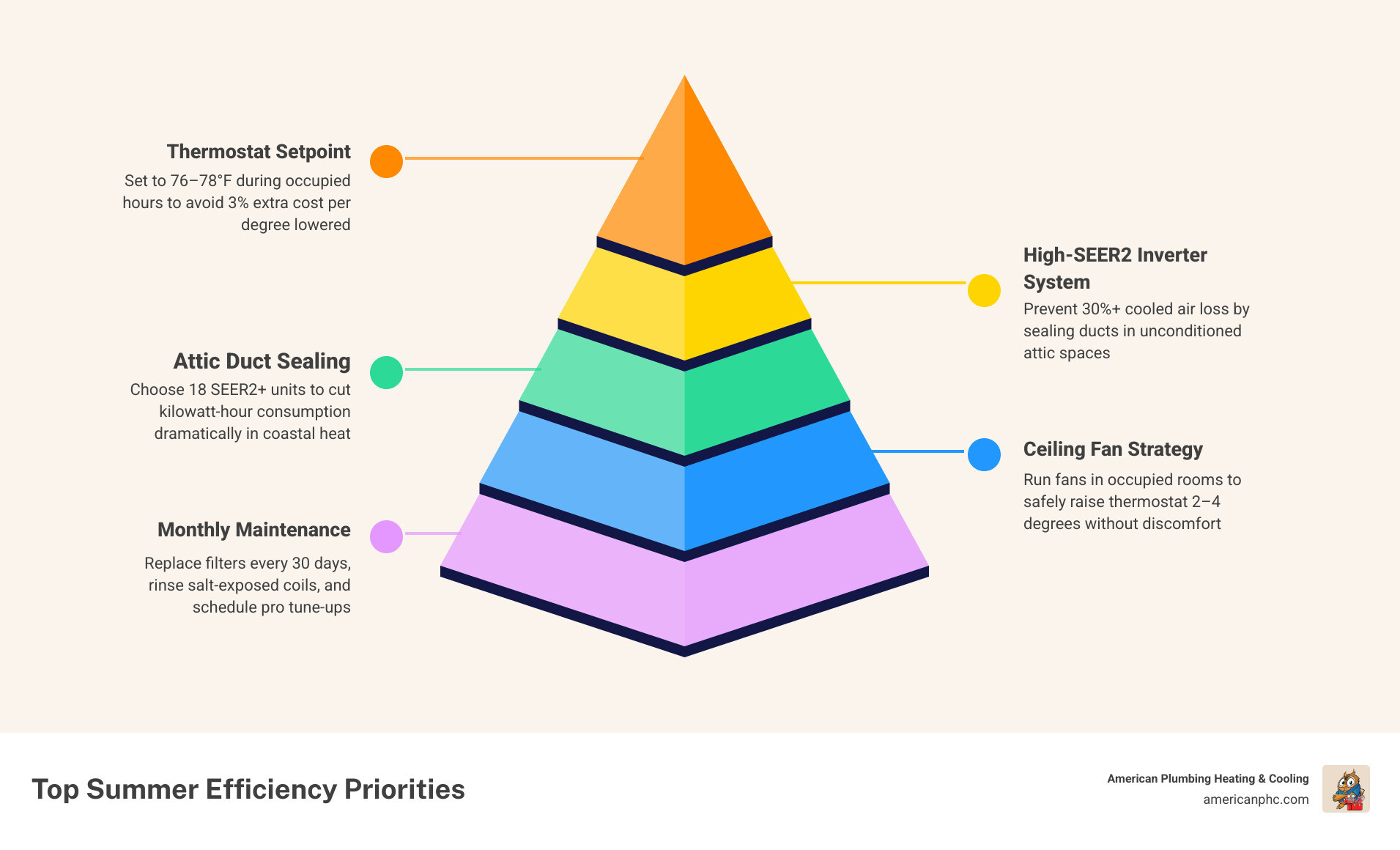
Here are the most impactful steps Florida coastal homeowners can take right now to cut summer energy costs:
- Set your thermostat to 76–78°F during the day — each degree lower adds roughly 3% to your cooling bill
- Use a smart thermostat with geofencing or scheduling to raise the setpoint to 80°F when the house is empty
- Switch to a high-SEER2 inverter-driven system (18 SEER2 or higher) to dramatically reduce kilowatt-hour draw
- Seal attic ductwork — duct losses in unconditioned attic spaces can waste more than 30% of your cooled air
- Run ceiling fans in occupied rooms so you can raise the thermostat 2–4 degrees without feeling warmer
- Replace filters every 30 days in summer — Florida's humidity and pollen load clog filters fast
- Rinse outdoor condenser coils monthly if you live within a few miles of the coast to fight salt-air corrosion
- Apply Low-E window film to south- and west-facing glass to cut solar heat gain by up to 40–60%
- Add shade trees or deep overhangs on sun-exposed walls to reduce the heat load before it ever reaches your AC
- Schedule a professional tune-up before peak season to verify refrigerant charge, clean coils, and flush condensate lines
What makes coastal Florida uniquely challenging is the combination of relentless heat, humidity that regularly exceeds 70%, and salt air that accelerates wear on mechanical equipment. A system that performs fine in the rest of the country can underperform — or fail outright — here without the right setup and care. The good news is that most of the biggest savings come from a handful of targeted moves, not a complete home overhaul.
Similar topics to summer efficiency tips for tropical coastal florida homes:
- air conditioning repair
- how to lower ac bills during summer
Passive Design and Architectural Wisdom for Coastal Living
Before air conditioning became the standard in the 1950s and 60s, Floridians survived the tropical heat by working with nature rather than fighting it. Modern homeowners in places like Sarasota and Cape Coral can still use these "passive cooling" strategies to take the load off their HVAC systems.
One of the most critical factors is house orientation. Ideally, a home in Florida should face south. This might sound counterintuitive, but a south-facing home allows you to manage solar gain more effectively. By using deep roof overhangs or porches on the south side, you can block the high summer sun while still letting in natural light. Minimizing windows on the east and west sides is equally important, as the low-angle morning and afternoon sun can turn your living room into an oven.

Thermal mass also plays a role. Materials like concrete, stone, or brick help stabilize indoor temperatures by absorbing heat during the day and releasing it slowly. When combined with elevated construction—lifting the home on piers or a crawlspace—cool air can circulate underneath the structure, further reducing the heat that radiates through the floor. Understanding the Best HVAC and Plumbing Setups to Beat the Coastal Heat often starts with these structural foundations.
Historical Cooling Strategies for Modern Homes
We often look back at "Cracker houses" and "Conch houses" for inspiration. These traditional designs featured:
- High Ceilings: Allowing hot air to rise well above the occupants.
- Louvered Shutters: These catch the prevailing southeast breezes while blocking direct sunlight.
- Breezeways and Courtyards: A single courtyard can lower a building’s energy bill by about 7% on average by creating a pocket of cooler air.
- Cross-Ventilation: Aligning windows and doors to allow air to flow through the house.
High-Efficiency HVAC Systems for the Florida Climate
When passive design isn't enough to beat a July afternoon in Bradenton, your HVAC system has to do the heavy lifting. In 2026, the technology available to Florida homeowners is more efficient than ever, but choosing the right type of system is vital.
Variable-speed or inverter technology is the gold standard for our climate. Unlike traditional units that are either "all on" or "all off," inverter-driven systems modulate their speed. Think of it like cruise control for your cooling. This allows the system to run longer at a lower, more efficient speed, which is significantly better for removing humidity—the real enemy in Florida.
Modern heat pumps are also an excellent choice for our region. Since temperatures in places like Fort Myers or Pensacola rarely stay below 40°F for long, heat pumps provide highly efficient cooling in the summer and affordable warmth during our brief winter snaps.
For many coastal homes, especially those with unconditioned attics where ductwork can lose 30% of its efficiency, ductless mini-splits are a game-changer. They allow for "zoning," meaning you only cool the rooms you are actually using. For a deeper dive into these metrics, check out A Homeowner Guide to Efficiency Ratings.
Central AC vs. Ductless Mini-Split Efficiency
| Feature | Central AC (14 SEER) | Inverter Mini-Split (22 SEER2) |
|---|---|---|
| Monthly Operating Cost | High ($115 - $130+) | Low ($60 - $90) |
| Energy Loss | 30%+ via attic ducts | Near Zero (No ducts) |
| Humidity Control | Standard | Superior (Variable speed) |
| Zoning Ability | Limited/Difficult | Excellent (Room-by-room) |
Essential Summer Efficiency Tips for Tropical Coastal Florida Homes
The most effective summer efficiency tips for tropical coastal Florida homes often involve behavioral changes and simple home sealing. The "magic number" for your thermostat is 78°F when you are home. While it might feel warm at first, using ceiling fans can make 78°F feel like 74°F. Just remember: fans cool people, not rooms. Turn them off when you leave the room to save even more.
Humidity management is just as important as the temperature. We recommend keeping your indoor relative humidity between 45% and 55%. If your home stays above 60%, it becomes a breeding ground for mold and makes the air feel "clammy," tempting you to lower the thermostat even further. Proper sealing is your first line of defense; if you Stop Burning Cash Just to Stay Cool This Summer, you'll likely find that sealing attic leaks and ductwork delivers the fastest return on investment.
Implementing Summer Efficiency Tips for Tropical Coastal Florida Homes via Smart Controls
Smart thermostats are no longer a luxury; they are an essential tool for Florida efficiency. These devices use learning algorithms to understand your schedule and geofencing to detect when you've left the house, automatically adjusting the temperature to an "away" setting (usually 80-82°F).
Many modern smart controls also feature humidity sensors that can trigger your AC to run specifically for moisture removal without over-cooling the house. This prevents the "rebound" effect where humidity spikes while you're at work, forcing the system to work twice as hard when you return.
Why Summer Efficiency Tips for Tropical Coastal Florida Homes Start with Proper Maintenance
You wouldn't drive your car 20,000 miles without an oil change, yet many Florida AC units run 2,500+ hours a year without a check-up. In our tropical environment, a neglected system can lose 5% of its efficiency every single year.
Key maintenance tasks include:
- Filter Replacement: In high-pollen areas like Milton and Navarre, filters should be checked monthly.
- Coil Cleaning: Dust and salt build-up on coils act as an insulator, forcing the compressor to work harder.
- Condensate Line Clearing: Algae thrives in our heat. Flushing lines with vinegar prevents backups that can shut down your system.
- Refrigerant Verification: Even a tiny leak can cause your bills to skyrocket as the system struggles to cool.
For more on why timing matters, read about The Magic Number for HVAC Maintenance Success.
Protecting Your Home from Salt Air and Humidity
For our neighbors in Siesta Key, Venice, and other coastal spots, "salt air" isn't just a vibe—it's a mechanical threat. Salt triggers galvanic corrosion, a process where the aluminum fins on your AC unit literally crumble away. To combat this, we recommend systems with coated coils and stainless steel fasteners.
Inside the home, the battle continues against moisture. When painting, choose satin or semi-gloss finishes. These are less porous than flat paints, making them resistant to moisture absorption and mold growth. Look for paints with antimicrobial additives and high vapor permeability, which allows the walls to "breathe" rather than trapping moisture that leads to peeling.
Living near the Gulf is a dream, but it requires a specific maintenance mindset. Learn how to protect your investment here: Don't Let the Salt Air Kill Your Vibe or Your AC.
Frequently Asked Questions about Florida Summer Efficiency
What is the best thermostat setting for a Florida summer?
The Department of Energy and local utilities like FPL recommend 78°F while you are at home. For sleeping, 74-75°F is a common comfort range. When you are away for more than four hours, set the thermostat to 82°F. Never turn the AC completely off, as humidity will quickly rise, leading to mold risks and a very expensive "recovery" run when you turn it back on.
How does salt air affect my air conditioner's efficiency?
Salt air causes the metal fins on your outdoor unit to corrode and disintegrate. This reduces the surface area available for heat exchange, meaning your AC has to run much longer to achieve the same cooling effect. Coastal units without protection often last only 7–10 years, compared to 12–15 years for inland units. Monthly rinsing of the outdoor coils with fresh water can help extend this lifespan.
Can landscaping actually lower my cooling costs?
Absolutely. Strategic landscaping is one of the best summer efficiency tips for tropical coastal Florida homes. Planting native shade trees, like live oaks or palms, on the south and west sides of your home can shade walls and windows, significantly reducing the "heat island" effect around your house. Shading your outdoor AC condenser can also improve its efficiency, provided you maintain at least two feet of clearance for airflow.
Conclusion
Managing a home in the Florida heat doesn't have to be a losing battle against your utility provider. By combining the architectural wisdom of the past with the high-efficiency technology of 2026, you can stay cool without breaking the bank. From Sarasota to Pensacola, the key is a proactive approach: maintain your equipment, manage your humidity, and respect the power of the Florida sun.
At American Plumbing Heating and Cooling, we’ve seen how the right maintenance and system choices can transform a home's comfort. Whether you need an efficiency audit in Lakewood Ranch or a salt-resistant AC installation in Cape Coral, our team brings over 100 years of combined experience to every job. Don't let the summer heat win—take control of your home's energy resilience today.
Need HVAC Help?
Our certified technicians are ready to help with all your heating and cooling needs.
Request ServiceAbout the Author
American Plumbing Heating and Cooling Team
Licensed Florida contractors — HVAC CAC1821761 · Plumbing CFC1431919
More Articles
View All PostsRelated Articles


Ready to Get Started?
Whether you need a repair, maintenance, or a new system installation, our expert team is here to help.