
All About Heat Pump Benefits for Florida Homeowners
By the American Plumbing Heating and Cooling Team
Licensed Florida contractors — HVAC CAC1821761 · Plumbing CFC1431919

Discover the top heat pump benefits for Florida homeowners including year-round efficiency, lower costs, and available 2026 incentives.
Reviewed bythe American Plumbing Heating and Cooling Team — Licensed Florida contractors — HVAC CAC1821761 · Plumbing CFC1431919. Published July 16, 2026. About American Plumbing Heating and Cooling
Dealing with this problem right now? Call (941) 735-6616 and talk to our local team.
Request ServiceWhy Heat Pump Benefits for Florida Homeowners Are Hard to Ignore
Heat pump benefits for Florida homeowners are real, measurable, and especially well-suited to our state's unique climate. Florida's long, hot summers and short, mild winters create near-perfect conditions for heat pump technology to shine — and if you're weighing your HVAC options, here's what you need to know right away:
Top heat pump benefits for Florida homeowners at a glance:
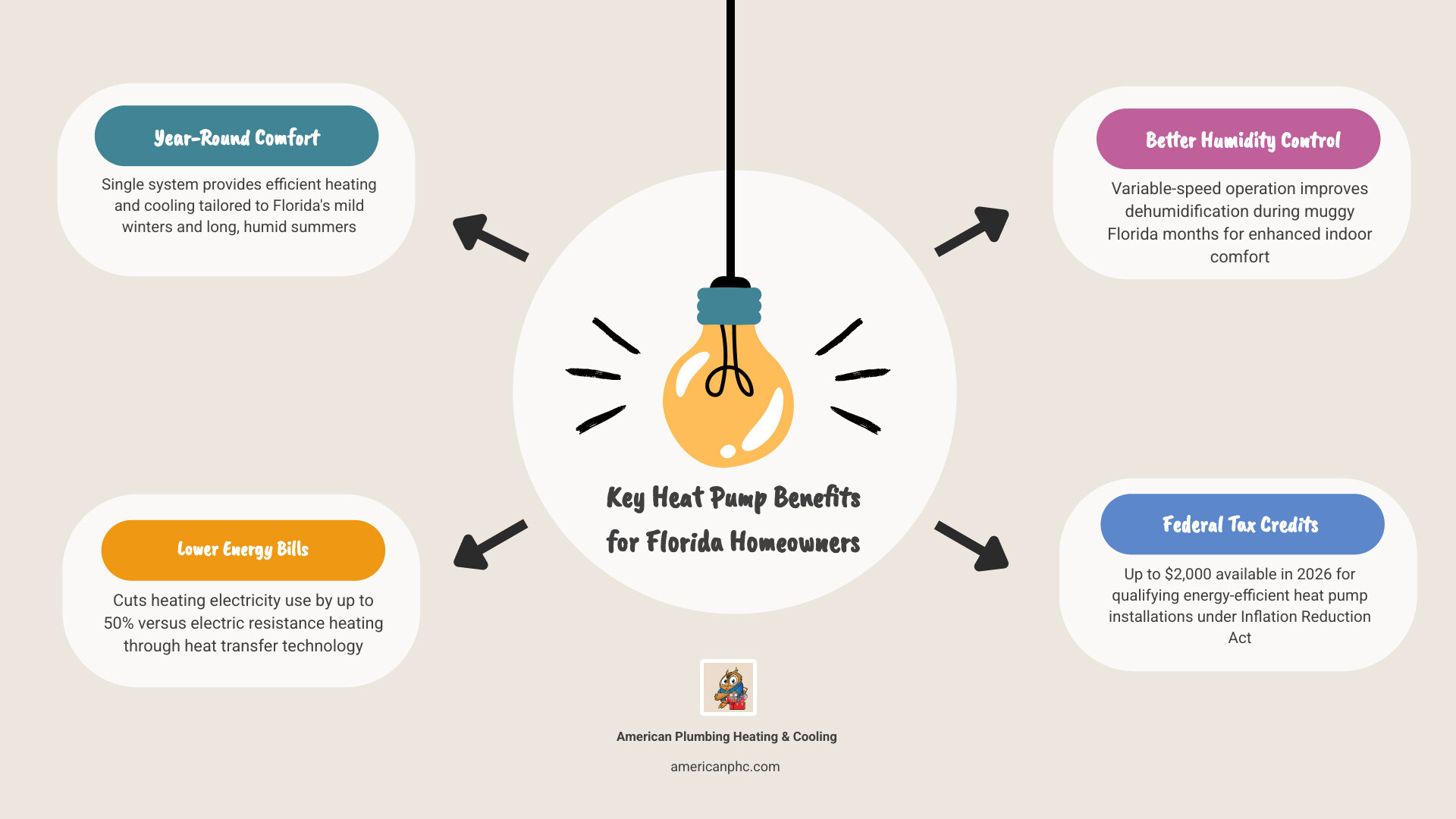
- Year-round comfort from a single system that both heats and cools
- Lower energy bills — heat pumps can cut heating electricity use by up to 50% compared to electric resistance heating
- Better humidity control through variable-speed operation during Florida's muggy months
- Federal tax credits up to $2,000 available in 2026 for qualifying installations
- Reliable performance even on the coldest Florida nights, down to 5°F with modern inverter technology
- Long lifespan of 15–20 years with proper maintenance
- Safer operation — no combustion, no gas lines, no carbon monoxide risk
HVAC systems account for over 40% of a Florida home's energy use. Choosing the right system isn't just about comfort — it directly affects what you pay every month. For most Florida homeowners, a heat pump is one of the smartest upgrades available.
The reason heat pumps work so well here comes down to simple climate math. In Minnesota or Michigan, a heat pump has to work hard to extract warmth from bitter cold air. In Florida, where winter nights rarely dip below the 40s across most of the state, a heat pump operates near peak efficiency almost year-round. You get all the cooling performance of a standard air conditioner — because in cooling mode, that's exactly what it is — plus highly efficient heating when those occasional chilly nights roll in.
Whether you're in Sarasota, Bradenton, or anywhere else across Southwest Florida, understanding how these systems work and what they can save you is the first step toward making a confident decision.
Understanding the Core Heat Pump Benefits for Florida Homeowners
To understand why a heat pump is so effective, it helps to look at how it works. Unlike traditional heating systems that burn fuel or use high-resistance electric coils to create heat, a heat pump simply moves heat from one place to another.
Even when the air outside feels chilly to you, it still contains a significant amount of heat energy. In the winter, the system's outdoor unit extracts this heat using a specialized refrigerant cycle and transfers it indoors. In the summer, the process reverses: the system pulls heat out of your indoor air and dumps it outside, functioning exactly like a standard air conditioner.
This magic is made possible by a small but crucial component called a reversing valve. With the flip of a switch (or a signal from your smart thermostat), the reversing valve changes the direction of the refrigerant flow, instantly switching the system from cooling mode to heating mode. Because moving heat requires far less electricity than generating it, this process is incredibly efficient. You can read more about how this compares to other systems in our Heating Options Comparison Florida guide.
Year-Round Efficiency as One of the Top Heat Pump Benefits for Florida Homeowners
In Southwest Florida communities like Cape Coral, Fort Myers, and Venice, as well as Northwest Florida areas like Milton and Navarre, we experience a highly lopsided climate. We have roughly nine to ten months of cooling demand and only a few weeks of sporadic heating needs.
Traditional homes often rely on a standard air conditioner paired with an electric furnace (or "heat strips") for those brief cold snaps. This setup is highly inefficient. When those heat strips kick on, they consume massive amounts of electricity.
A heat pump solves this by offering dual functionality. It serves as your primary high-efficiency air conditioner during our grueling summers, and then seamlessly transitions to an ultra-efficient heater when temperatures drop. Because it handles both jobs, you only have to maintain one system year-round, maximizing your home comfort without paying for separate, bulky heating equipment.

Lower Operating Costs and Other Heat Pump Benefits for Florida Homeowners
Because heat pumps transfer heat rather than generating it, they can achieve efficiencies of 300% to 400%. This means they deliver three to four times more heat energy than the electrical energy they consume.
By replacing an outdated electric resistance heating system with a modern heat pump, you can reduce your electricity use for heating by approximately 50%. This translates directly into lower monthly utility bills during our winter months. Furthermore, upgrading to a highly efficient HVAC system is a proven way to boost your property's long-term value. Prospective buyers in Florida are highly focused on energy costs, making a modern heat pump a strong selling point. For a deeper look at how these upgrades impact your property, check out our guide on the Energy Efficiency and Your Home Value Connection.
Proper Sizing and Maintenance for Long-Term Performance
To unlock these financial and comfort benefits, the system must be installed correctly. A standard "rule of thumb" estimate is never enough. At American Plumbing Heating and Cooling, we perform a detailed Manual J load calculation for every installation. This calculation factors in your home’s square footage, insulation levels, window types, and local climate data to determine the exact system size you need.
An oversized heat pump will cycle on and off too quickly (short-cycling), which ruins its ability to dehumidify your home. An undersized system will run constantly, driving up your energy bills and wearing out the compressor prematurely.
Additionally, your ductwork must be inspected and sealed. Florida homes typically lose 20% to 30% of their conditioned air through leaks in hot attics. No matter how efficient your new heat pump is, it cannot overcome leaky ducts. Ensuring your ductwork is sealed and clean also keeps dust, pollen, and mold spores out of your living spaces. Learn more about protecting your family's health in The Ultimate Guide to Improving Your Homes Air Quality.
Finally, if you live near the Gulf in places like Siesta Key, Pensacola, or Navarre, salt air is a major threat. Salt spray can pit and corrode standard aluminum and copper coils within just a few years. When installing a system in these coastal zones, we highly recommend upgrading to specialized anti-corrosion coil coatings to protect your investment.
Comparing Heat Pumps to Traditional HVAC Systems
When choosing a new climate control system, it helps to see how a heat pump stacks up against traditional options like electric resistance heat and gas furnaces.
| System Type | Heating Efficiency (COP) | Cooling Performance | Safety Profile | Best Suited For |
|---|---|---|---|---|
| Heat Pump | 3.0 – 4.0 (300%–400% efficient) | Excellent (Matches standard AC) | High (No combustion or gas lines) | Almost all Florida homes |
| Electric Strip Heat | 1.0 (100% efficient) | Excellent (When paired with standard AC) | High (No combustion) | Homes with extremely low heating needs |
| Gas Furnace | 0.80 – 0.98 (80%–98% efficient) | None (Requires separate AC unit) | Moderate (Combustion, carbon monoxide risk) | Regions with existing gas lines and colder winters |
For a more detailed breakdown of these heating methods, explore our Heating Options Comparison Florida resource page.
Heat Pumps vs. Air Conditioners with Electric Heat
Many older homes in Sarasota and Bradenton use a standard central air conditioner paired with electric heat strips. When winter arrives and you turn on your heater, these electric strips glow red-hot, and a fan blows air across them.
While this system is reliable, its Coefficient of Performance (COP) is capped at 1.0. This means for every unit of electricity consumed, you get exactly one unit of heat. A heat pump, by comparison, regularly operates at a COP of 3.0 or higher in Florida's mild winters. Because it is three times more efficient, switching to a heat pump dramatically reduces your energy consumption during those winter cold snaps.
Heat Pumps vs. Gas Furnaces
Gas furnaces are highly common in northern states because they produce incredibly hot air (typically 120°F to 125°F) very quickly. However, in our subtropical climate, this is usually overkill.
A gas furnace in a Southwest Florida home will often short-cycle, turning on for a few minutes, blasting the house with dry, hot air, and then shutting off. This creates uncomfortable temperature swings.
Additionally, gas furnaces require gas line plumbing, venting through your roof, and regular safety inspections to prevent carbon monoxide leaks. Heat pumps provide a softer, more consistent warmth (producing air around 90°F to 100°F) that keeps your home cozy without the safety risks or combustion byproducts of natural gas or propane.
Efficiency Ratings and Financial Incentives in 2026
When shopping for a heat pump, you will encounter several key efficiency ratings. Understanding these terms is crucial to selecting a system that will deliver the savings you expect.
- SEER2 (Seasonal Energy Efficiency Ratio 2): This measures the cooling efficiency of your system over a typical cooling season. In Florida, where we cool our homes for most of the year, a higher SEER2 rating is vital. We recommend looking for systems with a SEER2 of at least 15 or 16.
- HSPF2 (Heating Seasonal Performance Factor 2): This measures the heating efficiency of the system. For Florida's mild winters, an HSPF2 of 7.8 or higher is excellent.
- Variable-Speed Compressors: Traditional systems are either 100% "on" or completely "off." Variable-speed (or inverter-driven) compressors can scale their output up or down in tiny increments. This allows them to run almost continuously at a very low, highly efficient speed, maintaining a rock-steady temperature and providing superior dehumidification.
To learn more about how these numbers are calculated, read A Homeowner Guide to Efficiency Ratings.
Federal Tax Credits and the Inflation Reduction Act
In 2026, the financial incentives for upgrading to a heat pump are incredibly strong. Under the federal Section 25C Energy Efficient Home Improvement Credit, homeowners can claim a tax credit of up to 30% of the total installation cost, capped at $2,000 for qualifying heat pumps.
To qualify for this credit in the southern region of the United States, ducted heat pumps must meet specific efficiency thresholds, typically a SEER2 of 15.2 or higher and an HSPF2 of 7.8 or higher. When you work with us, we will provide you with the necessary AHRI certificate to prove your system qualifies when you file your taxes.
For more details on how to claim these savings, visit our Federal HVAC Tax Credits page and read How Florida Homeowners Can Cash in on the Inflation Reduction Act.
State and Utility Rebate Programs
On top of federal tax credits, local Florida utility companies offer generous rebates to help offset your upgrade costs.
- Florida Power and Light (FPL): FPL offers rebates for homeowners who upgrade to qualifying high-efficiency cooling and heating systems. You can learn more on our FPL Utility Rebates page.
- Duke Energy and TECO: Depending on your exact ZIP code in our service areas, local power companies offer rebates that scale based on the SEER2 rating of your new system.
By stacking these utility rebates with federal tax credits, you can significantly reduce your upfront investment. To navigate these programs smoothly, explore our comprehensive guides:
- Florida Energy Saver Rebates
- The Floridians Guide to High Efficiency Cooling Incentives
- How to Apply for Energy Rebates in Florida Without the Headache
Frequently Asked Questions About Florida Heat Pumps
Do heat pumps work during Florida cold snaps?
Yes, absolutely. A common myth is that heat pumps stop working when temperatures drop below freezing. While this was true of older models decades ago, modern inverter-driven heat pumps can operate efficiently down to 5°F, which is far colder than anything we see in Southwest or Northwest Florida.
If we do experience an extreme, historic freeze, your system can utilize auxiliary electric heat strips to assist the compressor, ensuring your home remains warm and safe.
How long do heat pumps last in Florida's humid climate?
A properly maintained heat pump in Florida typically lasts between 15 to 20 years. However, proximity to the coast plays a massive role.
In beachside communities like Siesta Key, Venice, or Navarre, salt air corrosion can degrade standard aluminum coils in as little as 5 to 7 years if they are left unprotected. To prevent this, we recommend:
- Applying specialized anti-corrosion coil coatings during installation.
- Rinsing the outdoor unit's coils with fresh water from a garden hose once a month to wash away salt and sand.
- Elevating the outdoor unit on a sturdy pad to keep it clear of standing water and sand.
What maintenance do Florida heat pumps require?
Because a heat pump handles both heating and cooling, it runs almost year-round in Florida. To keep it operating at peak efficiency, you should follow this simple maintenance routine:
- Change your air filters every 30 to 90 days, depending on whether you have pets or allergies.
- Clear your condensate drain line quarterly. Florida's high humidity means your system pulls gallons of water out of the air daily. Algae and mold can build up in the drain line, leading to clogs and water damage if not cleared.
- Keep the outdoor unit clear of grass clippings, weeds, and debris to ensure proper airflow.
- Schedule professional maintenance twice a year — once in the spring before the brutal summer cooling season, and once in the fall before our winter heating needs begin.
Conclusion
Upgrading to a heat pump is one of the most practical, energy-efficient, and cost-effective decisions a Florida homeowner can make. By taking advantage of the natural climate math of our mild winters, a heat pump delivers outstanding year-round comfort, lower energy bills, and superior humidity control. Plus, with the federal tax credits and local utility rebates available in 2026, there has never been a better time to make the switch.
At American Plumbing Heating and Cooling, we have over 100 years of combined team experience serving homeowners in Sarasota, Bradenton, Cape Coral, Fort Myers, Milton, Navarre, and surrounding areas. Our fully licensed, certified pros are dedicated to honest, upfront pricing and quality workmanship backed by a 100% satisfaction guarantee.
If you are ready to experience the year-round comfort and savings of a modern heat pump, we are here to help. Schedule a consultation with our heating experts today, or call us to discuss your home's unique needs!
Need HVAC Help?
Our certified technicians are ready to help with all your heating and cooling needs.
Request ServiceAbout the Author
American Plumbing Heating and Cooling Team
Licensed Florida contractors — HVAC CAC1821761 · Plumbing CFC1431919
More Articles
View All PostsRelated Articles


Ready to Get Started?
Whether you need a repair, maintenance, or a new system installation, our expert team is here to help.