
All About Federal Tax Credits for Heat Pump and AC Upgrades
By the American Plumbing Heating and Cooling Team
Licensed Florida contractors — HVAC CAC1821761 · Plumbing CFC1431919

Discover how federal tax credits for heat pump and ac upgrades can lower costs for Florida homeowners with expert HVAC installation.
Reviewed bythe American Plumbing Heating and Cooling Team — Licensed Florida contractors — HVAC CAC1821761 · Plumbing CFC1431919. Published July 15, 2026 · Last updated July 29, 2026. About American Plumbing Heating and Cooling
Dealing with this problem right now? Call (941) 735-6616 and talk to our local team.
Request ServiceHow Federal Tax Credits for Heat Pump and AC Upgrades Can Save You Money
Federal tax credits for heat pump and AC upgrades are one of the most valuable — and most overlooked — ways Florida homeowners can reduce the real cost of replacing aging HVAC equipment. Under the Inflation Reduction Act's Section 25C Energy Efficient Home Improvement Credit, you may be able to claim up to $3,200 in federal tax credits in a single year when you upgrade to qualifying high-efficiency systems.
Here's a quick summary of what's available:
| Upgrade Type | Max Annual Credit |
|---|---|
| Qualifying heat pump (air-source) | $2,000 |
| Central air conditioner | $600 |
| Home energy audit | $150 |
| Insulation, windows, doors | Up to $1,200 combined |
| Total possible in one year | Up to $3,200 |
| Geothermal heat pump (Section 25D) | 30% — no dollar cap |
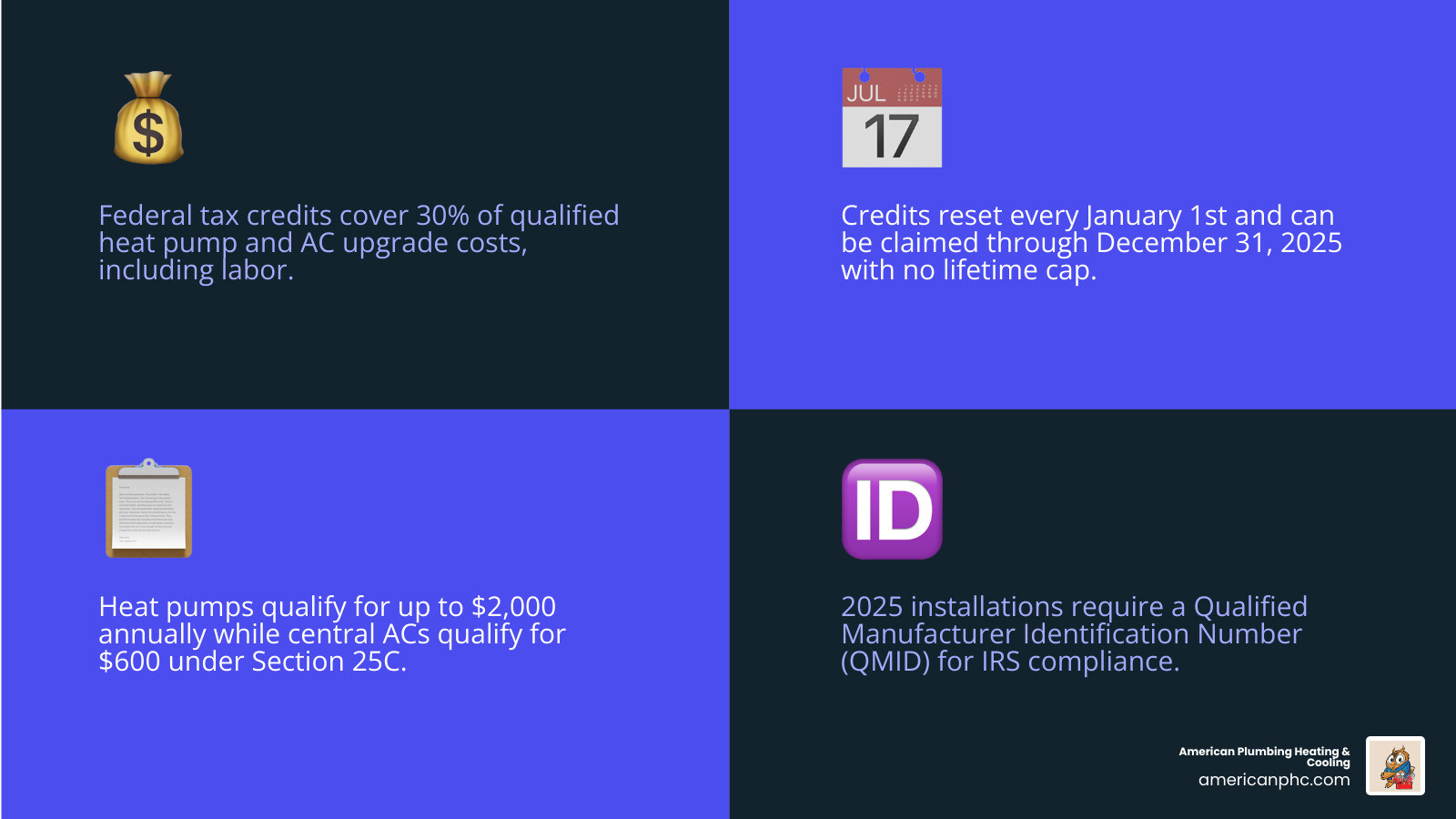
These credits equal 30% of your qualified installation costs, including labor, and they reset every January 1 — meaning you can claim them year after year through December 31, 2025, with no lifetime limit.
If you've been putting off an HVAC upgrade because of the upfront investment, these credits change the math significantly. And as a Florida homeowner, where cooling systems run hard and early replacement can catch you off guard, knowing what you're entitled to before you buy is essential.
The rules around eligibility, efficiency ratings, and documentation have also tightened in recent years — particularly for 2025 installations, which now require a Qualified Manufacturer Identification Number (QMID) on your tax return. This guide walks you through everything you need to know to claim every dollar you're owed.
Federal tax credits for heat pump and ac upgrades vocab explained:
- florida energy rebates for ac upgrades
- fpl and duke energy rebates for gulf coast homeowners
- how to apply for energy rebates in florida
Understanding the Federal Tax Credits for Heat Pump and AC Upgrades
When navigating home improvements, understanding how Section 25C works can save you thousands of dollars. The Energy Efficient Home Improvement Credit (Section 25C) is structured as a nonrefundable tax credit. This means it can reduce the amount of federal income tax you owe dollar-for-dollar, though it cannot refund you more than you actually owe in taxes for the year.
Unlike older versions of the tax credit that had a strict lifetime cap, the current framework under the Inflation Reduction Act allows these limits to reset annually. This annual reset offers a massive advantage to homeowners who plan their upgrades carefully. To learn more about how these legislative changes benefit your household, check out our guide on How Florida Homeowners Can Cash In on the Inflation Reduction Act.
By choosing high-efficiency systems, you are not only lowering your monthly utility bills but also securing a direct reduction in your federal tax liability. For a broader look at the various financial incentives available to local residents, read our article on How to Get Paid for Upgrading Your Florida Home.
Maximizing Federal Tax Credits for Heat Pump and AC Upgrades
Because Section 25C resets every calendar year, you can maximize your tax savings by strategically phasing your home improvements. The credit structure features two primary caps that work together:
- The $1,200 General Cap: This applies to traditional energy-efficiency upgrades, such as central air conditioners (capped at $600), qualified gas furnaces (capped at $600), home energy audits (capped at $150), and building envelope components like windows and doors.
- The $2,000 Heat Pump Cap: This is a completely separate limit dedicated exclusively to electric heat pumps, heat pump water heaters, and biomass stoves.
Because the heat pump credit sits on top of the general efficiency cap, you can claim up to $3,200 in total credits in a single tax year.
For example, if you install a qualified central air conditioner (eligible for a $600 credit) and a qualifying electric Heat Pumps system (eligible for up to $2,000) in the same year, while also getting a home energy audit ($150 credit) and adding attic insulation, you can easily reach that $3,200 maximum. If you have multiple projects on your wish list, such as upgrading your Air Conditioning in year one and installing a heat pump water heater in year two, phasing these installations across different tax years allows you to claim the maximum credit limit twice.
How Do Federal Tax Credits for Heat Pump and AC Upgrades Interact with State Rebates?
Many homeowners ask whether they can combine federal tax credits with other savings programs. The short answer is yes—but you must calculate your credit using the correct "cost basis."
Under IRS rules, if you receive a rebate or financial incentive directly connected to the purchase and installation of the equipment (such as state-administered HEEHRA rebates or direct manufacturer rebates), you must subtract that rebate amount from your total project cost before calculating your 30% federal tax credit.
For example, if a high-efficiency system installation qualifies for a state rebate, you subtract the rebate from the total cost first, and then apply the 30% tax credit to the remaining balance.
Fortunately, utility incentives—such as those offered by FPL or Duke Energy on the Florida Gulf Coast—often do not reduce your federal tax basis in the same way, allowing you to stack savings even further. To make sure you don't leave any money on the table, read our advice on how to Maximize Your Utility Rebates on the Florida Gulf Coast and learn How to Apply for Energy Rebates in Florida Without the Headache.
Eligibility Rules and Technical Standards for HVAC Upgrades

To claim federal tax credits for heat pump and ac upgrades, both your property type and the specific equipment you install must meet strict federal guidelines.
First, the property rules:
- Primary Residences: Virtually all qualifying upgrades under Section 25C must be installed in an existing home that serves as your principal residence in the United States.
- Second Homes: You can claim credits for residential energy property (like heat pumps and central AC units) on a second home that you use as a residence, but you cannot claim building envelope improvements (like insulation, windows, or doors) on second homes.
- Rental Properties: Landlords and property owners cannot claim Section 25C credits for properties they rent out. The credit is designed exclusively for homes occupied by the taxpayer.
- Renters: If you rent your home, you can actually claim credits for certain portable or installed energy property (such as qualified heat pumps) if you paid for the upgrade yourself, though building envelope improvements remain restricted to primary homeowners.
Understanding how these upgrades affect your property is key to making a smart investment. Dive deeper into the relationship between home upgrades and property value in our guide, Energy Efficiency and Your Home Value Connection, or check out The Floridians Guide to High Efficiency Cooling Incentives for local insights.
Efficiency Ratings Required for Heat Pumps and Central AC
You cannot simply buy any off-the-shelf HVAC system and expect to qualify for federal tax credits. The IRS requires that qualifying equipment meet or exceed the highest efficiency tiers established by the Consortium for Energy Efficiency (CEE) in effect at the start of the year the system is placed in service.
These standards are measured using modern HVAC efficiency metrics:
- SEER2 (Seasonal Energy Efficiency Ratio 2): Measures cooling efficiency.
- EER2 (Energy Efficiency Ratio 2): Measures cooling efficiency at peak operating temperatures.
- HSPF2 (Heating Seasonal Performance Factor 2): Measures heating efficiency.
For split-system central air conditioners to qualify for the $600 credit, they generally must meet a SEER2 rating of 16 or higher. For air-source heat pumps to qualify for the $2,000 credit, split ducted systems must meet a SEER2 of 15.2 or above, while non-ducted (mini-split) systems must meet a SEER2 of 16 or higher, alongside meeting strict EER2 and HSPF2 minimums.
That for split systems, both the indoor coil and outdoor unit must be certified together as a matched system to qualify. For a complete breakdown of what these numbers mean for your comfort and your wallet, read A Homeowner Guide to Efficiency Ratings and The Ultimate Guide to High Efficiency Systems Reduce Summer Costs.
Geothermal Heat Pumps and Section 25D
If you are looking beyond standard air-source systems, geothermal heat pumps offer an even more robust tax incentive under Section 25D (the Residential Clean Energy Credit).
Unlike the Section 25C credit, Section 25D provides a flat 30% tax credit with no annual dollar limit for geothermal systems installed through 2032. The credit percentage will begin to step down to 26% in 2033 and 22% in 2034. Furthermore, Section 25D geothermal credits can be claimed for both primary residences and newly constructed or second homes, making it an exceptionally flexible option for major eco-friendly renovations.
How to Claim Your Tax Credits and Required Documentation
Claiming your tax credit requires careful record-keeping. You must claim the credit on your federal tax return for the specific tax year in which the system was fully installed and placed in service—not the year it was purchased, if those dates happen to differ.
To successfully file, you will need:
- Detailed installation receipts showing the breakdown of equipment and labor.
- The manufacturer’s certification statement confirming the model qualifies for the tax credit.
- IRS Form 5695 (Residential Energy Credits), which you will fill out and submit alongside your standard tax return.
If you are looking for flexible ways to manage the upfront costs of your installation before tax season arrives, explore our Financing options to find a plan that fits your budget.
New 2025 and 2026 Manufacturer PIN and QMID Requirements
To combat fraudulent claims, the IRS introduced strict compliance measures starting with products placed in service on or after January 1, 2025.
To claim the Section 25C credit for any qualifying HVAC equipment, your tax return must include a Qualified Manufacturer Identification Number (QMID) or a product-specific Product Identification Number (PIN). This unique code is provided by the manufacturer to verify that the specific model installed in your home meets all certified CEE efficiency standards. When we install your new high-efficiency system, our team will provide you with all the necessary manufacturer documentation, including this required QMID, so your tax filing goes smoothly.
Frequently Asked Questions About HVAC Tax Credits
Navigating tax laws can feel overwhelming. Below is a quick comparison table to help you understand the core differences between the two primary residential energy tax credits:
| Feature | Section 25C (Energy Efficient Home Improvement) | Section 25D (Residential Clean Energy Credit) |
|---|---|---|
| Primary Equipment | Air-Source Heat Pumps, Central AC, Insulation | Geothermal Heat Pumps, Solar Panels, Battery Storage |
| Credit Percentage | 30% of qualified expenses | 30% of qualified expenses |
| Annual Limit | Up to $3,200 ($2,000 for heat pumps / $1,200 general) | No annual maximum limit |
| Lifetime Limit | None (resets annually through Dec 31, 2025) | None (available through 2034) |
| Second Home Eligible | Only for residential energy property (no insulation/doors) | Yes, fully eligible |
| Refundable? | No (nonrefundable, cannot carry forward) | No (but unused Section 25D credits can carry forward) |
Can I claim the tax credit for a rental property or second home?
You cannot claim Section 25C credits for rental properties that you own but do not live in. The property must be used as a residence by the taxpayer claiming the credit. However, you can claim Section 25C credits for qualified HVAC equipment installed in a second home, provided you personally use that second home as a residence during the year. Building envelope upgrades (like windows and insulation) are strictly limited to your primary residence.
What is the maximum amount I can claim in a single tax year?
The absolute maximum combined annual credit under Section 25C is $3,200. This is achieved by combining the $2,000 maximum credit for a qualified electric heat pump or heat pump water heater with the $1,200 general cap for other qualifying upgrades, such as a home energy audit ($150), central AC ($600), or qualified insulation and doors.
Are installation and labor costs included in the tax credit calculation?
Yes! For residential energy property—which includes central air conditioners, air-source heat pumps, and heat pump water heaters—the qualified expenses used to calculate your 30% tax credit include both the equipment costs and the professional labor/installation costs. However, please note that for building envelope components (like insulation, windows, and doors), labor costs do not qualify; only the cost of the product itself can be used to calculate the credit.
Conclusion
Upgrading your home’s heating and cooling systems is a major step toward long-term energy savings, improved indoor comfort, and lower utility bills. By taking advantage of federal tax credits for heat pump and ac upgrades, you can offset a substantial portion of your installation costs while investing in a system that will keep your home comfortable for years to come.
At American Plumbing Heating and Cooling, we bring over 100 years of combined team experience, honest upfront pricing, and certified professional expertise to every job. We serve homeowners across Southwest and Northwest Florida, including Sarasota, Bradenton, Milton, Navarre, Pensacola, and Cape Coral. Our team is ready to help you select a qualifying high-efficiency system, install it to the highest industry standards, and provide the exact manufacturer documentation you need to claim your tax credits with confidence.
Ready to maximize your comfort and your tax savings? Schedule your high-efficiency AC upgrade with American Plumbing Heating and Cooling today.
{"@context": "https://schema.org", "@graph": [{"@type": "Article", "headline": "Federal Heat Pump and AC Tax Credits | American Plumbing", "description": "Learn how federal tax credits for heat pump and AC upgrades can cut HVAC costs by up to $3,200. See eligibility and plan your upgrade today.", "author": {"@type": "Person", "name": "American Plumbing Heating and Cooling"}, "publisher": {"@type": "Organization", "name": "American Plumbing Heating and Cooling", "logo": {"@type": "ImageObject", "url": "https://firebasestorage.googleapis.com/v0/b/ai-templates.appspot.com/o/bot%2FiTB8FxoyvSplQzS7StV8%2Flogo%2FScreenshot%202026-03-16%20at%2012.43.20%E2%80%AFPM.png?alt=media&token=4ae5e171-7bb5-4a27-91f4-47e969b91c80"}}, "datePublished": "2026-07-15T02:47:36+00:00", "dateModified": "2026-07-15T02:47:52.358025", "mainEntityOfPage": {"@type": "WebPage", "@id": "https://pms.ciwebgroup.com/americanphc/2026/07/15/all-about-federal-tax-credits-for-heat-pump-and-ac-upgrades/"}, "image": "https://images.unsplash.com/photo-1566917064245-1c6bff30dbf1?crop=entropy&cs=tinysrgb&fit=max&fm=jpg&ixid=M3w2MTMxNjF8MHwxfHNlYXJjaHw4fHxmZWRlcmFsJTIwdGF4JTIwY3JlZGl0cyUyMGhlYXQlMjBwdW1wJTIwQUN8ZW58MHwwfHx8MTc4MDQ3Mjk0N3ww&ixlib=rb-4.1.0&q=80&w=1080"}, {"@type": "FAQPage", "mainEntity": [{"@type": "Question", "name": "How much can homeowners claim in federal tax credits for heat pump and AC upgrades?", "acceptedAnswer": {"@type": "Answer", "text": "Under the Inflation Reduction Act's Section 25C Energy Efficient Home Improvement Credit, homeowners may be able to claim up to $3,200 in federal tax credits in a single year for qualifying upgrades, including up to $2,000 for an air-source heat pump and $600 for a central air conditioner."}}, {"@type": "Question", "name": "What HVAC upgrades qualify for federal energy tax credits?", "acceptedAnswer": {"@type": "Answer", "text": "Qualifying upgrades may include high-efficiency air-source heat pumps, central air conditioners, home energy audits, and certain insulation, window, and door improvements. Geothermal heat pumps fall under Section 25D and may qualify for a 30% credit with no dollar cap."}}, {"@type": "Question", "name": "Do federal tax credits for heat pump and AC upgrades reset every year?", "acceptedAnswer": {"@type": "Answer", "text": "Yes, the credits reset every January 1 and can be claimed year after year through December 31, 2025, with no lifetime limit under the current Inflation Reduction Act rules."}}, {"@type": "Question", "name": "Are heat pump and AC federal tax credits refundable?", "acceptedAnswer": {"@type": "Answer", "text": "No, the Section 25C Energy Efficient Home Improvement Credit is nonrefundable, meaning it can reduce the federal income tax you owe dollar-for-dollar but cannot refund more than you owe in taxes for the year."}}, {"@type": "Question", "name": "What documentation is required for 2025 HVAC tax credit claims?", "acceptedAnswer": {"@type": "Answer", "text": "For 2025 installations, the rules require a Qualified Manufacturer Identification Number, or QMID, to be included on your tax return when claiming the credit."}}]}]}Need HVAC Help?
Our certified technicians are ready to help with all your heating and cooling needs.
Request ServiceAbout the Author
American Plumbing Heating and Cooling Team
Licensed Florida contractors — HVAC CAC1821761 · Plumbing CFC1431919
More Articles
View All PostsRelated Articles


Ready to Get Started?
Whether you need a repair, maintenance, or a new system installation, our expert team is here to help.