
Cheat Sheet to Heat Pump vs Traditional AC in Florida Homes
By the American Plumbing Heating and Cooling Team
Licensed Florida contractors — HVAC CAC1821761 · Plumbing CFC1431919

Compare heat pump vs traditional ac for florida homes to find the most efficient cooling and heating solution for your climate.
Reviewed bythe American Plumbing Heating and Cooling Team — Licensed Florida contractors — HVAC CAC1821761 · Plumbing CFC1431919. Published July 23, 2026 · Last updated July 29, 2026. About American Plumbing Heating and Cooling
Dealing with this problem right now? Call (941) 735-6616 and talk to our local team.
Request ServiceThe Honest Comparison Florida Homeowners Need: Heat Pump vs Traditional AC
When it comes to heat pump vs traditional ac for florida homes, the short answer for most homeowners is this: a heat pump wins in the majority of cases — but where you live in Florida matters more than most people realize.
Here's a quick breakdown before we go deeper:
| Factor | Heat Pump | Traditional Central AC |
|---|---|---|
| Cooling ability | Yes — same as central AC | Yes |
| Heating ability | Yes — efficient down to ~35°F | No — needs separate heat source |
| Energy efficiency (heating) | 250–350% (COP 2.5–3.5) | N/A (requires electric strips or furnace) |
| Best for | Most of Florida, especially Central and North FL | South Florida (Miami area) with minimal heating demand |
| Federal tax credit (2026) | Up to $2,000 (Section 25C) | Generally not eligible |
| Typical lifespan in FL | 10–15 years | 15–20 years |
| Coastal durability | Needs coil coating near saltwater | Same requirement |
Florida's climate is unlike almost anywhere else in the country. Your AC runs for eight to ten months a year. Your heating system might kick on for a few weeks — or just a handful of nights, depending on where you live. That reality completely changes how you should evaluate your next HVAC system.
In Miami, a traditional AC paired with electric strip heat may actually be the smarter financial choice because heating demand is so low — only three to eight nights below 50°F per year on average. But in Orlando or Jacksonville, where cold nights are more frequent, a heat pump can cut your heating costs dramatically compared to electric resistance heat, which costs three to four times more per BTU delivered.
The 2026 federal Section 25C tax credit — up to $2,000 for qualifying heat pump installations — also shifts the math significantly, narrowing the upfront cost gap between the two systems to nearly zero in many cases.
This guide cuts through the noise so you can make a confident, informed decision for your specific home and location.
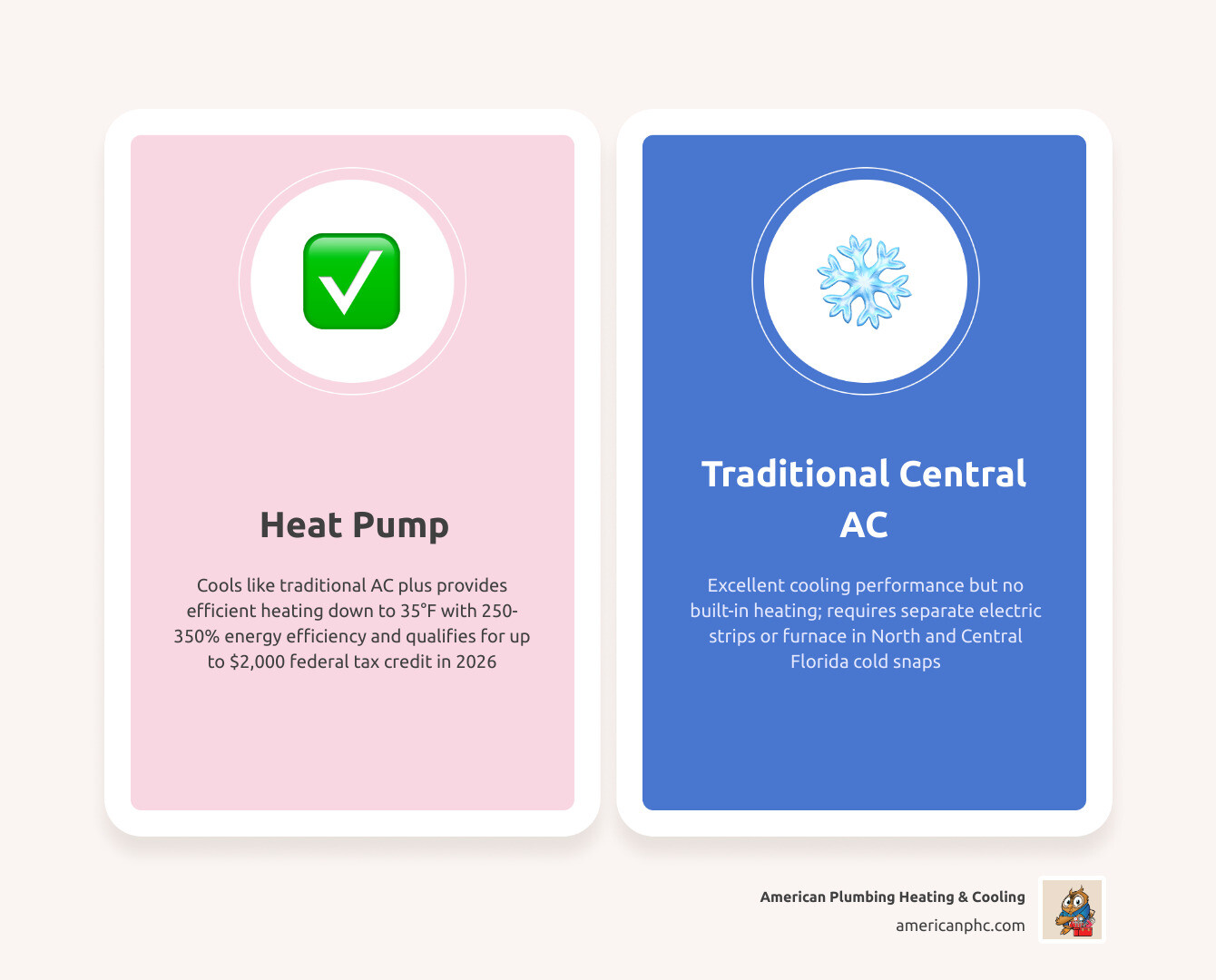
Core Differences: How Heat Pumps and Traditional ACs Work
To understand which system is right for your home, it helps to understand how they work under the hood.
At their core, both a traditional central air conditioner and a heat pump are heat transfer machines. They do not actually "create" cold air; instead, they extract heat from inside your home and dump it outdoors.
A traditional straight-cool air conditioner is a one-way street. It uses a compressor, a condenser coil, an evaporator coil, and chemical refrigerant to absorb indoor heat and move it outside. When the winter months arrive and temperatures drop, a traditional AC cannot help you. To keep your home warm, a traditional system must rely on a separate heating source. In most Florida homes, this is an electric resistance heating kit (often called "electric strip heat" or "heat strips") installed inside the indoor air handler. You can learn more about these fundamentals in our guide on AC System Basics Florida Homes.
A heat pump, on the other hand, is a two-way street. It looks almost identical to a traditional central AC, uses the same indoor air handler, and shares about 90% of the same mechanical parts. However, it features a critical component called a reversing valve.
In the summer, the reversing valve directs the refrigerant flow so the heat pump operates exactly like a traditional AC, cooling your home with identical efficiency. In the winter, the reversing valve reverses the flow of the refrigerant. Instead of extracting heat from inside your home, the system extracts heat from the outdoor air—even when it feels chilly outside—and pumps that heat indoors.
Because moving heat requires significantly less electricity than creating heat, heat pumps are incredibly efficient. To explore how these dynamics change when heating your home, read our breakdown of Heating System Basics Florida.
Why a Heat Pump vs Traditional AC for Florida Homes Fits the Sunshine State
In colder northern climates, heat pumps historically struggled because there is very little ambient heat to extract when temperatures drop below freezing. But in Florida, our winter temperatures are mild, typically hovering between 35°F and 65°F.
In this temperature range, a heat pump operates at peak performance, achieving a Coefficient of Performance (COP) of 2.5 to 3.5. This means that for every single unit of electricity the heat pump consumes, it delivers 2.5 to 3.5 units of heat energy into your home. That equates to an incredible 250% to 350% efficiency rating.
By comparison, traditional electric strip heat operates at exactly 100% efficiency—one unit of electricity produces exactly one unit of heat. This makes electric resistance heat highly inefficient and expensive to run.
By choosing a heat pump over a traditional AC with heat strips, you are choosing a system that can provide 3 to 5 times more energy output for every unit of electricity used during the winter. For a deeper look at how these ratings impact your monthly bills, consult A Homeowner Guide to Efficiency Ratings and our comprehensive Heating Options Comparison Florida.
Choosing Between a Heat Pump vs Traditional AC for Florida Homes
When shopping for a new HVAC system, comparing the technical features of both options side-by-side can help clarify your decision.
| Feature / Metric | Heat Pump | Traditional Central AC |
|---|---|---|
| Primary Efficiency Rating (Cooling) | Measured in SEER2 (typically 15.2 to 28+) | Measured in SEER2 (typically 14.3 to 20+) |
| Heating Efficiency Rating | Measured in HSPF2 (typically 7.8 to 10+) | Not applicable (strip heat has a COP of 1.0) |
| Compressor Options | Single-stage, multi-stage, or variable-speed (inverter) | Single-stage, multi-stage, or variable-speed |
| Upfront Equipment Cost | Moderate premium over straight-cool systems | Lower base equipment cost |
| Long-Term Heating Costs | Extremely low (saves 30% to 50% vs. strip heat) | High (when relying on electric heat strips) |
| Environmental Impact | Reduces household carbon emissions by ~40% | Higher carbon footprint if paired with electric strips |
Both systems offer excellent cooling performance, but the heat pump's ability to transition seamlessly into an ultra-efficient heating system makes it a versatile choice.
Modern heat pumps and traditional air conditioners are both available in various configurations, including single-stage, two-stage, and advanced variable-speed designs. For a detailed comparison of these installation paths, check out our AC Installation Options Comparison Guide and our analysis of AC Installation Single Stage vs Variable Speed.
Regional Climate Factors: Heat Pump vs Traditional AC for Florida Homes
Your geographic location in Florida is the single most important factor when determining whether the upfront investment of a heat pump is justified. Florida's climate varies significantly from the temperate Northwest Panhandle down to the tropical Southwest coast.
Let's look at how the heating load changes across our primary service areas:
- Northwest Florida (Pensacola, Milton, Navarre): This region experiences a genuine winter season, averaging 20 to 40 nights below 50°F per year. Because of this consistent heating load, homeowners in the Panhandle rely on their heating systems frequently. Choosing a heat pump in Northwest Florida is a highly cost-effective decision, providing rapid payback periods by eliminating the need for expensive electric strip heating.
- Southwest Florida (Sarasota, Bradenton, Lakewood Ranch, Venice, Siesta Key): In this coastal and inland region, winters are milder, averaging 8 to 15 nights below 50°F per year. While the heating load is lower than in the Panhandle, a heat pump still provides valuable savings during occasional winter cold snaps and cool desert-like evenings.
- Extreme Southwest Florida (Cape Coral, Fort Myers): This area experiences very warm winters, averaging only a handful of nights below 50°F. Because the heating load is so minimal, the energy savings from a heat pump during the winter may take longer to offset the upfront price premium of the equipment, making a high-efficiency traditional AC a highly competitive alternative.
Financial Incentives and Tax Credits in 2026
In July 2026, federal financial incentives have made the transition to energy-efficient heat pumps more attractive than ever before. Under the Inflation Reduction Act's Section 25C residential energy efficiency tax credit, qualifying heat pump installations are eligible for a federal tax credit of up to $2,000.
To qualify for this credit in our southern climate zone, the heat pump must meet specific Consortium for Energy Efficiency (CEE) Tier 1 thresholds:
- Ducted Systems: Minimum 15.2 SEER2, 11.7 EER2, and 7.8 HSPF2.
Because traditional straight-cool air conditioners generally do not qualify for these significant federal tax credits, this incentive effectively reduces the upfront premium of a heat pump compared to a traditional AC to nearly zero.
Additionally, local utility companies offer rebates that can be stacked with federal incentives to maximize your savings. For example, homeowners can take advantage of Florida Energy Saver Rebates and specific federal programs. To learn more about maximizing these savings, review our guide to Federal HVAC Tax Credits.
Lifespan, Maintenance, and Coastal Durability in Florida
Florida's unique environment—characterized by intense humidity, high heat, and corrosive salt air—poses challenges for any outdoor HVAC condenser.
A traditional central air conditioner in Florida typically lasts 15 to 20 years, provided it receives regular maintenance. A heat pump, by contrast, has an expected lifespan of 10 to 15 years. This shorter lifespan is not due to inferior build quality; rather, it is a direct result of year-round operation. While a traditional AC rests during the winter months, a heat pump continues to cycle to keep your home warm.
For homes located near the coast in areas like Siesta Key, Venice, Cape Coral, or Pensacola Beach, salt air corrosion is a major threat. Salt spray can quickly corrode and pit standard aluminum outdoor coils, leading to refrigerant leaks and premature system failure.
To combat this, we highly recommend investing in a specialized coastal coil-coating package for any outdoor unit installed within five miles of saltwater. This protective barrier shields the delicate coils from corrosive salt air, extending the life of your system. You can explore these coastal challenges further in our article on Coastal Cooling Battles Between Central AC and Mini Splits. If your current system is showing signs of salt wear, check out our resource on AC Repair vs Replacement Florida.
Maintenance and Installation Considerations
Because a heat pump operates during both the cooling and heating seasons, it requires diligent maintenance. While a traditional AC only requires a single comprehensive tune-up prior to the summer, a heat pump benefits from twice-yearly professional inspections: once in the spring to prepare for the cooling season, and once in the fall to test the reversing valve, defrost controls, and auxiliary electric heat strips.
Proper installation is also critical. Up to 70% of HVAC installations suffer from design or sizing defects, often due to restricted airflow or undersized ductwork. During installation, our technicians perform a static pressure test to ensure your home's ductwork can handle the precise airflow requirements of your new system.
Additionally, as of the recent environmental transitions, new HVAC systems utilize modern A2L refrigerants (such as R-454B and R-32), which replace older R-410A systems. These modern refrigerants have a 75% lower Global Warming Potential (GWP), making your new system highly environmentally friendly. They do require updated leak-detection sensors and certified handling, which our professional team is fully equipped to manage. For tips on managing indoor air comfort alongside these technical upgrades, read about AC Humidity Control Florida Homes.
Frequently Asked Questions About Florida HVAC Systems
Do heat pumps work effectively during Florida cold snaps?
Yes. Modern heat pumps are highly effective during occasional Florida freezes. Even when temperatures drop into the 30s in places like Pensacola or Milton, a heat pump can extract sufficient ambient heat from the outdoor air to keep your home warm.
If temperatures drop below freezing, the outdoor coil may develop a thin layer of frost. When this occurs, the system automatically initiates a brief defrost cycle, temporarily reversing itself to warm the outdoor coils while utilizing auxiliary electric heat strips to keep the indoor air comfortable.
Can I switch from a traditional AC to a heat pump using my current ducts?
In the vast majority of cases, yes. If your existing ductwork is in good structural condition and is properly sized, it can easily accommodate a high-efficiency heat pump.
During our initial consultation, we will perform a thorough ductwork evaluation and static pressure test to confirm that your home's infrastructure can handle the airflow. If your home lacks ductwork, or if you have a historic home or a new room addition, we can discuss ductless mini-split options. You can read more about this in The Great Chill Debate of Ducted vs Ductless Systems.
How do these systems handle Florida's intense humidity?
Both traditional air conditioners and heat pumps remove humidity during the cooling cycle as warm, moist indoor air passes over the cold evaporator coil, causing moisture to condense and drain away.
However, systems equipped with variable-speed compressor technology are significantly better at humidity control. Instead of turning on and off at full blast, a variable-speed system runs continuously at lower, steadier speeds. This longer, gentler run cycle allows the system to extract significantly more moisture from the air, preventing that "clammy" indoor feeling. To compare this to other moisture-control solutions, read our guide on Whole Home Dehumidifier vs AC Upgrade Florida.
Conclusion
Choosing between a heat pump vs traditional ac for florida homes ultimately comes down to your specific location, your heating needs, and how you plan to maximize modern financial incentives. Whether you are seeking peak energy efficiency in Pensacola, reliable year-round comfort in Sarasota, or cost-effective cooling in Cape Coral, selecting the right system will keep your home comfortable for years to come.
An upgraded, high-efficiency HVAC system does more than just lower your monthly utility bills—it can also enhance your home's overall value and marketability. To explore these long-term benefits, read our In-Depth Guide to New HVAC Benefits Beyond Comfort, look over The Ultimate Guide to HVAC Condition and Home Appraisals, or discover How a Fresh HVAC System Puts Your Home Sale on the Fast Track. You can also learn more about the financial connection in Energy Efficiency and Your Home Value Connection.
If you are ready to explore your options, we can help you navigate local incentives with The Floridian's Guide to High Efficiency Cooling Incentives. Depending on your location, you may also qualify for FPL Utility Rebates or exclusive manufacturer offers like Daikin Rebates Offers.
At American Plumbing Heating and Cooling, our team brings over 100 years of combined experience, honest upfront pricing, and certified professional service to every job. Whether you need a detailed system evaluation, a professional installation, or 24/7 emergency support, we are here to help.
Schedule your professional HVAC consultation with American Plumbing Heating and Cooling today to find the perfect system for your Florida home.
{"@context": "https://schema.org", "@graph": [{"@type": "Article", "headline": "Heat Pump vs Traditional AC for FL Homes | American PHC", "description": "Compare heat pump vs traditional AC for Florida homes, costs, comfort, tax credits and climate fit. Learn which HVAC system is right for you.", "author": {"@type": "Person", "name": "American Plumbing Heating and Cooling"}, "publisher": {"@type": "Organization", "name": "American Plumbing Heating and Cooling", "logo": {"@type": "ImageObject", "url": "https://firebasestorage.googleapis.com/v0/b/ai-templates.appspot.com/o/bot%2FiTB8FxoyvSplQzS7StV8%2Flogo%2FScreenshot%202026-03-16%20at%2012.43.20%E2%80%AFPM.png?alt=media&token=4ae5e171-7bb5-4a27-91f4-47e969b91c80"}}, "datePublished": "2026-07-23T13:46:05+00:00", "dateModified": "2026-07-23T13:46:28.059987", "mainEntityOfPage": {"@type": "WebPage", "@id": "https://pms.ciwebgroup.com/americanphc/2026/07/23/cheat-sheet-to-heat-pump-vs-traditional-ac-in-florida-homes/"}, "image": "https://images.unsplash.com/photo-1667983453881-4992fe86ab1b?crop=entropy&cs=tinysrgb&fit=max&fm=jpg&ixid=M3w2MTMxNjF8MHwxfHNlYXJjaHwzfHxoZWF0JTIwcHVtcCUyMHZzJTIwdHJhZGl0aW9uYWwlMjBBQyUyMHN5c3RlbXxlbnwwfDB8fHwxNzgzMjIzODEwfDA&ixlib=rb-4.1.0&q=80&w=1080"}, {"@type": "FAQPage", "mainEntity": [{"@type": "Question", "name": "Is a heat pump or traditional AC better for Florida homes?", "acceptedAnswer": {"@type": "Answer", "text": "A heat pump is the better choice for most Florida homes because it provides the same cooling as central AC while also offering efficient heating. However, location matters: traditional AC with electric strip heat may make more financial sense in South Florida where heating demand is very low."}}, {"@type": "Question", "name": "When does a traditional AC make more sense than a heat pump in Florida?", "acceptedAnswer": {"@type": "Answer", "text": "A traditional AC may be the smarter financial choice in places like Miami, where homes may only need heat on about three to eight nights below 50°F per year. In that case, the added heating efficiency of a heat pump may not matter as much."}}, {"@type": "Question", "name": "Why is a heat pump more efficient for heating than electric strip heat?", "acceptedAnswer": {"@type": "Answer", "text": "A heat pump transfers heat rather than creating it, giving it heating efficiency of about 250–350% with a COP of 2.5–3.5. Electric resistance heat costs three to four times more per BTU delivered compared with a heat pump."}}, {"@type": "Question", "name": "Are heat pumps eligible for federal tax credits?", "acceptedAnswer": {"@type": "Answer", "text": "Qualifying heat pump installations may be eligible for the 2026 federal Section 25C tax credit of up to $2,000. This can significantly reduce the upfront cost difference between a heat pump and a traditional AC system."}}, {"@type": "Question", "name": "How long do heat pumps and traditional AC systems last in Florida?", "acceptedAnswer": {"@type": "Answer", "text": "In Florida, heat pumps typically last about 10–15 years, while traditional central AC systems typically last about 15–20 years. Homes near saltwater may need coil coating for coastal durability with either system."}}]}]}Need HVAC Help?
Our certified technicians are ready to help with all your heating and cooling needs.
Request ServiceAbout the Author
American Plumbing Heating and Cooling Team
Licensed Florida contractors — HVAC CAC1821761 · Plumbing CFC1431919
More Articles
View All PostsRelated Articles


Ready to Get Started?
Whether you need a repair, maintenance, or a new system installation, our expert team is here to help.