
The Ultimate Guide to Mini Split vs Central Air in Florida
By the American Plumbing Heating and Cooling Team
Licensed Florida contractors — HVAC CAC1821761 · Plumbing CFC1431919

Is a mini split better than central air in Florida? Compare energy efficiency, humidity control, and installation for your home.
Reviewed bythe American Plumbing Heating and Cooling Team — Licensed Florida contractors — HVAC CAC1821761 · Plumbing CFC1431919. Published July 14, 2026. About American Plumbing Heating and Cooling
Dealing with this problem right now? Call (941) 735-6616 and talk to our local team.
Request ServiceIs a Mini Split Better Than Central Air in Florida? Here's What You Need to Know First
Is a mini split better than central air in Florida? For most homeowners, the honest answer is: it depends — but mini splits have some real, measurable advantages in Florida's hot, humid climate that central air simply can't match on paper.
Here's a quick breakdown to get you oriented:
| Factor | Mini Split | Central Air |
|---|---|---|
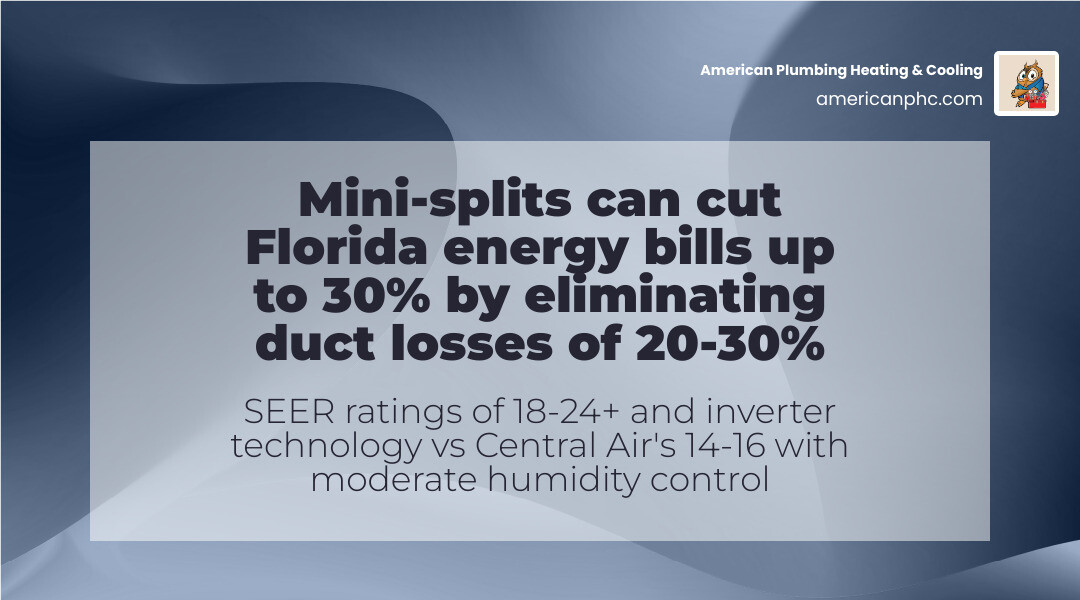
| Energy Efficiency | SEER ratings of 18-24+ | SEER ratings of 14-16 |
| Duct Losses | None | 20-30% of cooled air lost |
| Humidity Control | Excellent (runs longer at lower speed) | Moderate (short cycles can leave air clammy) |
| Best For | Older homes, additions, no ductwork, zoned cooling | Homes with existing good ductwork, whole-home coverage |
| Installation Disruption | Minimal — no ductwork needed | Significant if new ducts are required |
| Long-Term Savings | Can cut energy bills up to 30% | Higher operating costs, especially with leaky ducts |
Florida is not like most states. Your air conditioner runs eight to ten months a year — sometimes more. That kind of relentless demand means small efficiency gaps between systems turn into large differences on your monthly electric bill over time.
Central air has long been the go-to for whole-home cooling, and it still makes strong sense in the right situation. But mini splits — which connect an outdoor compressor to one or more wall-mounted indoor units without any ductwork — use inverter-driven compressors that adjust output based on demand rather than cycling on and off at full blast. That technology pairs especially well with Florida's climate, where humidity control is just as important as temperature control.
The biggest variable? Your existing ductwork. Whether you have it, how well it's sealed, and where it runs (often through a sweltering attic) will shape this decision more than almost anything else.
This guide walks through every angle of the comparison — efficiency, installation, humidity, costs, incentives, and maintenance — so you can make a confident call for your specific home.
Similar topics to is a mini split better than central air in florida:
- adding cooling without ductwork options compared
- central air vs mini split for the gulf coast homes
- florida room air conditioning
Understanding the Core Differences: Ductless vs. Central AC
To understand why one system might outperform the other in your home, we have to look at how they move air.
Traditional central air conditioning relies on a single, centralized indoor air handler, usually tucked away in a closet or garage, and a large outdoor condenser unit. The system cools air at this central point and then uses a powerful fan to push it through a complex web of metal or flexible ductwork hidden behind your walls, ceilings, and attic. The entire house is treated as one giant zone, regulated by a single thermostat.
On the flip side, ductless mini-split systems completely eliminate the middleman: the ductwork. Instead of one central air handler, a mini-split system uses individual, small air-handling units installed directly in the rooms or "zones" they are meant to cool. These indoor units are connected to a single outdoor compressor via a small bundle of copper refrigerant lines, electrical wiring, and a condensate drain line.
This design completely changes the dynamic of how your home is cooled. In The Great Chill Debate of Ducted vs. Ductless Systems, we explore how this fundamental structural difference impacts air distribution. Because mini-splits deliver cooled air directly into the room where the unit is mounted, they don't have to fight the friction and thermal resistance of long duct runs.
Furthermore, mini-splits offer true zoning capabilities. Each indoor unit operates independently with its own thermostat. If you prefer your bedroom ice-cold at night but don't care about cooling an empty guest room or kitchen, you can adjust each zone accordingly. Central air, by contrast, cools the entire house uniformly, which often leads to wasting energy on unoccupied spaces. To dive deeper into the mechanics of these systems, you can check out our guide on Mini-Split Air Conditioning 101.
Is a Mini Split Better Than Central Air in Florida for Energy Efficiency?
When we talk about surviving a Florida summer—which stretches from early spring well into late autumn—energy efficiency isn't just a buzzword; it's a direct line to your wallet.
The primary metric used to measure cooling efficiency is the Seasonal Energy Efficiency Ratio (SEER) or the updated SEER2 standard. The higher the number, the more cooling comfort the system delivers per unit of electricity consumed.
Traditional central air conditioning systems in Florida typically carry SEER ratings ranging from 14 to 16, with some high-end models reaching up to 21 SEER2. In contrast, modern ductless mini-split systems commonly start at 18 SEER and can reach up to 30+ SEER2.
The secret to this incredible efficiency lies in inverter technology. Standard central AC compressors are single-stage or two-stage, meaning they operate much like a light switch: they are either 100% on or completely off. When your home warms up, the central AC kicks on at full power, blasts cold air until the thermostat is satisfied, and then shuts off. This constant stop-and-start cycle consumes a massive amount of electricity.
Mini-splits use variable-speed, inverter-driven compressors. Instead of shutting down completely, the compressor slows down or speeds up incrementally to maintain a highly consistent temperature. It runs almost continuously at a very low, ultra-efficient speed, using 25% to 40% less cooling energy than a standard ducted system. This is why we often highlight this technology in our comparison of Coastal Cooling Battles: Central AC vs. Mini-Splits.
| Feature | Standard Central AC | Ductless Mini-Split |
|---|---|---|
| Typical SEER/SEER2 Range | 14 to 21 SEER2 | 18 to 30+ SEER2 |
| Compressor Type | Single- or Two-Stage (On/Off) | Variable-Speed (Inverter-Driven) |
| Energy Loss Method | Duct leaks and attic heat transfer | Minimal (no duct losses) |
| Zoning Capability | Limited (requires complex dampers) | Built-in (independent room control) |
| Energy Consumption | Higher due to frequent cycling | Up to 30% lower overall |
How Duct Losses Impact Central AC Efficiency in Florida
If you want to understand the true cost of central air in Florida, you have to look up—specifically, into your attic.
In a typical home in Sarasota, Cape Coral, or Pensacola, the ductwork is run through the attic space. During July and August, attic temperatures can easily soar past 130°F.
Even a professionally installed, well-sealed duct system will lose efficiency through thermal transfer. The cold air traveling through those hot ducts warms up before it ever reaches your living spaces.
Worse yet, standard residential ductwork is rarely perfectly sealed. Studies show that central air systems lose 20% to 30% of their conditioned air through minor duct leaks, gaps, unsealed joints, and poor insulation. This means you are paying to air-condition your dusty, unoccupied attic. Because mini-splits do not use ducts, they suffer absolutely zero duct loss, delivering 100% of the cooled air directly into your living room, bedroom, or kitchen.
Why Dehumidification Matters: Is a Mini Split Better Than Central Air in Florida for Humidity Control?
Any Floridian knows that heat is only half the battle; it's the heavy, thick humidity that makes the air feel oppressive. Proper air conditioning must act as a dehumidifier to keep your home comfortable and prevent mold growth.
Central air conditioners remove moisture from the air, but only when they are actively running. Because they cycle on and off rapidly, they often cool the home down to the target temperature so quickly that they don't run long enough to pull the moisture out of the air. This results in a home that feels cold but clammy.
Mini-splits excel at humidity control because of their variable-speed inverter compressors. By running continuously at lower speeds, they keep air constantly moving across the cold evaporator coils. This extended run time allows them to extract significantly more moisture from the air, maintaining a highly comfortable relative humidity level and keeping indoor spaces feeling crisp and dry.
Installation and Structural Considerations for Florida Homeowners
Choosing between these two systems isn't just about efficiency ratings; it's also about the physical structure of your home.
Installing central air is relatively straightforward if your home already has a functional, clean network of ducts. However, if you are building an addition, converting a garage, or restoring a historic property, running new ductwork can be a logistical nightmare.
Installing ducts requires cutting into drywall, dropping ceilings, and sacrificing precious closet space to run bulky metal or flexible tubes. It can turn a simple cooling upgrade into a major home renovation project.
Ductless mini-splits offer a minimally invasive alternative. To connect the indoor air handler to the outdoor compressor, all that is required is a small three-inch hole through an exterior wall. This hole accommodates the copper refrigerant lines, electrical cables, and a small condensate drain line. To get a complete picture of how these systems fit into your home, take a look at Everything You Need to Know About Ductless Air Conditioning.
However, you must also consider aesthetics and layout. Central air is virtually invisible; you only see small, flat registers on the floor or ceiling. Mini-splits require an indoor unit mounted on the wall, floor, or ceiling in every room you want to cool. For some homeowners, this visual presence is a trade-off, while others appreciate the sleek, modern design of contemporary units. We break down these structural and upfront investment differences in our Central AC vs. Mini-Split: Price Tag Showdown.
When to Choose a Mini-Split System
There are several scenarios where a mini-split is clearly the superior option for Florida homes:
- Garage Conversions and Workshops: Garages are rarely connected to the home's central duct system. A mini-split can turn a hot, dusty garage into a comfortable, air-conditioned workshop or home gym without overloading your main system.
- Sunrooms and Florida Rooms: These glass-heavy spaces experience intense heat gain. A mini-split can provide the dedicated, powerful cooling needed to keep these rooms comfortable year-round.
- Older or Historic Homes: Many historic homes in areas like Sarasota or Pensacola were built before central AC existed and lack the wall cavities needed for ductwork. Mini-splits provide modern cooling comfort without destroying historic plaster walls or architectural charm.
- Zoned Comfort Needs: If family members constantly fight over the thermostat, mini-splits allow everyone to set their own perfect temperature in their respective rooms.
When Central Air Conditioning Makes More Sense
Despite the high efficiency of mini-splits, traditional central air remains the practical choice in many situations:
- Existing Functional Ductwork: If your home already has a well-designed, clean, and properly sealed duct system, replacing an old central unit with a new, high-efficiency central AC system is often the most straightforward approach.
- Whole-Home Cooling with Open Floor Plans: If you have a large, open-concept home and want uniform temperatures throughout every single room, a single central air system is highly effective at maintaining a consistent climate.
- Aesthetic Preferences: If you do not want visible indoor air handlers mounted on your walls or ceilings, central air keeps the mechanical components completely out of sight.
Long-Term Maintenance, Lifespan, and Florida Incentives
To keep either system running efficiently in our salty, humid coastal air, regular maintenance is absolutely essential.
With central air systems, basic home maintenance involves changing your replaceable MERV-rated air filters every one to three months. These filters are located at your return vents or directly at the air handler.
Mini-splits use built-in, washable mesh filters located inside the front panel of each indoor unit. Because these units pull air directly from the room, these filters should be popped out and rinsed under a tap at least once a month. Neglecting this simple step can restrict airflow and drastically reduce the system's efficiency.
Both systems require annual professional maintenance. For central air, this includes cleaning the evaporator coils, checking duct integrity, and clearing the condensate drain line. For mini-splits, a technician must clean the indoor blower wheels, flush the individual condensate drains, and treat the outdoor coils to prevent corrosion from salty coastal air.
With proper care, both systems typically last between 15 and 20 years. However, the harsh Florida elements—including extreme heat, heavy rain, and salt spray in coastal areas like Venice, Siesta Key, and Cape Coral—can shorten this lifespan if maintenance is ignored.
When looking at the long-term value, Florida homeowners should also consider available incentives. Under the federal Energy Efficient Home Improvement Credit (Section 25C), homeowners may qualify for tax credits when upgrading to qualified high-efficiency heat pumps, including many mini-split systems. Additionally, local utility companies across Southwest and Northwest Florida often offer rebates for upgrading to energy-efficient cooling systems.
Deciding Your Best Option: Is a Mini Split Better Than Central Air in Florida for Your Home?
To determine if is a mini split better than central air in florida for your specific situation, ask yourself these key questions:
- What is the condition of my current ductwork? If your ducts are falling apart, leaking, or located in a baking-hot attic, switching to a ductless system or using mini-splits to supplement your cooling can save you significant energy.
- How do I use my home day-to-day? If you live in a large multi-story home but spend 90% of your time in just two or three rooms, a zoned mini-split system allows you to turn down the cooling in empty rooms and enjoy substantial energy savings.
- Am I planning additions or renovations? If you are adding a room or converting a space, a mini-split is almost always the easiest and most efficient way to cool that new square footage.
Frequently Asked Questions
Which system is easier to maintain in Florida's coastal climate?
Neither system is completely "set it and forget it," but they require different types of care. Central air systems are simpler for homeowners because you only need to swap out a central filter every few months. Mini-splits require you to physically wash the mesh filters in each indoor unit monthly. However, mini-splits eliminate the need for duct cleaning and duct sealing, which can be a major maintenance headache for central AC owners in humid coastal regions.
Can I combine central air with a mini-split in my Florida home?
Absolutely! This is a highly popular option for many homeowners in Southwest and Northwest Florida. You can keep your existing central air system to handle the main living areas of the home, and install a single-zone mini-split to handle a notoriously hot upstairs bedroom, a newly added sunroom, or a converted garage. This hybrid approach keeps your main system from working overtime.
Do mini-splits comply with Florida's strict hurricane building codes?
Yes, provided they are installed professionally. Florida has some of the strictest building codes in the country, particularly regarding wind resistance for outdoor equipment. The outdoor condenser of a mini-split must be securely bolted to a heavy concrete or composite pad using hurricane straps or certified anchors capable of withstanding high-velocity hurricane winds.
Conclusion
The choice between a mini-split and central air comes down to your home's layout, your lifestyle, and how you want to manage your energy consumption. If you have a home with functional ductwork and prefer a system that stays completely out of sight, central air is a reliable, time-tested option. However, if you want maximum energy efficiency, precise room-by-room temperature control, and superior humidity management without the hassle of ductwork, a mini-split system is an incredibly compelling choice for Florida living.
At American Plumbing Heating and Cooling, we have over 100 years of combined team experience helping homeowners stay comfortable year-round. Whether you are in Sarasota, Bradenton, Cape Coral, Fort Myers, Milton, Navarre, or Pensacola, our certified pros are here to help you evaluate your home and choose the perfect system.
Ready to upgrade your home comfort? Schedule your Florida AC consultation today and let our family take care of yours!
Need HVAC Help?
Our certified technicians are ready to help with all your heating and cooling needs.
Request ServiceAbout the Author
American Plumbing Heating and Cooling Team
Licensed Florida contractors — HVAC CAC1821761 · Plumbing CFC1431919
More Articles
View All PostsRelated Articles


Ready to Get Started?
Whether you need a repair, maintenance, or a new system installation, our expert team is here to help.