
What Temperature Should I Set My Thermostat in Florida: Detailed Guide
By the American Plumbing Heating and Cooling Team
Licensed Florida contractors — HVAC CAC1821761 · Plumbing CFC1431919

Discover what temperature should I set my thermostat in Florida for energy savings, humidity control, and year-round comfort in your home.
Reviewed bythe American Plumbing Heating and Cooling Team — Licensed Florida contractors — HVAC CAC1821761 · Plumbing CFC1431919. Published July 9, 2026 · Last updated July 29, 2026. About American Plumbing Heating and Cooling
Dealing with this problem right now? Call (941) 735-6616 and talk to our local team.
Request ServiceWhat Temperature Should I Set My Thermostat in Florida? (Quick Answer)
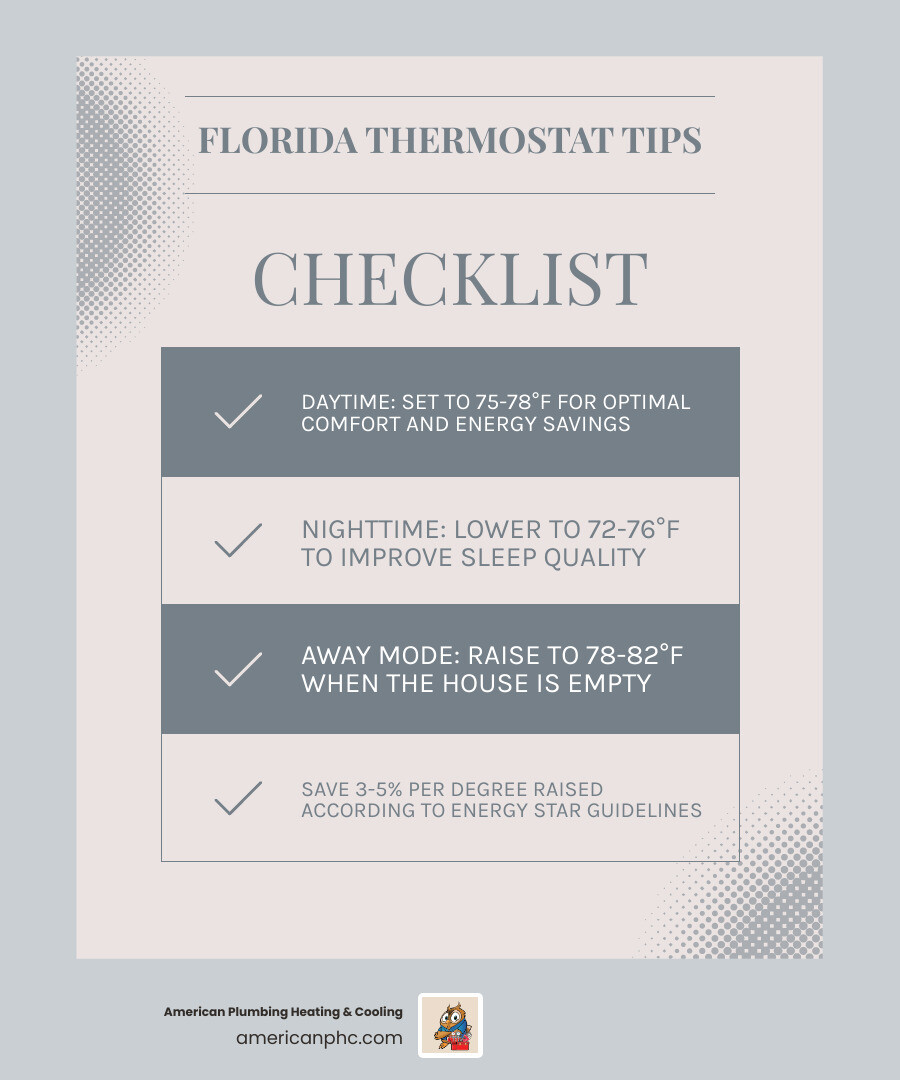
If you're wondering what temperature should I set my thermostat in Florida, here's the short answer before we dive deeper:
| Situation | Recommended Setting |
|---|---|
| Home during the day | 75°F – 78°F |
| Sleeping at night | 72°F – 76°F |
| Away from home | 78°F – 82°F |
| Extended absence | Up to 85°F (fan on auto) |
Florida's heat and humidity make thermostat settings more critical than almost anywhere else in the country. Unlike northern states where you can crack a window at night or let the house warm up while you're at work, Florida's climate demands that your AC runs consistently — not just to keep you cool, but to keep moisture under control.
According to a 2024 poll of over 7,000 Florida residents, 78°F is the single most popular daytime setting, chosen by 21% of respondents. Energy Star also points to 78°F as the most energy-efficient cooling temperature for homes. But comfort isn't one-size-fits-all — your health, home type, and humidity levels all play a role in finding the right number for your household.
In this guide, we break down the best settings for every part of your day, explain why humidity changes everything in Florida, and cover the smart habits and thermostat features that can help you stay comfortable without running up a massive electric bill.
Finding the Sweet Spot: What Temperature Should I Set My Thermostat in Florida?
Living in the Sunshine State means your air conditioner is the MVP of your home. As we move through May 2026, we are already seeing the familiar climb of the heat index. Finding the perfect balance between a refreshing indoor climate and a manageable utility bill is an art form. Most Florida homeowners find their "sweet spot" between 75°F and 78°F during the day.
When you stop burning cash just to stay cool this summer, you realize that every degree matters. In Florida, the indoor climate isn't just about the temperature on the screen; it’s about managing the "felt" temperature. Because our outdoor air is so saturated with moisture, a home at 78°F with low humidity can actually feel more comfortable than a home at 72°F that feels "sticky" or damp.
Ideal Daytime Settings for Florida Homes
The 78°F recommendation from Energy Star and many Florida utility companies isn't just a random number. It is designed to minimize the gap between the scorching outdoor air and your indoor sanctuary. The smaller this gap, the less your system has to work, and the more money stays in your pocket.
Statistics show that for every degree you raise your thermostat above 75°F, you can save up to 5% on your monthly cooling costs. If you move your setting from 73°F to 78°F, you could potentially slash your energy bill by nearly 50%. We know that how to set your thermostat without starting a family feud is a real challenge, but compromise is key. Try starting at 78°F and nudging it down one degree at a time until everyone is satisfied.
The Best Nighttime Thermostat Setting in Florida for Sleep
While 78°F might work while you're moving around the kitchen, it’s often too warm for a restful night. Your body’s circadian rhythm naturally calls for a drop in core temperature to initiate deep sleep. For most Floridians, the ideal nighttime range is 72°F to 76°F.
Why your thermostat is the secret to a better night's sleep often comes down to how much moisture the AC can pull out of the air while you dream. Since Florida nights rarely provide a significant temperature drop, your AC has to do all the heavy lifting. Setting the temperature a few degrees lower at night helps ensure you don't wake up in a sweat, but avoid going below 72°F if you want to keep your energy usage from skyrocketing.
Managing Humidity and Away Settings

In Florida, your thermostat is as much a "dehumidistat" as it is a temperature controller. If you set the temperature too high when you leave, the relative humidity inside your home can spike, leading to that "musty" Florida smell or, worse, mold growth on your furniture and walls.
When you are leaving the nest? Don't forget to adjust your thermostat, but don't be tempted to turn it off entirely. We recommend setting it to 78°F – 82°F while you are at work. If you're going on vacation, 82°F is generally the upper limit. Going to 85°F is only advisable if you have a high-efficiency system and your fan is set to "AUTO" to ensure the evaporator coils can properly shed moisture.
Why Humidity Dictates What Temperature Should I Set My Thermostat in Florida
The main job of your AC—besides cooling—is removing "latent heat," which is the heat trapped in water vapor. If your AC runs in short, frantic bursts because the setting is too low, it won't run long enough to pull the moisture out of the air. This results in a home that is cold but "clammy."
Knowing how to prepare AC for Florida heat in 7 easy steps includes understanding your system's dehumidification needs. If your home feels muggy even when the AC is running, it may be because your thermostat is set to a temperature that doesn't allow for long enough cooling cycles to reach the proper dew point.
Adjusting for Seasonal Changes in the Sunshine State
While we spend most of our time talking about cooling, Florida does have those few weeks where the "winter" chill arrives. During these times, the Department of Energy suggests a baseline of 68°F for heating.
However, the transition periods in Sarasota or Pensacola can be tricky. You might need heat at 6:00 AM and cooling by 2:00 PM. How to get your cooling system ready for hot weather involves ensuring your thermostat can handle these fluctuations without "short cycling," which is when the system turns on and off too rapidly, causing unnecessary wear and tear.
Maximizing Efficiency with Smart Features and Habits
To truly master your home’s climate, you need to understand the tools at your disposal.
| Thermostat Type | Pros | Cons |
|---|---|---|
| Manual | Simple to use, no tech required. | Easy to forget to adjust; least efficient. |
| Programmable | Schedules save money automatically. | Can be difficult to program; rigid. |
| Smart | Remote access, learns patterns, humidity alerts. | Higher initial investment; needs Wi-Fi. |
Using ceiling fans is one of the best ways to supplement your thermostat. Fans create a "wind chill effect" on your skin, making you feel up to 4 degrees cooler than the actual room temperature. This allows you to keep the thermostat at 78°F while feeling like it's 74°F. Just remember: fans cool people, not rooms. Turn them off when you leave the room to save even more.
Understanding a homeowner guide to efficiency ratings can also help you realize how much your thermostat's "adaptive recovery" feature helps. This feature learns how long it takes to cool your home and starts the process early so it’s perfectly comfortable by the time you walk through the door.
Common Thermostat Mistakes to Avoid
One of the biggest myths we hear in Florida is that cranking the thermostat down to 60°F will cool the house faster. It won't. Your AC works at one speed—full blast. Setting it lower just makes it run longer, which can lead to system stress and a frozen evaporator coil.
Another mistake is neglecting airflow. A dirty filter makes your system work twice as hard to reach the temperature you've set. This is a crucial part of how to prepare AC for Florida heat in 7 easy steps. Also, ensure your thermostat isn't placed near a sunny window or a heat-producing appliance, as this will give it a false reading and cause your AC to run unnecessarily.
Smart Technology for Florida Comfort
Modern smart thermostats offer features specifically designed for our climate. "Humidity control mode" can slow down the blower fan to allow more moisture to be removed from the air. Geofencing can sense when your phone is nearing your home in Bradenton or Cape Coral and begin cooling the house from its "away" setting.
When you stop burning cash just to stay cool this summer, smart energy reports become your best friend. They show you exactly when your system is running the most, allowing you to tweak your schedule for maximum savings.
When to Call a Professional for AC Issues
Sometimes, no matter what you set the thermostat to, the house just won't stay cool. If you notice your AC is "short cycling" (turning on and off every few minutes), if your utility bills have suddenly doubled, or if you see ice forming on the outdoor unit, it’s time to call in the pros.
Knowing don't sweat it: top signs your AC needs professional help can save you from a total system breakdown in the middle of a July heatwave. Often, the issue is a failing thermostat sensor or a refrigerant leak. We believe the magic number for HVAC maintenance success is twice a year—especially if you live near the salt air in places like Siesta Key or Navarre.
Frequently Asked Questions about Florida Thermostat Settings
How much can I save by raising my thermostat one degree?
In Florida, raising your thermostat by just one degree can save you between 3% and 5% on your monthly cooling costs. If you are looking for ways to improve your home's performance, check out a homeowner guide to efficiency ratings to see how small changes add up.
Should I turn my AC off when I leave for work?
No. Turning your AC off completely in Florida allows humidity to build up rapidly. This can lead to mold and makes your AC work much harder to "recover" the temperature when you get home. Instead, use an "away mode" setting of 78°F to 82°F. For more tips, see our guide on leaving the nest? Don't forget to adjust your thermostat.
Is 78 degrees too hot for a Florida home?
For some, yes; for others, it's perfect. Comfort is subjective. However, if you use ceiling fans and keep your humidity levels below 50%, 78°F can feel quite pleasant. If you're still clashing with housemates, read up on how to set your thermostat without starting a family feud.
Conclusion
Mastering what temperature should I set my thermostat in Florida is the key to surviving our unique climate without breaking the bank. By aiming for 78°F during the day, slightly lower for sleep, and never letting the house get too warm while you're away, you protect both your comfort and your home's integrity.
At American Plumbing Heating and Cooling, we’ve seen it all across Sarasota, Pensacola, Bradenton, and beyond. With over 100 years of combined experience, our certified pros are here to ensure your system is running at peak efficiency. Whether you need a smart thermostat installation or a full system tune-up, we provide honest, upfront pricing and 24/7 emergency service.
Don't wait for the next record-breaking heatwave to find out your system isn't up to the task. Here are 20 reasons to schedule your HVAC tune-up today. Ready to optimize your home's cooling? Visit our air conditioning service page to book your appointment now.
{"@context": "https://schema.org", "@graph": [{"@type": "Article", "headline": "Florida Thermostat | American Plumbing Heating and Cooling", "description": "Wondering what temperature should I set my thermostat in Florida? Learn ideal AC settings for comfort, humidity control, and savings. Read now.", "author": {"@type": "Person", "name": "American Plumbing Heating and Cooling"}, "publisher": {"@type": "Organization", "name": "American Plumbing Heating and Cooling", "logo": {"@type": "ImageObject", "url": "https://firebasestorage.googleapis.com/v0/b/ai-templates.appspot.com/o/bot%2FiTB8FxoyvSplQzS7StV8%2Flogo%2FScreenshot%202026-03-16%20at%2012.43.20%E2%80%AFPM.png?alt=media&token=4ae5e171-7bb5-4a27-91f4-47e969b91c80"}}, "datePublished": "2026-07-09T02:46:14+00:00", "dateModified": "2026-07-09T02:46:37.711097", "mainEntityOfPage": {"@type": "WebPage", "@id": "https://pms.ciwebgroup.com/americanphc/2026/07/09/what-temperature-should-i-set-my-thermostat-in-florida-detailed-guide/"}, "image": "https://images.pexels.com/photos/32737485/pexels-photo-32737485.jpeg?auto=compress&cs=tinysrgb&h=650&w=940"}, {"@type": "FAQPage", "mainEntity": [{"@type": "Question", "name": "What temperature should I set my thermostat to in Florida during the day?", "acceptedAnswer": {"@type": "Answer", "text": "For daytime in Florida, the recommended thermostat setting is 75°F to 78°F. Energy Star and many Florida utility companies point to 78°F as an energy-efficient cooling temperature."}}, {"@type": "Question", "name": "What is the best thermostat setting for sleeping in Florida?", "acceptedAnswer": {"@type": "Answer", "text": "The recommended thermostat setting for sleeping at night in Florida is 72°F to 76°F. This range helps maintain comfort while still accounting for Florida’s heat and humidity."}}, {"@type": "Question", "name": "What temperature should I set my thermostat to when I am away from home in Florida?", "acceptedAnswer": {"@type": "Answer", "text": "When you are away from home in Florida, a recommended thermostat setting is 78°F to 82°F. For an extended absence, the article recommends setting it up to 85°F with the fan on auto."}}, {"@type": "Question", "name": "Why is humidity important when setting a thermostat in Florida?", "acceptedAnswer": {"@type": "Answer", "text": "Florida’s high humidity makes thermostat settings especially important because air conditioning helps control moisture as well as temperature. A home at 78°F with low humidity can feel more comfortable than a home at 72°F that feels sticky or damp."}}, {"@type": "Question", "name": "What is the most popular thermostat setting in Florida?", "acceptedAnswer": {"@type": "Answer", "text": "According to a 2024 poll of more than 7,000 Florida residents, 78°F is the most popular daytime thermostat setting. It was chosen by 21% of respondents."}}]}]}Need HVAC Help?
Our certified technicians are ready to help with all your heating and cooling needs.
Request ServiceAbout the Author
American Plumbing Heating and Cooling Team
Licensed Florida contractors — HVAC CAC1821761 · Plumbing CFC1431919
More Articles
View All PostsRelated Articles


Ready to Get Started?
Whether you need a repair, maintenance, or a new system installation, our expert team is here to help.