
Is It Normal for Your AC to Run All Day in Summer?
By the American Plumbing Heating and Cooling Team
Licensed Florida contractors — HVAC CAC1821761 · Plumbing CFC1431919

Is it normal for your AC to run all day in summer? Learn when nonstop cooling is expected and when to call a pro for help.
Reviewed bythe American Plumbing Heating and Cooling Team — Licensed Florida contractors — HVAC CAC1821761 · Plumbing CFC1431919. Published July 10, 2026 · Last updated July 29, 2026. About American Plumbing Heating and Cooling
Dealing with this problem right now? Call (941) 735-6616 and talk to our local team.
Request ServiceIs It Normal for Your AC to Run All Day in Summer?
Is it normal for your AC to run all day in summer? The short answer is: it depends on how hot it is outside and whether your system is actually keeping up.
Here is a quick breakdown:
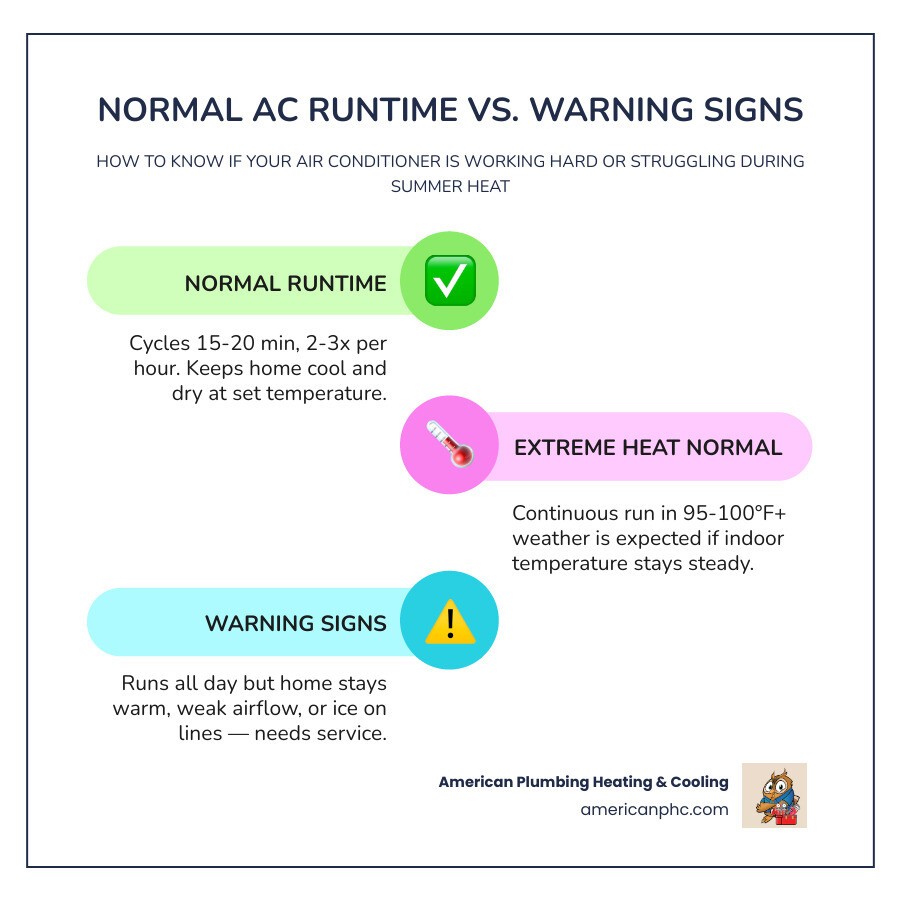
- During extreme heat (95°F-100°F+): Yes, continuous or near-continuous operation is expected and normal, especially in Florida's humid climate.
- On a typical summer day: Your AC should run in cycles of about 15-20 minutes, 2-3 times per hour, then shut off briefly.
- If it runs all day but your home stays cool: Likely normal in peak heat - your system is doing its job.
- If it runs all day and your home is still warm: That is a sign something is wrong and needs attention.
- If it runs all day in mild weather: That almost always points to a problem such as a dirty filter, low refrigerant, or an undersized unit.
So while a hot Florida afternoon can absolutely push your AC into long or continuous operation, your system should still be reaching your set temperature. If it is not, that gap between "working hard" and "struggling" matters - and it is worth knowing the difference.
In this guide, we walk through what normal AC runtime actually looks like, what causes a system to run too long, and when it is time to call for help.
Yes, sometimes it is.
A lot of homeowners assume an AC should always click on, cool quickly, then shut off like clockwork. Real life is messier, especially in Florida. In places like Sarasota, Cape Coral, Fort Myers, Venice, Bradenton, and Pensacola, summer heat is only half the story. Humidity adds a second job for your system: moisture removal.
On a normal summer day, many central air conditioners run for around 15 minutes at a time, about 2 to 3 times per hour. But when outdoor temperatures climb into the mid-90s or higher, runtime often stretches much longer. On the hottest days of the year, a properly sized system may run nearly nonstop because it was designed to handle that peak condition.
That surprises people, but it is actually a sign of proper sizing in many cases. An AC that can run steadily on a design-temperature day is often doing exactly what it should.
Single-stage systems are more likely to have obvious on/off cycles. Variable-speed systems are different. They are designed to run longer at lower output for better comfort and humidity control, so longer runtime is not automatically bad news.
When all-day runtime is normal during heat waves
During heat waves or very hot summer afternoons, all-day runtime can be completely normal.
Research shows AC systems may run 12 to 20 hours per day during extreme heat, and in very hot climates, continuous operation on the hottest day is expected. If your home is holding the thermostat setting, airflow feels cool, and indoor humidity stays reasonably comfortable, long runtime is usually just your AC carrying a heavy load.
Normal all-day or near-all-day operation usually looks like this:
- The home is still reaching or staying close to the set temperature
- Air coming from the vents feels cool
- Humidity feels controlled, not sticky
- The system does not make unusual noises
- There is no ice on the lines or indoor coil
- Runtime gets worse in peak afternoon heat, then eases later
If your AC runs from late morning through evening during a Florida heat wave, that alone is not proof of a problem. It may simply be battling solar gain, hot attic temperatures, and high outdoor humidity all at once. Summer in Florida does not exactly believe in taking it easy.
When is it normal for your AC to run all day in summer in Florida?
In Florida, longer runtimes are more common than in drier climates because the system is cooling and dehumidifying at the same time. That means homeowners in our service areas may notice the AC running much of the afternoon and early evening, especially in older homes, two-story homes, or houses with lots of west-facing windows.
Still, there is an important distinction: in Florida, long runtimes can be normal, but the system should generally still cycle off at some point if everything is working well and the weather is not extreme.
Realistic expectations for Florida include:
- Longer afternoon cycles than you might see in spring
- Higher runtime during muggy days, even if the temperature is not record-breaking
- Longer operation in homes with sun exposure, leaky ducts, or weak insulation
- Better humidity control from longer cycles than from short bursts
If you want a Florida-specific breakdown of why this happens, see our Step-by-Step Guide to Why Your AC Runs Constantly in Florida Heat.
What Makes an AC Run Constantly and How to Tell if It’s a Problem

If your AC never seems to get a break, the cause is usually one of three things:
- The weather is extreme
- The house is hard to cool
- The system has a performance problem
Sometimes it is a combination of all three.
Common causes of nonstop AC runtime
The most common reasons an AC runs constantly include:
- Dirty air filter
- Blocked or closed vents
- Dirty evaporator or condenser coils
- Leaky ductwork
- Low refrigerant from a leak
- Thermostat problems
- Poor insulation or air leaks
- Strong sun exposure through windows
- An undersized system
- An aging system losing efficiency
A clogged filter is one of the simplest and most common issues. Restricted airflow makes the system work harder and longer, and research shows a dirty filter can raise monthly energy use by 5% to 15%. That is a pretty expensive piece of dust.
Dirty coils create a similar problem. If the indoor coil cannot absorb heat well or the outdoor coil cannot release it, cooling performance drops and runtime climbs.
Low refrigerant is another major red flag. Refrigerant does not get "used up," so if levels are low, there is usually a leak. That reduces cooling capacity and can lead to ice buildup.
Leaky ducts, attic heat, poor insulation, and air leaks around doors and windows can also keep adding heat faster than your AC can remove it. In that case, your equipment may be fine, but the house itself is making the job much harder.
Signs your AC is struggling, not just working hard
A hardworking AC and a struggling AC do not sound the same, look the same, or cool the same.
Watch for these warning signs:
- Weak airflow from vents
- Air feels lukewarm or warm
- Indoor temperature keeps rising
- The system runs nonstop without reaching setpoint
- High indoor humidity
- Ice on the refrigerant line or indoor unit
- Water leaking around the air handler
- Unusual sounds like hissing, buzzing, or rattling
- Very long cycles even in average summer weather
- A sudden jump in runtime compared with previous weeks
A simple rule we use: if the AC runs all day and the house stays comfortable, that may be normal. If it runs all day and comfort gets worse, it is time to investigate.
How Temperature, System Size, and Insulation Change AC Runtime
Your AC runtime is not just about the unit itself. It is also about the heat load on the home.
That load changes based on outdoor temperature, humidity, home size, insulation, windows, duct leakage, occupancy, cooking, and even whether the blinds are open.
Why hotter weather means longer cooling cycles
On a typical summer day, an AC often cycles for about 15 to 20 minutes at a time, 2 to 3 times per hour. As outdoor temperatures rise, those cycles get longer because more heat is entering the home.
That extra heat comes from:
- Sun beating through windows
- Heat soaking into the roof and attic
- Hot outdoor air leaking indoors
- Warm ductwork in attics or garages
- Humidity entering the home every time doors open
The hottest part of the day usually creates the longest runtime, especially in late afternoon. That is why a system that seems fine at 9 a.m. can look exhausted by 4 p.m.
Is it normal for your AC to run all day in summer if your unit is undersized?
Sometimes yes, but that does not make it acceptable.
An undersized AC may run constantly because it simply does not have enough capacity to handle the home on very hot days. It may cool decently in the morning and evening but fall behind in the afternoon. Research commonly notes 40+ minute cycles and failure to reach setpoint as warning signs.
Typical signs of an undersized system include:
- The thermostat setting is rarely reached on hot days
- The house gets warmer as the day goes on
- Some rooms never cool properly
- Humidity feels high indoors
- The system runs very long even after maintenance issues are ruled out
A proper load calculation matters. Bigger is not always better either. Oversized systems can short cycle, which hurts humidity control and comfort. For more on that, read How to Size Your Gulf Coast AC Without Breaking a Sweat.
How insulation, windows, and duct leaks keep your AC running
Sometimes the AC is not the problem. The house is.
Poor attic insulation, air leaks, old weatherstripping, sun-exposed windows, and leaky ducts can all force longer runtime. In Florida homes, attic heat gain alone can be brutal. If cool air is leaking into the attic or hot attic air is sneaking into return ducts, the AC has to keep making up the difference.
A few big contributors:
- Thin or deteriorated attic insulation
- Gaps around doors and windows
- Unsealed duct joints
- Rooms with large west-facing windows
- Blinds left open during peak sun
Closing blinds can meaningfully cut radiant heat gain, and sealing leaks helps your system keep the cool air it already paid to produce. Think of it this way: running your AC with a leaky house is like trying to chill a cooler with the lid cracked open.
Maintenance Steps That Help Prevent Excessive AC Runtime
Good maintenance does not guarantee short runtimes in a Florida summer, but it does help prevent your system from running longer than necessary.
The simple maintenance tasks homeowners can do
There are several homeowner-friendly steps that help reduce unnecessary runtime:
- Replace or clean the air filter regularly
- Make sure supply and return vents are open and not blocked by furniture or drapes
- Clear leaves, grass, and debris from around the outdoor unit
- Keep about 2 to 3 feet of clearance around the condenser
- Set the thermostat fan to AUTO instead of ON
- Close blinds or curtains during the hottest part of the day
- Use ceiling fans to improve comfort
- Avoid frequent thermostat changes
- Do not keep turning the AC off and on during heat waves
That last one matters. Repeatedly shutting the system off and restarting it usually makes the house hotter and forces the AC to work harder to recover. In most cases, steady operation is better than playing thermostat ping-pong.
Filter changes are especially important. Depending on the filter type, pets, and indoor dust levels, many homes need attention every 1 to 3 months, and sometimes more often in peak season.
Professional maintenance that improves efficiency
Some important maintenance steps should be handled by a trained HVAC professional, including:
- Cleaning evaporator and condenser coils
- Checking refrigerant charge
- Looking for refrigerant leaks
- Testing airflow
- Inspecting duct performance
- Calibrating the thermostat
- Checking electrical components and capacitors
- Inspecting drain lines and condensate removal
Professional tune-ups help catch small issues before they turn into nonstop runtime, poor cooling, or a midsummer breakdown. If you want to go deeper, we recommend these resources:
- Don't Sweat It: A Local Guide to HVAC System Maintenance
- 20 Reasons to Schedule Your HVAC Tune-Up Today
- The Magic Number for HVAC Maintenance Success
- How to Get Your Cooling System Ready for Hot Weather
- How to Prepare AC for Florida Heat in 7 Easy Steps
How All-Day AC Operation Affects Comfort, Energy Use, and System Life
Long runtime affects more than just the sound you hear in the background. It can affect comfort, electric use, and equipment wear.
Does running the AC all day damage the system?
Not necessarily.
Air conditioners are built to run for long stretches, especially during hot weather. In fact, steady-state operation is often easier on the system than rapid starting and stopping. Short cycling creates extra stress because startup is one of the hardest moments for many components.
So if your AC runs a long time on a brutally hot day and keeps the home comfortable, that is not automatically harmful.
What does increase risk?
- Running with a dirty filter
- Running with dirty coils
- Running while low on refrigerant
- Running with weak airflow
- Running an older system that is already worn down
In those cases, long runtime can accelerate wear because the system is operating under strain instead of under normal heavy load.
It can also raise energy use. Longer runtime means more electricity consumption, and research suggests every degree you lower the thermostat below the upper-70s can noticeably increase cooling demand. In Florida, setting the thermostat a little higher is usually far better than shutting cooling off altogether during extreme heat.
How thermostat settings and home upgrades reduce runtime
A few smart adjustments can lower runtime without sacrificing comfort.
For many Florida homes, a thermostat setting in the 74 to 78 degree range offers a good balance between comfort and efficiency. Smart or programmable thermostats can also help by keeping temperatures consistent instead of overcooling the home.
Helpful strategies include:
- Use a steady temperature instead of constant manual changes
- Pre-cool the home earlier in the day before peak heat
- Raise the setting a bit when away
- Run ceiling fans in occupied rooms
- Keep blinds closed during strong afternoon sun
- Seal obvious air leaks
- Improve attic insulation where needed
Here is a quick comparison:
| Runtime reducer | What it helps improve |
|---|---|
| Clean air filter | Airflow and efficiency |
| Thermostat on AUTO | Better humidity control |
| Closed blinds | Less solar heat gain |
| Ceiling fans | Comfort at a slightly higher thermostat setting |
| Sealed duct leaks | More cooled air reaching rooms |
| Added insulation | Less heat entering the home |
| Smart thermostat | More consistent scheduling and runtime control |
Efficiency upgrades that may be worth considering
If your system is older or struggles every summer, it may be worth looking at efficiency improvements.
Options can include:
- Higher-efficiency equipment
- Variable-speed systems that run longer but more efficiently
- Improved humidity control features
- Better duct sealing
- Insulation and air-sealing upgrades
- Smarter thermostat controls
If you want to learn more, these guides are useful next steps:
- A Homeowner Guide to Efficiency Ratings
- The Floridian's Guide to High Efficiency Cooling Incentives
- Stop Burning Cash Just to Stay Cool This Summer
When to Call a Professional for an AC That Runs Nonstop
Sometimes the answer to is it normal for your AC to run all day in summer is a calm "yes." Other times it is a sweaty "please call someone."
Call for help if your AC runs constantly and still won't cool
You should schedule professional service if:
- The home will not reach the thermostat setting
- The indoor temperature rises while the system is running
- Air from the vents feels warm or barely cool
- Airflow is weak in multiple rooms
- You see ice on the refrigerant line or indoor coil
- You notice water leaks around the unit
- The thermostat seems inaccurate or unresponsive
- The system needs repeated resetting
- Humidity indoors feels unusually high
These symptoms can point to refrigerant problems, coil issues, airflow restrictions, thermostat faults, or failing components. Trying to "push through" with a struggling AC often leads to more stress on the system and less comfort for you.
Call sooner if the problem shows up in normal summer weather
Nonstop operation is more concerning when it happens on regular hot days instead of during extreme weather.
Call sooner if:
- The AC runs all day when temperatures are not unusually high
- Your energy use suddenly spikes
- Some rooms are much hotter than others
- The system is older and performance has declined
- It has been more than a year since service
- Runtime has clearly increased compared with last summer
For homeowners in Sarasota, Cape Coral, Fort Myers, Venice, Bradenton, Pensacola, and nearby Florida communities, that kind of pattern often points to maintenance, airflow, duct, or sizing issues that deserve a professional diagnosis.
Conclusion
So, is it normal for your AC to run all day in summer? Sometimes, yes. In Florida heat and humidity, long runtimes can be completely normal, especially during extreme weather. But nonstop operation should still come with good cooling, reasonable humidity control, and a home that stays near your thermostat setting.
If your system is running all day and falling behind, blowing weak or warm air, icing up, or driving up energy use, it is time to get it checked.
At American Plumbing Heating and Cooling, we help Florida homeowners figure out whether their AC is just working hard or asking for help. Our team brings over 100 years of combined experience, honest upfront pricing, certified pros, and 24/7 service when cooling problems cannot wait.
For more information or to schedule service, visit our air conditioning page.
{"@context": "https://schema.org", "@graph": [{"@type": "Article", "headline": "Is It Normal for Your AC to Run All Day in Summer | APHC", "description": "Wondering is it normal for your AC to run all day in summer? Learn what runtime is normal, warning signs, and when to call our experts.", "author": {"@type": "Person", "name": "American Plumbing Heating and Cooling"}, "publisher": {"@type": "Organization", "name": "American Plumbing Heating and Cooling", "logo": {"@type": "ImageObject", "url": "https://firebasestorage.googleapis.com/v0/b/ai-templates.appspot.com/o/bot%2FiTB8FxoyvSplQzS7StV8%2Flogo%2FScreenshot%202026-03-16%20at%2012.43.20%E2%80%AFPM.png?alt=media&token=4ae5e171-7bb5-4a27-91f4-47e969b91c80"}}, "datePublished": "2026-07-10T02:46:53+00:00", "dateModified": "2026-07-10T02:47:20.973970", "mainEntityOfPage": {"@type": "WebPage", "@id": "https://pms.ciwebgroup.com/americanphc/2026/07/10/is-it-normal-for-your-ac-to-run-all-day-in-summer/"}, "image": "https://images.unsplash.com/photo-1623113879540-476117b4be1f?crop=entropy&cs=tinysrgb&fit=max&fm=jpg&ixid=M3w2MTMxNjF8MHwxfHNlYXJjaHwxMHx8QUMlMjB0aGVybW9zdGF0JTIwb24lMjB3YWxsJTIwaW4lMjBhfGVufDB8MHx8fDE3Nzk1OTQ0ODB8MA&ixlib=rb-4.1.0&q=80&w=1080"}, {"@type": "FAQPage", "mainEntity": [{"@type": "Question", "name": "Is it normal for my AC to run all day in the summer?", "acceptedAnswer": {"@type": "Answer", "text": "Yes, it can be normal during extreme heat, especially when outdoor temperatures reach 95°F to 100°F or higher in Florida’s humid climate. If your home stays cool and reaches the set temperature, the system is likely doing its job."}}, {"@type": "Question", "name": "How often should an AC run on a typical summer day?", "acceptedAnswer": {"@type": "Answer", "text": "On a typical summer day, many central air conditioners run in cycles of about 15 to 20 minutes, around 2 to 3 times per hour. The system should then shut off briefly between cycles."}}, {"@type": "Question", "name": "When is an AC running all day a sign of a problem?", "acceptedAnswer": {"@type": "Answer", "text": "If your AC runs all day but your home is still warm, or if it runs constantly in mild weather, something may be wrong. Possible issues mentioned include a dirty filter, low refrigerant, or an undersized unit."}}, {"@type": "Question", "name": "Why does an AC run longer in Florida summers?", "acceptedAnswer": {"@type": "Answer", "text": "In Florida cities like Sarasota, Cape Coral, Fort Myers, Venice, Bradenton, and Pensacola, humidity adds extra work because the AC must remove moisture as well as cool the air. This can make the system run longer, especially during very hot weather."}}, {"@type": "Question", "name": "Do variable-speed AC systems run longer than regular AC units?", "acceptedAnswer": {"@type": "Answer", "text": "Yes, variable-speed systems are designed to run longer at lower output to improve comfort and humidity control. Because of that, longer runtime is not automatically a problem with these systems."}}]}]}Need HVAC Help?
Our certified technicians are ready to help with all your heating and cooling needs.
Request ServiceAbout the Author
American Plumbing Heating and Cooling Team
Licensed Florida contractors — HVAC CAC1821761 · Plumbing CFC1431919
More Articles
View All PostsRelated Articles


Ready to Get Started?
Whether you need a repair, maintenance, or a new system installation, our expert team is here to help.